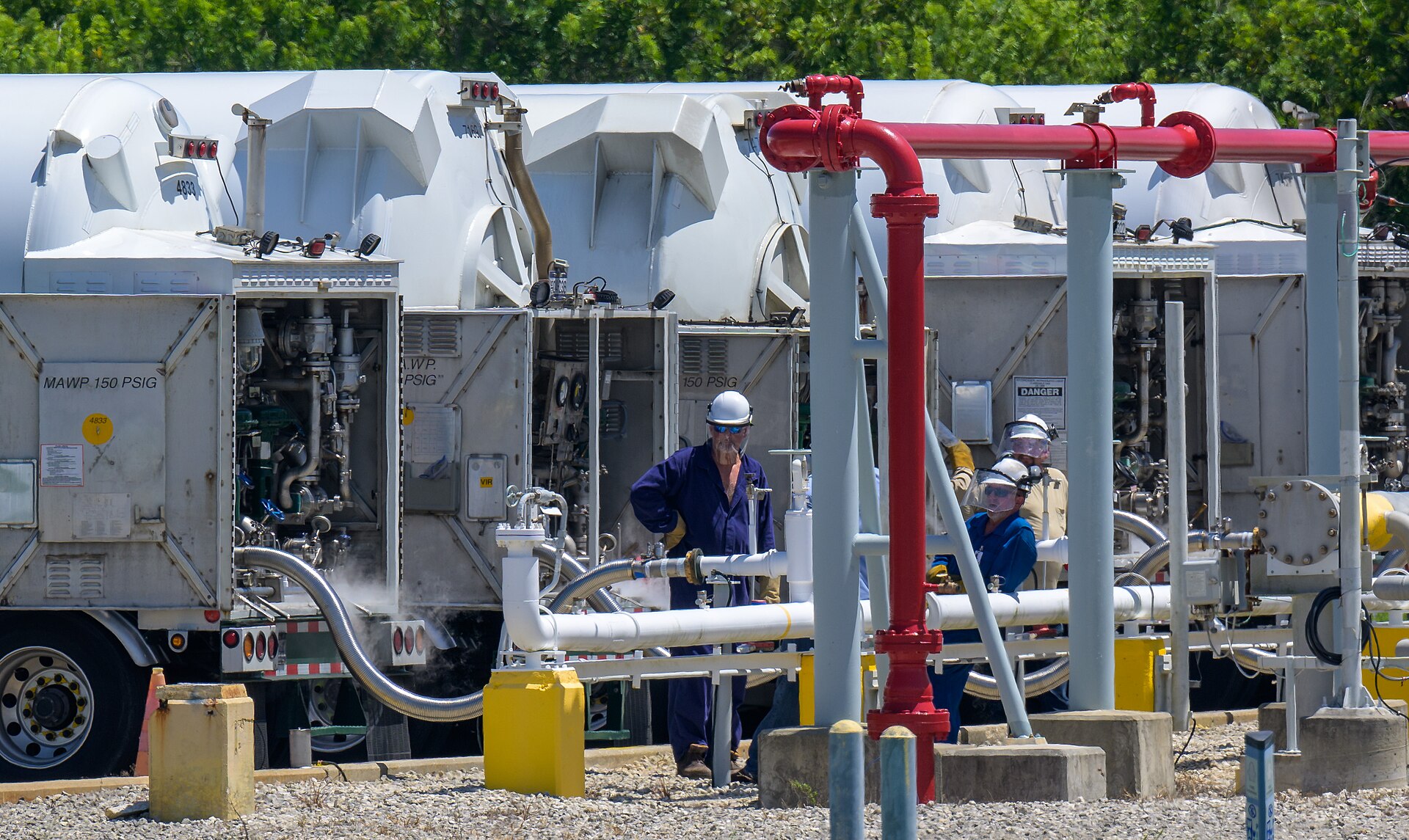
Hydrogen infrastructure, including electrolyzers, refueling stations, fuel cells, storage and distribution, is rapidly scaling, and seal manufacturers are responding with dedicated hydrogen product lines. But hydrogen is not just “another gas to seal against.” Its molecular size and behavior create two distinct failure modes that do not appear with conventional gases, and a seal rated “hydrogen compatible” on a generic datasheet can still fail in service if the selection does not account for the specific duty cycle.
Failure Mode One: Permeation
Hydrogen has an extremely small molecular size. So small, in fact, that it can diffuse through elastomers far more readily than larger gas molecules; this is a diffusion problem rather than a chemical attack problem: the elastomer is simply not an effective barrier, as opposed to degrading.
Permeation is a serious issue in hydrogen sealing solutions. It reduces system efficiency by causing hydrogen loss, poses serious safety risks in enclosed spaces, and can, over time, contribute to internal damage as the gas accumulates within the polymer matrix.
FKM generally exhibits lower hydrogen diffusivity than NBR or EPDM, though all common elastomers permeate to some degree. Keep in mind that this is a matter of degree, not absolute barrier vs. non-barrier. There is, however, a better polymer barrier material.
PTFE is virtually inert to hydrogen with markedly lower permeation than any common elastomer, which is why it has become the default choice as pressure and criticality increase
Failure Mode Two: Rapid Gas Decompression (RGD)
Rapid gas decompression (RGD) is the failure mode most specific to hydrogen sealing and the one most likely to be underappreciated by engineers accustomed to conventional gas sealing. In this failure mode, hydrogen molecules that have diffused into the elastomer during sustained high-pressure exposure need time to escape when pressure drops; if depressurization happens faster than the gas can diffuse back out, it becomes trapped and forms internal voids, blisters, or cracks as it expands within the material.
This is also an instance where the failure mode is not solely a chemical compatibility issue. A material can be chemically compatible with hydrogen yet still fail catastrophically under rapid depressurization (RGD) if the duty cycle involves fast pressure drops. This highlights the importance of understanding the kinetics of gas escape and the mechanical response of the seal material.
This is why RGD damage can range from subsurface blistering to structural rupture, especially in high-pressure hydrogen systems such as fueling stations, electrolyzer connections, and pipeline seals. Recognizing these failure modes is essential for preventing field failures during pressure cycling, which are common in applications like rapid fueling or frequent pressure adjustments.
Material Selection Is Not One-Size-Fits-All
Here are some suggested material selections.
EPDM (Ethylene Propylene Diene Monomer)
This is often the default for lower-demand applications, and specifically for alkaline electrolyzers, offering good general hydrogen compatibility and low-temperature flexibility at a reasonable cost. It exhibits excellent low-temperature flexibility, a good compression set, and resistance to alkaline media. However, it has a higher hydrogen gas permeation rate than some other options, namely fluoropolymers such as PTFE. It is primarily used with alkaline electrolyzers (AEL/AEM), water/coolant loops, low-pressure distribution, and low-temperature static seals.
FKM (Fluoroelastomer / Viton)
FKM is favored where chemical resistance matters more broadly (e.g., acidic environments in PEM electrolyzer balance-of-plant). However, it is incompatible with certain hydrogen-adjacent process chemistries, where EPDM may be required instead. It exhibits very low hydrogen permeation compared with synthetic rubbers and has excellent thermal stability across a wide temperature range. However, it becomes brittle at extremely low temperatures, which can lead to leakage during cold thermal cycling. Note that FKM and EPDM are not interchangeable substitutes for each other. It is often used with PEM fuel cells and PEM electrolyzers (oxygen-side/stack sealing), high-temperature gas processing, and high-pressure static connections.
HNBR (Hydrogenated Nitrile Butadiene Rubber )
This material is often specified for fueling-station dispenser seals where low-temperature performance (down to around -40°C) matters, since dispensing frequently involves pre-cooled hydrogen. It has excellent mechanical strength, wear resistance, and extrusion resistance. It is also highly resistant to RGD when compounded properly and retains its flexibility at low temperatures. However, it has a moderate hydrogen permeation rate, and its continuous-use temperature is capped at 300°F. HNBR is commonly used for high-pressure hydrogen valves, compressors, sour gas blends, and pipeline seals, as well as dynamic applications subject to rapid cycling
PTFE (Polytetrafluoroethylene)
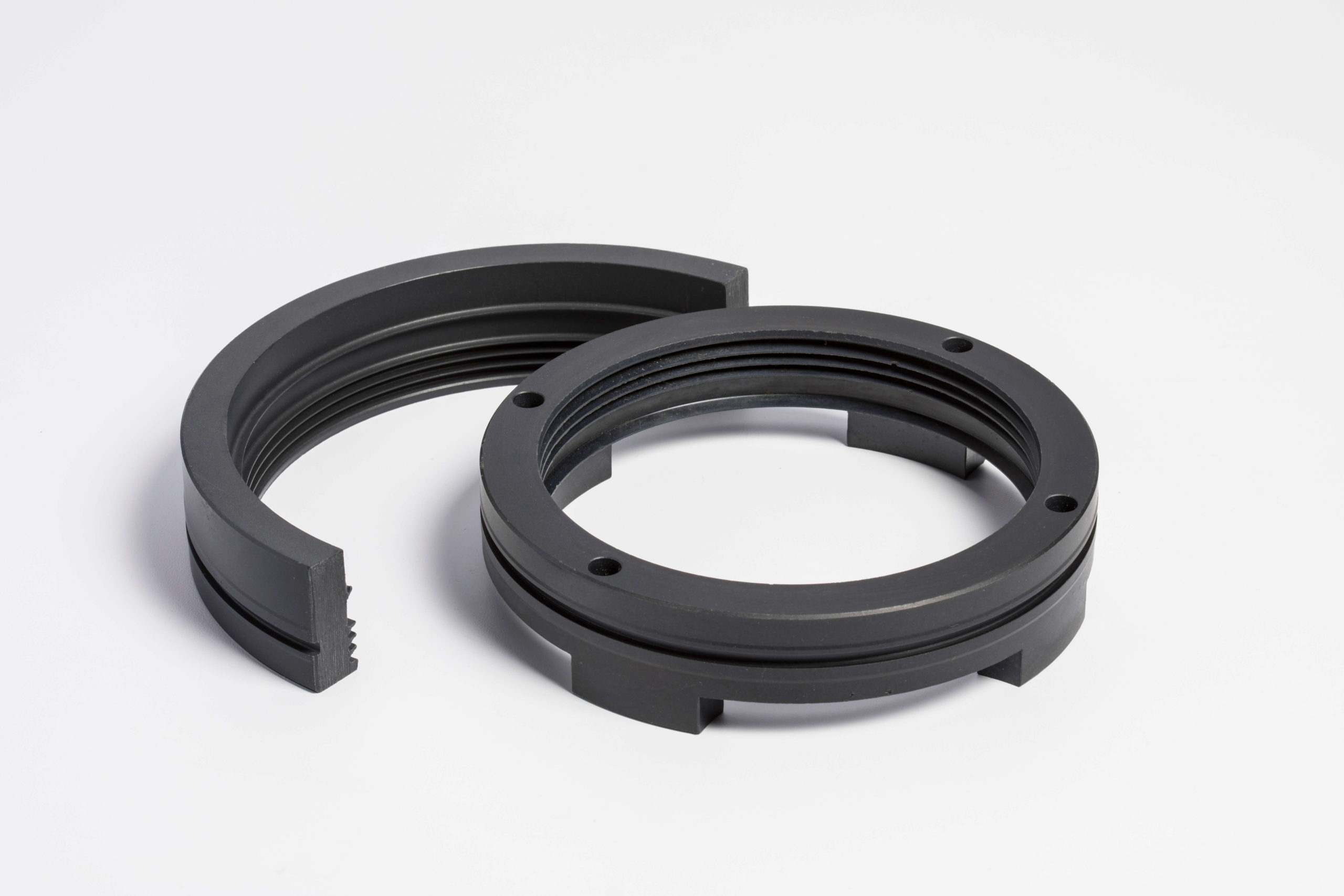
PTFE is the default across nearly all pressure tiers once RGD resistance and minimal permeation become priorities. It is inert, low-permeation, and functional across an unusually wide temperature range, though it comes with its own design considerations. It is non-elastic in the sense that it has no inherent memory. It is also prone to creep under continuous pressure loads. Note that it is typically used in energized seal configurations rather than as a standalone elastomer substitute. . It is often used with spring-energized dynamic shaft/stem seals in high-pressure valves, cryogenic liquid hydrogen valves, compressor packing rings, and anti-extrusion back-up rings..
Material Selection and the Duty Cycle
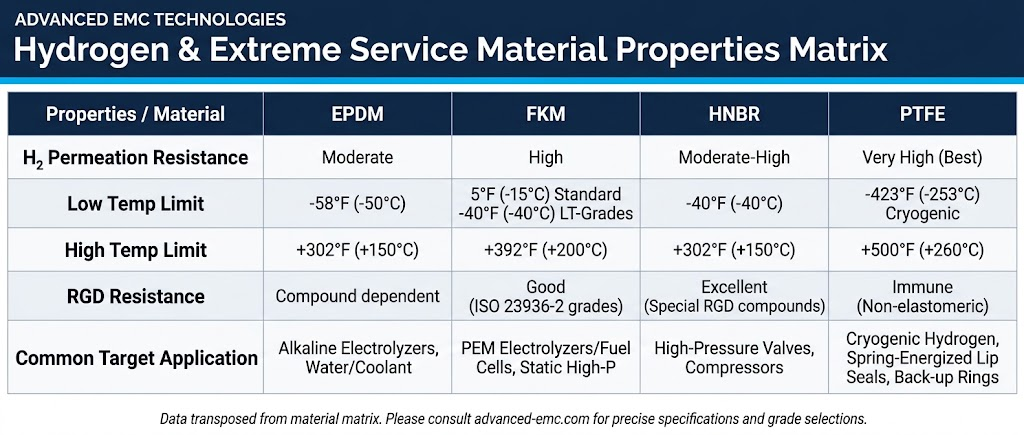
Material selection must consider the actual duty cycle, including pressure cycling frequency, depressurization rates, and temperature swings, rather than relying solely on a generic ‘hydrogen compatible’ rating. For example, two systems operating at the same peak pressure may have vastly different RGD risks depending on their depressurization speed and cycling frequency, which directly impact seal longevity.
Conclusion
Hydrogen sealing involves two key failure modes, permeation and RGD, and understanding these helps engineers feel more equipped to select appropriate materials as infrastructure scales. If you need further assistance finding an effective, reliable sealing solution for your system, contact the sealing experts here at Advanced EMC.