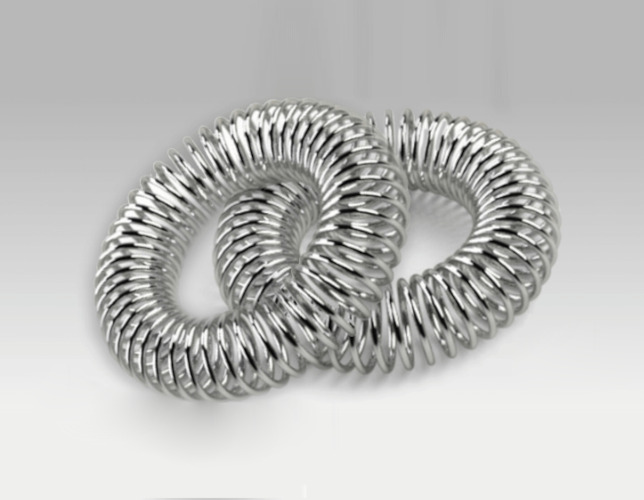

In high-stakes environments such as aerospace, defense, and medical devices, maintaining a solid electrical connection and effective EMI shielding is crucial — which is where slant coil springs, also known as canted coil springs, stand out. Their unique design delivers consistent multi-point contact, excellent conductivity, and 360-degree shielding in one compact component. They also help absorb misalignment and mechanical stress.
This post breaks down how slant coil springs support electrical performance, manage EMI, and enhance mechanical resilience. It also introduces FlexForce®, a tried and trusted solution for demanding electrical and shielding applications.
What Are Slant Coil Springs
Slant coil springs, also called canted coil springs, are precision-manufactured from wire that has been coiled at an angle relative to the spring’s axis. This type of configuration allows the spring to maintain multiple points of contact across mating surfaces, leading to a conductive path that is uniform and reliable. And unlike traditional round wire springs or wave springs, canted coil springs not only maintain consistent electrical contact but also provide EMI shielding and compensate for mechanical misalignment (increasing their reliability even further).
These springs can be carefully engineered to deliver specific forces, contact pressures, and electrical characteristics. Their versatility makes them ideal for integration into high-reliability connector systems, shielding components, and critical interfaces where space is limited and high performance is necessary.
Electrical Contact Performance
Canted coil springs serve as high-reliability electrical contact elements. Each coil touches the mating surface independently, creating multiple paths for current to flow. This design reduces the risk of contact failure and ensures stable conductivity, even under fluctuating conditions.
Because the spring maintains a consistent contact force, it minimizes issues like micro-arcing, intermittent signals, and fretting. Such reliability is critical in applications where signal integrity is non-negotiable—think medical diagnostics, missile guidance systems, or aerospace data links.
Another key advantage: canted coil springs provide repeatable performance over thousands of connection cycles. They resist compression set and wear, which makes them ideal for high-mating-cycle connectors or modular systems that must be assembled and disassembled frequently.
Unlike traditional contact pins or leaf springs, canted coil springs do not rely on bulk material deformation to make contact. Instead, they use engineered deflection, which means lower insertion forces and more predictable mechanical behavior over time.
EMI Shielding Capabilities
In mission-critical applications or high-frequency electronics, EMI shielding is as important as connectivity and conduction. Electromagnetic interference can degrade performance, disrupt signals, and even lead to complete system failure. Canted coil springs can act as both an electrical contact and a continuous shielding element.
When a canted coil is installed between two conductive surfaces (e.g., connector shell and housing) the spring forms a uniform 360-degree conductive path blocking EMI from leaking in or out of the enclosure. Mesh gaskets or conductive elastomers can degrade or lose compression over time, but slant coil springs maintain consistent shielding effectiveness across a wide range of operating conditions, irregular surfaces, and slight misalignments. And their flexibility makes them ideal for dynamic or modular systems, where connections must be repeatedly made and unmade without compromising performance.
Mechanical Compliance and Tolerance Compensation
The angled coil geometry of canted coil springs allows them to flex axially, radially, and even angularly, making them highly effective at absorbing mechanical variation and compensating for tolerance stack-up in complex assemblies.
In real-world applications, acheiving perfect alignment is extremely rare. Components will expand with heat, shift under load, or deviate slightly during assembly. And a slant coil spring adapts to these changes without losing contact or compromising performance, even when gaps vary, surfaces move, or vibrations are present.
Why FlexForce® Slant Coil Springs?
Not all canted coil springs are created equal. FlexForce® canted coil springs are engineered for performance, reliability, and precision in even the most critical applications. Every spring is manufactured to tight tolerances, using materials selected for specific mechanical, electrical, and environmental requirements. FlexForce® springs have been deployed in a wide range of environments, from cleanroom-compatible connectors in medical diagnostics to ruggedized defense electronics exposed to shock and vibration.

Application Examples
Canted coil springs are essential in industries where performance and reliability cannot be compromised. Their unique design supports electrical contact, EMI shielding, and mechanical compliance in demanding environments.
Medical Devices: From surgical tools to imaging systems and implants, electrical connections must endure sterilization, vibration, and repeated use. FlexForce® springs meet these challenges with biocompatibility, corrosion resistance, and low insertion force, all while ensuring consistent contact.
Aerospace and Defense: Slant coil springs provide EMI shielding in avionics, secure connections in guidance systems, and signal stability in flight controls. Their ability to handle vibration and dimensional shifts is critical for mission success.
Industrial and EV Applications: Electric vehicles and automated systems need compact, durable connectors with high cycle life and reliable EMI protection. Canted coil springs excel in battery packs, high-voltage units, and rotating sensors, boosting uptime and serviceability.
Conclusion
Canted coil springs are high-performance electrical contact springs, robust EMI shielding elements, and reliable compliance mechanisms in critical environments. Their slanted geometry delivers a consistent contact force, absorbs mechanical variations, and maintains shielding effectiveness across thousands of use cycles.
For engineers responsible for high-reliability systems, whether in medical, aerospace, defense, or industrial applications, these springs offer a compact, multifunctional solution. And with FlexForce®, Advanced EMC delivers precision-engineered slant coil springs tailored to your exact performance requirements.
If you have an application that demands superior electrical contact and EMI shielding, connect with our engineering team today to learn how FlexForce® canted coil springs can solve some of your toughest design challenges.