Conventional bearings seize when oil runs out, but there are engineering polymer bearings that do not seize, nor do they experience stick-slip behavior. Where oil-free operation is required (e.g., food processing, pharma, wet/submerged environments), self-lubricating, high-performance polymers are the solution. This blog post discusses self-lubricating polymer plain bearings, including how they work, what the best naturally self-lubricating polymer options are, and how to select the right material.
The Problem with Conventional Lubrication
When the oil film fails at the contact surface, serious issues begin to develop for plain bearings, including adhesive wear, heat buildup, and seizure. The cost of failure of plain bearings is expensive and includes not only the cost of repairs but also unplanned downtime, contamination, and potential compliance risks. And while lubrication is necessary, there are some industries where adding lubrication to a bearing is simply impractical. These include food and beverage (NSF H1 and FDA), cleanrooms, and underwater applications.
How Self-Lubricating Polymer Bearings Work
The core mechanism of self-lubricating bearings lies in the natural self-lubricating nature of the polymer (such as PTFE, UHMW-PE, and POM). There are two phases to the self-lubricating process: the run-in phase and the steady-state phase.
The Run-In (Break-In) Phase: When a new polymer bearing is installed, the metal shaft, no matter how highly polished it may be, has microscopic peaks and valleys called asperities. When the shaft begins to rotate against the bearing under a load, these asperities act like microscopic sandpaper. The asperities shear off a very thin layer of the polymer, and during this phase, the wear rate and friction are slightly higher. The image below shows an example of the asperities and their interaction with the lubricant film using PTFE as an example.
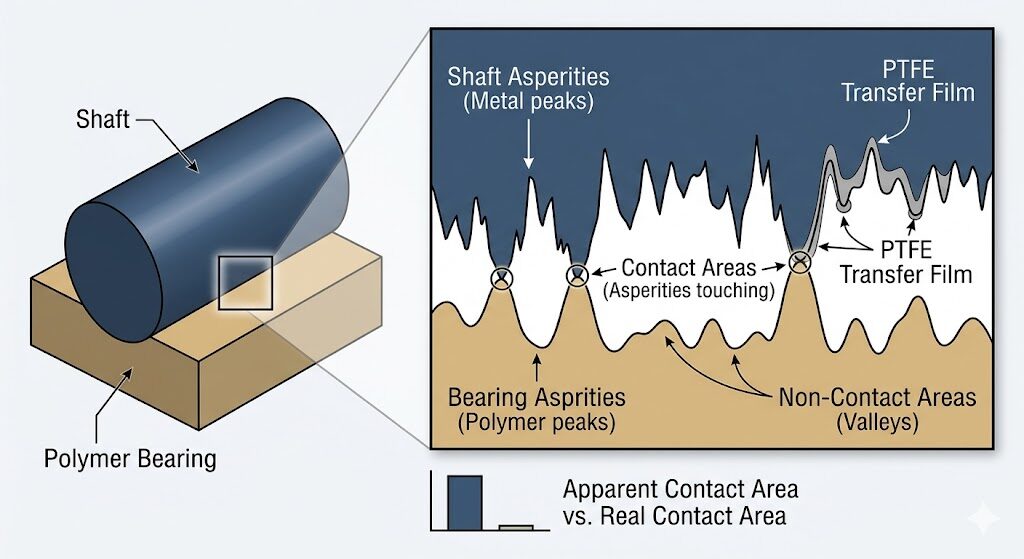
Steady-State Phase: The sheared polymer debris do not disappear. Rather, they get compacted into the valleys of the metal shaft’s surface. This process creates the transfer film. Once this film is fully established, the bearing is no longer rubbing against metal. Instead, it is rubbing against a thin layer of its own polymer material. Because polymer-on-polymer friction is exceptionally low, the wear rate drops dramatically, and the bearing can operate indefinitely without a need for external grease or oil, continuously replenishing the film as needed.
Key Polymer Materials (~150 words)
There are several polymers that have inherent self-lubricating properties due to their molecular structure, with no fillers or additives needed. Four of them are commonly used for plain bearings.
PTFE (Polytetrafluoroethylene)
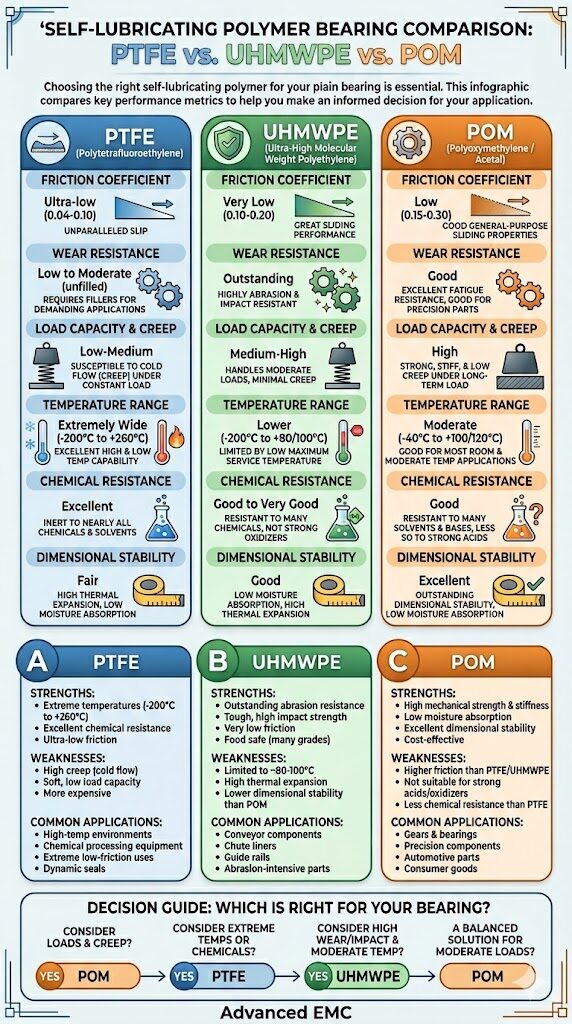
PTFE has a fluorine-carbon backbone with extremely weak intermolecular forces, giving it one of the lowest coefficients of friction of any solid material (μ ≈ 0.04–0.10). The downside of PTFE for bearings tends to be its poor wear resistance, low load capacity, and tendency to creep in its pure form. However, it is available as a bearing-grade polymer that possesses additives to enhance the strength, stiffness, and wear of unfilled PTFE without sacrificing its low friction and natural lubricity. These fillers include carbon fiber, bronze, and graphite.
UHMWPE (Ultra-High Molecular Weight Polyethylene)
UHMWPE is heavily used in extreme bearing, wear pad, and sliding applications in its virgin, unfilled state. While cross-linked or oil-filled versions exist for specialty uses, its natural abrasion resistance is so remarkably high that it rarely needs compounding to function as a heavy-duty wear surface. Its low friction, excellent toughness, and good wear resistance make it an excellent choice for ebarings, and it is widely used in food processing and orthopedic implants.
Bearing-Grade POM (Acetal/Delrin)
Bearing-grade POM is naturally slippery because of its smooth, crystalline surface and low surface energy. While it is not as low-friction as PTFE, it does offer better dimensional stability and is load-capable without any additives. Virgin POM is hard, slick, and makes an excellent light-duty bearing, but at higher speeds or loads, it can generate excess heat or squeal (caused by slip-stick). The most common bearing-grade acetal has about 10-20% PTFE fibers as an additive. These fibers effectively smear across the contact surface during operation. This further lowers the coefficient of friction and increases the limiting PV value associated with virgin acetal.
Real-World Payoff
Using a self-lubricating plain polymer bearing eliminates the need for re-lubrication intervals, which leads to significant labor and downtime savings. In addition, self-lubricating bearings pose no issues with lubricant contamination, having a direct impact on product quality as well as compliance benefits. In addition, these beatings result in an extended service life in wet, abrasive, or chemically aggressive environments where oil-lubricated bearings fail rapidly. In fact, as an example, consider a conveyor bushing in a food plant. The voice of a lubrication-free bearing means operation exceeds the service life of traditional greased bronze bearings by 3x.
Conclusion
Self-lubricated plain bearings are a proven engineering solution to bearing lubrication issues, not a compromise. The combination of the right material with correct design and proper run-in can provide you with reliable oil-free operation. Advanced EMC encourages you to evaluate your highest-maintenance lubrication points as retrofit candidates for replacement with self-lubricating solutions. For more information on self-lubricating bearings, contact us today!