
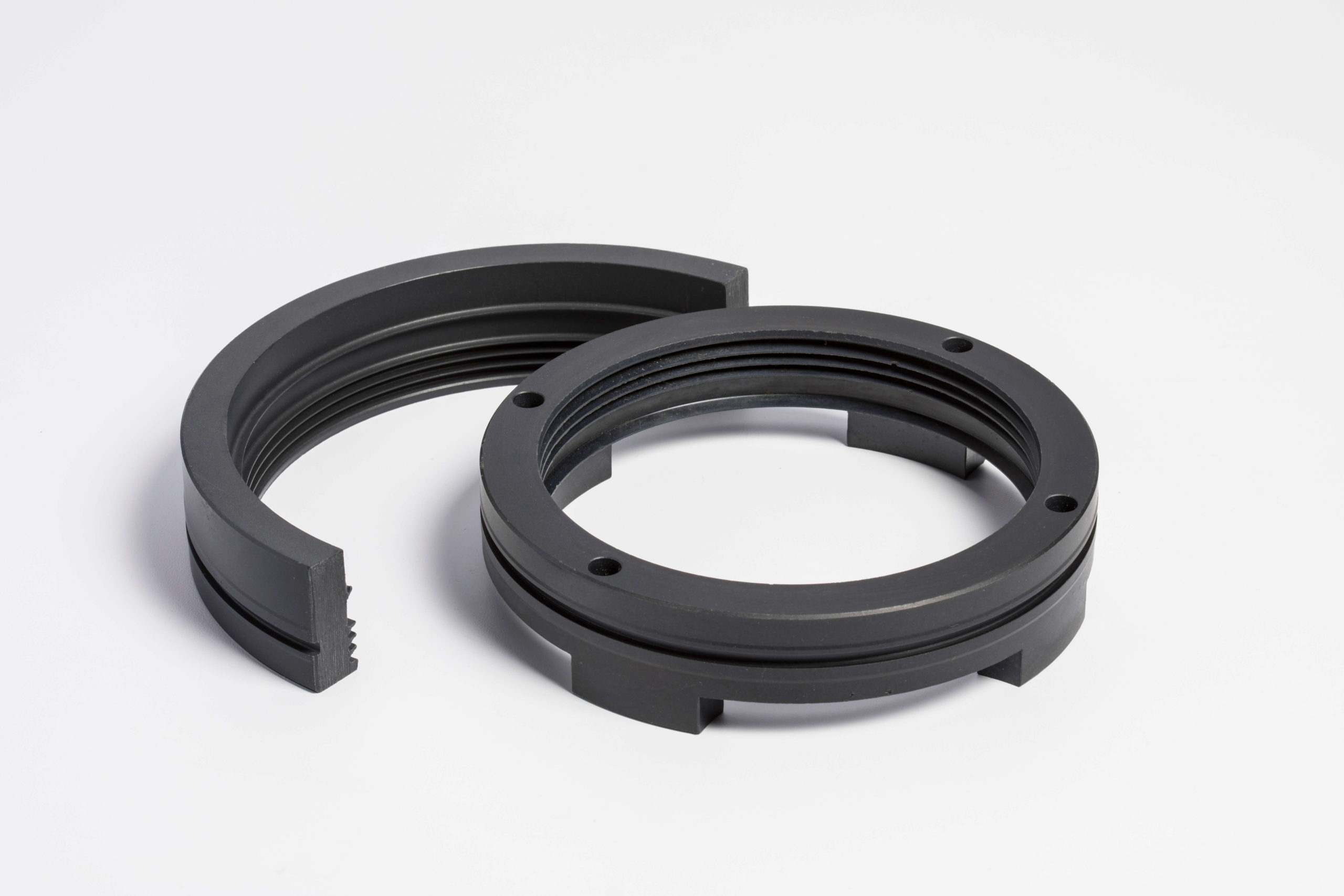
Labyrinth seals are a non-contact sealing solution used in high-speed, high-performance machinery. Unlike contact seals, labyrinth seals rely on geometry and fluid dynamics, rather than friction, to prevent leaks.
This article examines the reasons why labyrinth seals are so effective, including their low wear, high-speed capabilities, thermal stability, and long lifespan.
Fundamentals of Labyrinth Seal Operation
The Basic Mechanism
Labyrinth seals create a tortuous path that resists fluid passage through a series of cavities and restrictions. With every cavity, the fluid experiences a drop in liquid pressure that is directly caused by the turbulent flow and the kinetic energy dissipated. It is these pressure differentials and losses in velocity that prevent fluids from escaping. This tortuous path is also what allows the labyrinth seals to have a non-contact design.
Non-Contact Design Advantages
The non-contact architecture of labyrinth seals eliminates frictional wear, extending both seal and shaft life. This also enables the operation of these seals with extremely high shaft speeds and in environments where lubrication is limited or undesirable (e.g., aerospace, cryogenic, and vacuum applications). This non-contact operation also reduces heat generation, thereby improving energy efficiency.
Polymer Material Science in Labyrinth Seals
Traditional metallic labyrinth seals, such as those made from nickel alloys, aluminum, and stainless steel, do not possess the same advantages as engineering polymers. These advantages include less weight, a more compact design, and better chemical resistance.
Additionally, some polymers are self-lubricating, eliminating the need for lubricants, and have extremely low coefficients of friction. They also exhibit better thermal expansion properties than traditional metal solutions. Unlike metal labyrinth seals, polymer seals can also achieve tighter clearances and reduced leakage because the teeth deflect during any contact without wear or damage to the rotor. Finally, polymers exhibit superior resistance to abrasion.
Two of the most commonly used polymers for labyrinth seals are PEEK and Torlon.
PEEK Labyrinth Seals
PEEK has some excellent properties, including a high strength-to-weight ratio, thermal stability up to ~480°F (250°C), and resistance to aggressive chemicals. They are also self-lubricating and can withstand continuous operating temperatures of around -94°F (-70°C), making them ideal for cryogenic conditions.
Torlon Labyrinth Seals
Torlon (PAI) is an ultra-high-performance polymer offering even higher mechanical strength and creep resistance than PEEK. Torlon labyrinth seals are also self-lubricating with a very high strength-to-weight ratio and support continuous service temperatures above 500°F (260°C) while still maintaining excellent dimensional stability. It also works exceptionally well in cryogenic operating conditions, maintaining its key physical properties. Torlon labyrinth seals also have excellent compressive strength, allowing for consistent tooth geometry even in high-pressure or thermally cycled environments.
Performance Characteristics That Make Labyrinth Seals Exceptional
Non-contact labyrinth seals are able to avoid frictional drag, supporting their use in turbines, compressors, and rotating equipment that operate at speeds exceeding 20,000 RPM. Unlike contact seals, these seals exhibit very little dynamic instability and can actually improve energy efficiency. In addition, polymers like PEEK and Torlon can handle transient temperature spikes and repeated thermal cycling without loss of integrity.
In addition, labyrinth seals manufactured from PEEK or Torlon exhibit resistance to corrosive gases, fuels, and lubricants in aerospace and energy applications, expanding their potential applications beyond those of metal labyrinth seals.
The absence of frictional wear significantly extends their service life, and they do not seize or gall even after long periods of inactivity. Both of these features result in reduced maintenance costs and decreased equipment downtime.
Industry Applications
In wind turbine gearboxes, polymer labyrinth seals block dust, moisture, and lubricant loss. Their complex paths trap contaminants before they reach internal components. These seals also dampen vibration and handle minor shaft misalignment, helping the gearbox run smoothly and last longer in rugged conditions.
In aerospace and cryogenic settings, these seals stay effective across extreme temperature changes and low pressures. Materials like PEEK and Torlon remain stable and flexible when metals cannot, maintaining tight sealing and reliable performance from cryogenic cold to intense heat.
Polymer labyrinth seals are ideal for compressors, pumps, and other rotating assemblies where reduced leakage, low drag, and high reliability are essential. They can maintain system efficiency, protect components from contamination, and ensure long-term performance in even the most demanding conditions.
Advanced EMC’s Engineering Approach
Advanced EMC has both the materials science expertise and precision manufacturing capabilities to design and manufacture the PEEK and Torlon labyrinth seals that you need. We offer customization capabilities that include geometry optimization, tolerance control, and thermal expansion matching for metal or composite housings. And finally, our polymer labyrinth seals are engineered to deliver high performance under extreme mechanical, thermal, and environmental stresses.
Conclusion
Labyrinth seals work so well because their non-contact design eliminates friction and wear while using precisely engineered geometry to minimize leakage. Advanced polymers, such as PEEK and Torlon, offer thermal stability, resilience, and rub tolerance to further enhance the effectiveness of labyrinth seals.
EMC’s polymer seals are engineered for mission-critical reliability in applications ranging from aerospace to industrial applications. Contact us to discuss a custom labyrinth seal solution for your next high-speed design challenge.
 properties