
What Every Engineer Needs to Know
The hydrogen economy is scaling fast, with global demand for hydrogen expected to double between 2021 and 2030 (Statista). And the growing demand for fuel cells, electrolyzers, pipelines, and green energy storage is all driving demand for hydrogen-compatible hardware.
Here is the problem engineers are facing: hydrogen is uniquely aggressive. It is the smallest molecule in existence, and it attacks both metallic components and elastomeric seals through. That is why it is dangerous for engineers to treat hydrogen as a typical gas and attempt to reuse designs from natural gas or nitrogen service. Doing so is just setting up a system for premature and potentially catastrophic failure.
Given the importance of the topic, the blog post focuses on hydrogen embrittlement and seal permeation, including the causes and industry best practices for addressing their effects in a hydrogen sealing solution.
Hydrogen Embrittlement in Metal Seals
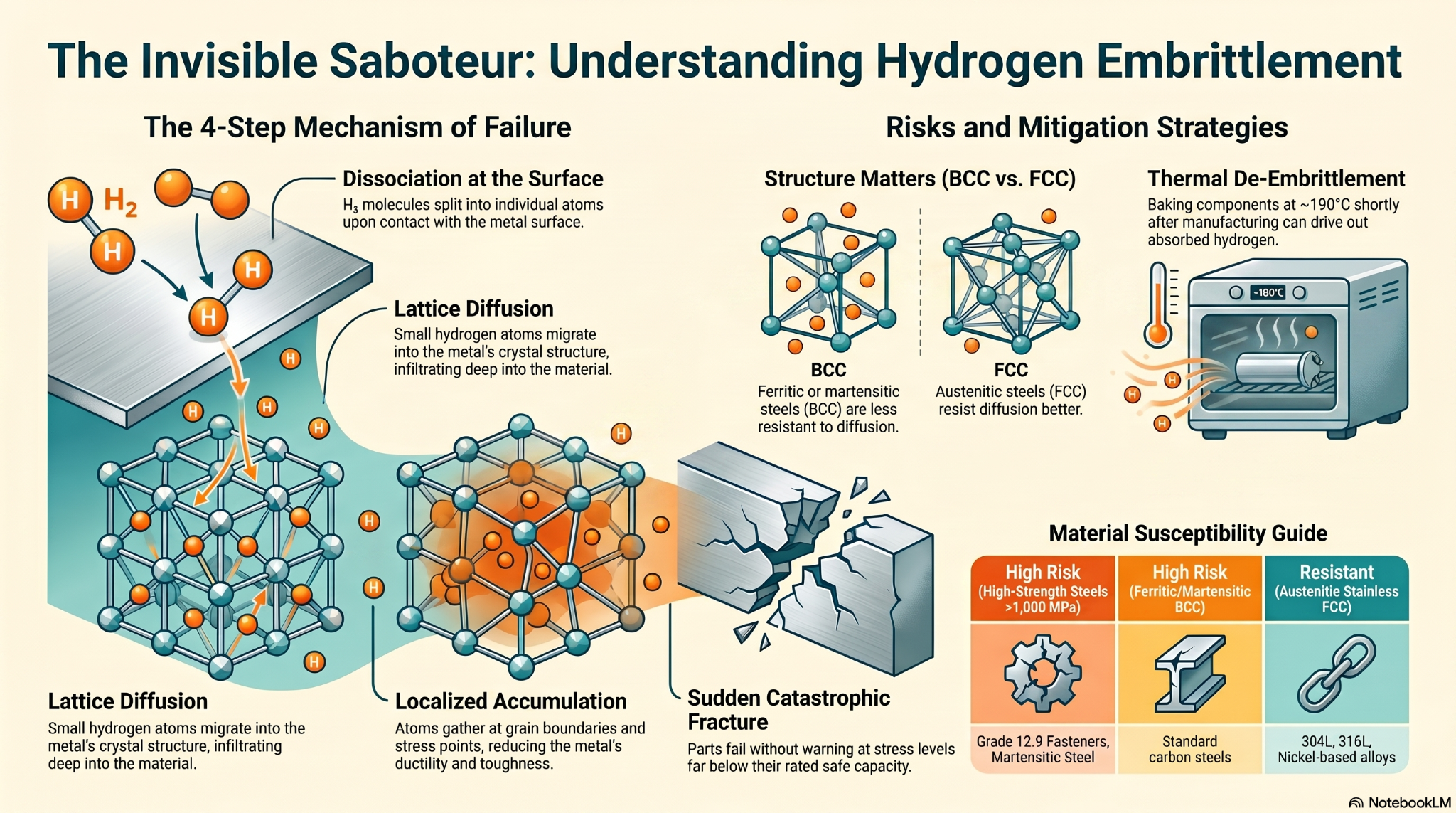
At metal surfaces, H₂ dissociates into atomic hydrogen at metal surfaces. This atomic hydrogen then diffuses into the metal’s crystal lattice, where it accumulates at grain boundaries, dislocations, and stress concentrations.
While the metal’s yield strength remains unchanged, its ductility and fracture toughness decrease. The metal part can then fail without warning at stresses far below what a standard tensile test would suggest is safe. This phenomenon is particularly dangerous.
The metals most susceptible to hydrogen embrittlement are high-strength steels above ~1,000 MPa; BCC crystal structures (ferritic and martensitic steels); and hardened fasteners like Grade 12.9, which are notorious. On the other hand, the more resistant metals include austenitic stainless steels (304L, 316L) and nickel-based alloys, as their FCC crystal structure resists hydrogen diffusion more effectively.
One of the best practices for addressing hydrogen embrittlement in metal seals is to use materials with reduced strength levels where conditions allow. For example, steel with an ultimate tensile strength of 800 MPa often outperforms 1,400 MPa steel when it is used in H₂ service. And for wetted components, engineers often opt for austenitic stainless steel.
Another approach is to control hydrogen-generating manufacturing processes (acid pickling, electroplating) per ASTM A143. Parts can also be baked at about ~190°C within hours of processing to drive out the absorbed hydrogen.
Finally, minimizing stress concentrations on metal seals is another effective approach. The impact of these stress concentrations is significantly greater in hydrogen service.
Seal Permeation and Rapid Gas Decompression with Elastomeric Seals
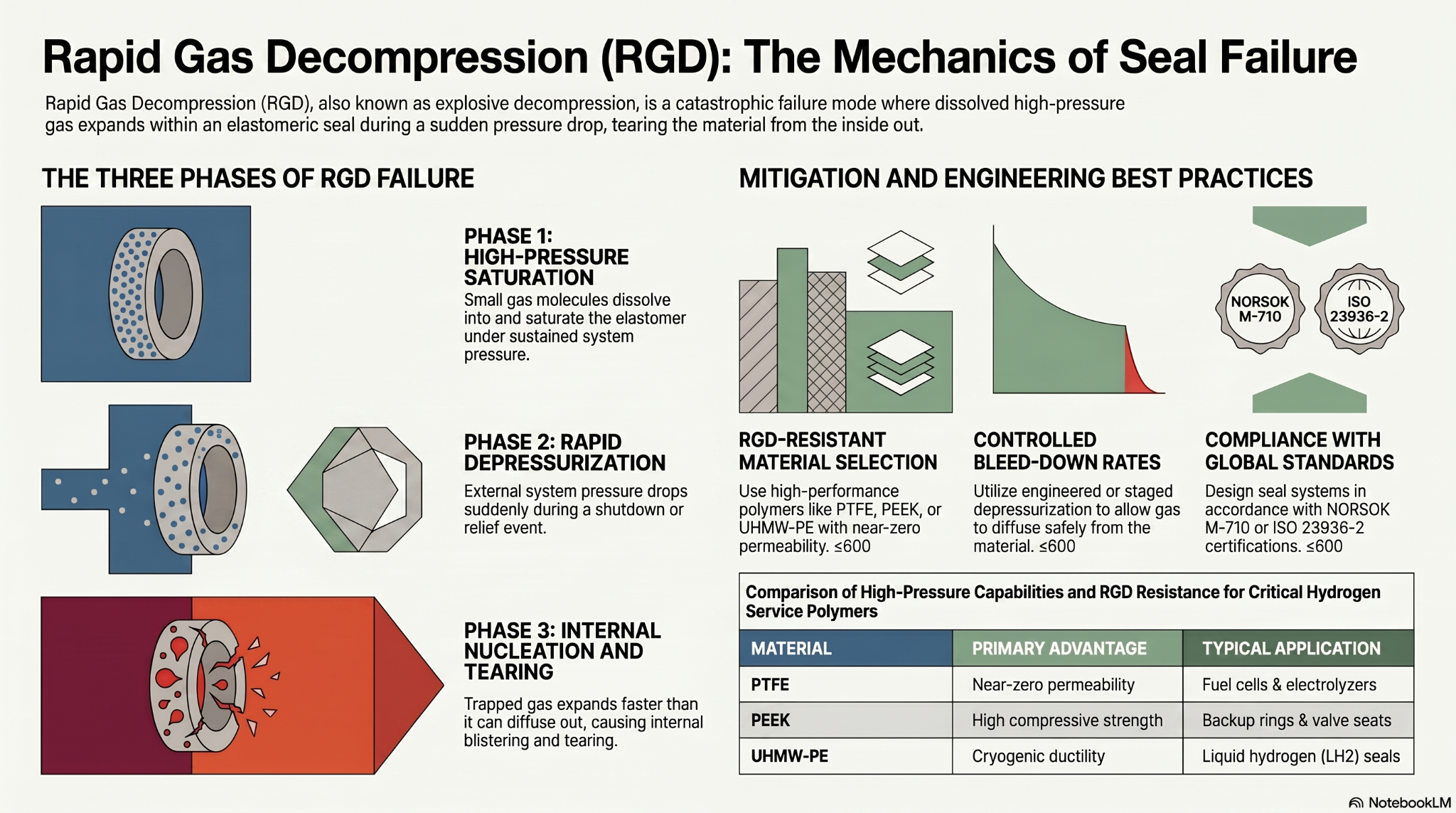
Elastomeric seals can also be sensitive to hydrogen, but through a different mechanism. Because of their small atoms, hydrogen dissolves into and diffuses through elastomeric seal materials at rates far exceeding other common gases. The permeation is made worse in the presence of elevated pressure and temperature, where a seal can become fully saturated with hydrogen.
When system pressure drops during shutdown or a relief event, dissolved hydrogen tries to exit the elastomer faster than it can diffuse out of the surface, a process known as RGD (Rapid Gas Decompression). The result is the elastomeric seals experiencing internal nucleation, blistering, and explosive tearing from the inside out. In short, a seal that survives thousands of cycles can be destroyed by a single fast depressurization event.
The most direct way to mitigate the effects of elastomeric seal permeation is to use a material that effectively resists it. Several options are summarized below.
- FFKM (Kalrez, Perlast) — Excellent: Best all-around performance in H₂ service; highest cost
- PTFE (spring-energized seals) — Good: Very low permeation rate; requires a different design approach than standard elastomeric seals
- EPDM — Good: Surprisingly strong RGD resistance; widely used in fuel cell systems
- FKM (Viton) — Moderate: Adequate at lower pressures but evaluate carefully for high-pressure cycling applications
- NBR / Silicone — Avoid: High hydrogen permeability; not suitable for H₂ service
Other best practices include controlling the decompression rate by utilizing engineered bleed-down or staged depressurization. In addition, face seals instead of radial seals tend to work better in high-pressure applications. Backup rings are another tool to use, limiting extrusion and preferving the seal geometry. Finally, design the seals in compliance with NORSOK M-710 or ISO 23936-2. Keep in mind that data sheets alone are not sufficient for high-pressure hydrogen duty
Conclusion
Neither hydrogen embrittlement nor seal permeation is a mystery as both are well-characterized and manageable. The engineers who will struggle are those who reach for familiar materials and assume the physics is the same. Here at Advanced EMC, we encourage engineers to know the mechanisms behind these failure modes related to hydrogen service, then select deliberately and test accordingly. And Advanced EMC is here to help you every step of the way. Contact one of our seal solution experts today to explore what your options are and put industry best practices to use.