
One challenge of working with PTFE and other polymer seal jackets is their poor elastic memory. Spring energizers address this challenge by providing the consistent sealing force required. However, choosing an energizer means trading off load, deflection range, friction, and leak tightness. This article presents a practical selection framework for selecting the right spring energizer.
What the Spring Energizer Actually Does
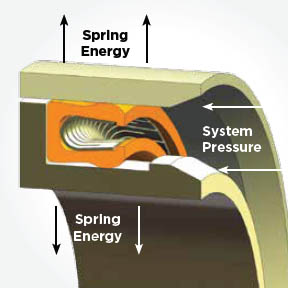
A spring energizer keeps the seal lip in contact even at low or zero system pressure. It effectively mitigates issues related to jacket creep, thermal contraction/expansion, and hardware tolerances over the life of the seal. As system pressure rises, fluid pressure pushes the seal lip outward and takes on more of the sealing load. In fact, the spring has the most significant impact at low pressures, vacuum conditions, and system startup. The spring energizer sets the baseline contact stress, while application requirements determine whether this minimum threshold is adequate.
The Three Spring Properties That Drive Selection
Three spring properties are critical to spring energizer selection: load, load-deflection curve, and where the load lands.
Load (Unit Load)
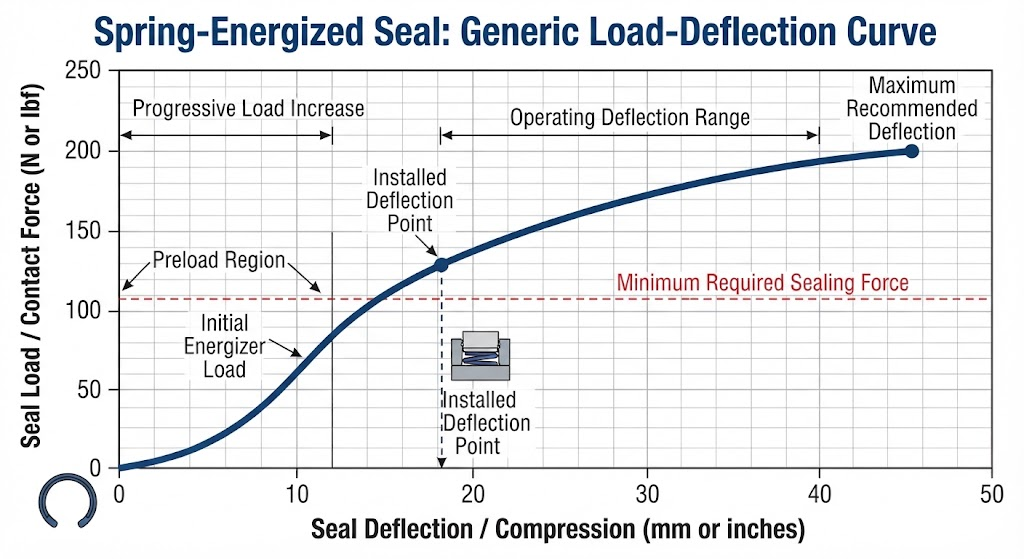
The load, or unit load, is the contact force per unit of circumference. Higher loads give better leak tightness at low pressure but lead to more friction and wear.
Load-Deflection Curve
The load-deflection curve shows how much the load changes as the spring compresses. This determines how well the seal handles tolerance issues, eccentricity, and wear.
Where the Load Lands
The load can be concentrated at the lip tip or spread along the lip. This affects scraping, friction, and gas tightness.
Cantilever (V) Spring Energizers
Cantilever spring energizers, also called V springs, are formed from a metal strip that has a V-shaped cross section. In this design, the load is concentrated near the front of the seal lip.
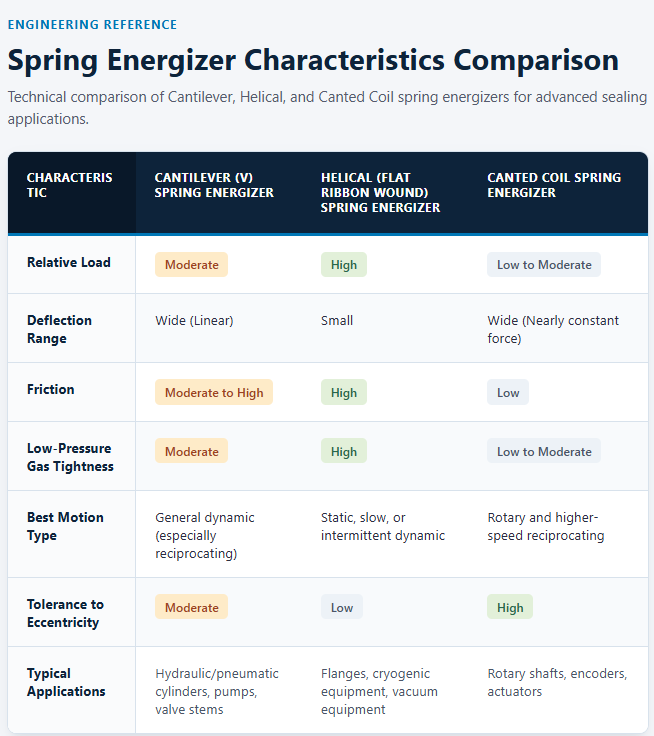
This type of spring energizer can handle a moderate load with a roughly linear load-deflection curve across a wide range. These spring energizers are good in general dynamic service, especially when it involves reciprocating motion. They also work well for scraping and excluding contamination and offer a good cost-to-performance ratio. Cantilever spring energizers are commonly used with hydraulic and pneumatic cylinders, pumps, and valve stems.
Cantilever spring energized seals do have limitations: (1) friction is going to be higher than in canted coil spring energizers, and (2) the open cavity can trap media.
Helical (Flat Ribbon Wound) Spring Energizers
Helical spring energizers are composed of a continuous wound ribbon that supports the full circumference of the lip. They can carry the highest load and have a steep load-deflection curve, meaning they have only a small usable deflection range. Helical spring energized seals offer the tightest seal at low pressure, in vacuum, and against light gases (helium, hydrogen).
Helical spring energized seals are typically found in static and slow or intermittent dynamic service, in flanges, and in cryogenic and vacuum equipment. However, the high load pushes the jacket into surface irregularities, which can tighten the seal but increase friction and wear in dynamic service. In addition, they are less tolerant of hardware tolerances and eccentricity.
Canted Coil Spring Energizers
Canted coil spring energizers are round wire coils wound at an angle, and each coil deflects at the same time when compressed. This creates a nearly constant force over a wide deflection range, which is often why canted coil springs are chosen. They exhibit low, stable friction and tolerate wear, tolerances, and eccentricity. In addition, canted coil spring energizers are well suited to rotary and higher-speed reciprocating service. They are used in applications where friction or torque must remain steady, as well as in rotary shafts, encoders, and actuators.
Canted coil spring energizers can typically handle a lower unit load than helical, so they tend to be less leak-tight in low-pressure gas or vacuum. In addition, abrasive media can damage the lips and cavity.
Side-by-Side Comparison
The table below compares the three spring types discussed in terms of key seal properties.
Spring Material Selection
Common spring options include 301-series stainless steel, Elgiloy® (a cobalt-chromium-nickel alloy), Hastelloy® C-276, and Inconel®. Experts recommend choosing the material based on factors such as corrosion, sour-service (NACE MR0175/ISO 15156) requirements, temperature, and relaxation resistance.
Conclusion
Each type of spring energizer has its own features and applications for which it is well adapted. To learn more about selecting the right one for your application, read Part 2 of this article series. And if you have questions, feel free to contact us today.