
Many flange gasket failures trace back to a few root causes: inadequate chemical compatibility, poor conformability to the flange face, or gradual loss of sealing force through creep. Standard PTFE sheet addresses these challenges only partially. Filled formulations introduce a problematic contamination risk in ultra-pure applications, while unfilled skived PTFE often struggles to conform to rougher or damaged sealing surfaces.
ePTFE sheet was developed to close these gaps. Made from 100% PTFE with no fillers, it expands into a multi-directional microfibril structure that delivers significantly greater flexibility and creep resistance than standard PTFE sheet, without compromising chemical or thermal performance. The sections that follow examine the properties behind this performance and the applications where ePTFE sheet is most commonly specified.
What Makes ePTFE Sheet Different from Standard PTFE
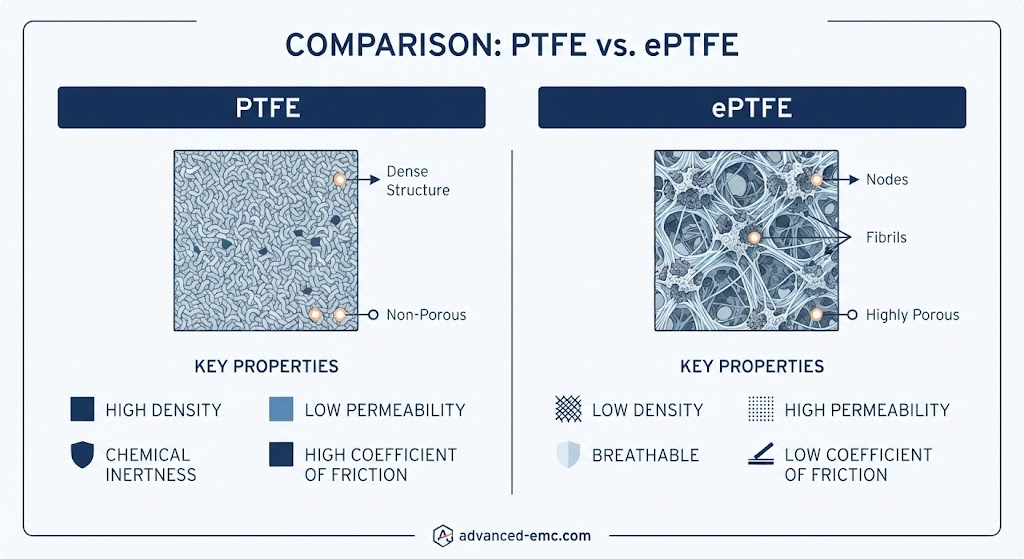
ePTFE sheet is made from 100% PTFE with no fillers and expanded through a special process into a multi-directional microfibril structure. Its interconnected node-and-fibril structure, illustrated below, creates a highly compressible material that can conform to flange-face irregularities while maintaining useful tensile strength and improved resistance to cold flow. The result is a PTFE sheet with strong creep resistance that is also easy to cut and fabricate on site.
Key Performance Properties
What follows are some of the key properties of ePTFE sheet:
- Temperature range: -286°C to 270°C (-450°F to 518°F), making it a good choice over a wide range of temperatures
- pH range 0–14 (chemical resistance)
- Tensile strength >20 MPa
- Stress retention of 15 MPa
- Specific leakage rate 2.6×10⁻⁷
- Compressibility 45% / recovery 14% (ASTM F36M)
- Bonus properties: hydrophobic, low friction coefficient, UV resistant
It also has PTFE’s chemical inertness and extremely low coefficient of friction. It is also hydrophobic and UV resistant.
Benefits of ePTFE Sheet
ePTFE sheet is low-friction, non-stick, chemically inert, and exhibits good strength. It also offers excellent extreme-temperature reliability and high dielectric strength. These sheets are strongly hydrophobic, provide good electrical insulation properties, and can handle long-term exposure to UV as well as harsh outdoor conditions. Certain virgin-PTFE materials may be suitable for food-contact or pharmaceutical applications when supported by the supplier’s applicable FDA and compliance documentation. ePTFE’s resistance to creep and deformation under load leads to good dimensional stability.
Drawbacks of ePTFE
As with any material, ePTFE has drawbacks. These include its cost, mainly due to its manufacturing process and the fact that PTFE is a high-performance polymer. However, that cost is often justified because no other feasible solution may exist. ePTFE is primarily a static-sealing material. As such, it is generally not the preferred choice for applications requiring high abrasion resistance, dynamic sliding wear resistance, or high mechanical recovery. Repeated thermal cycling can cause dimensional changes that affect performance. Finally, ePTFE does not work well with molten alkali metals such as lithium and concentrated sodium.
Where ePTFE Sheet Gets Specified
In oil and gas applications, ePTFE sheet is most commonly used at flange connections. Its chemical resistance across a pH range of 0–14, combined with a 200 bar pressure rating, makes it an excellent option for static sealing across a broad range of process media, including aggressive hydrocarbons and treatment chemicals.
Pharmaceutical and medical applications have different requirements. Because ePTFE contains no fillers, it is well suited to glass-lined flange seals and sanitary sealing points, where product purity cannot be compromised by leaching or contamination, which is a common limitation of filled gasket materials in these environments.
In chemical processing, ePTFE sheet is used for valve and pump static seals. Its chemical inertness and strong creep resistance help maintain sealing force through repeated thermal cycling and exposure to corrosive media. ePTFE is also used for analytical instrument seals, research equipment that requires chemical compatibility, and laboratory glassware components.
Pulp and paper operations rely on ePTFE sheet for maintenance hole cover gaskets. Its conformability compensates for the slightly irregular or worn sealing surfaces typical of large access covers, reducing the need for tighter machining tolerances.
Food processing and pharmaceutical facilities both specify ePTFE sheet for mixers and similar equipment, where its purity profile and resistance to cleaning chemicals support the frequent washdown cycles required in food-grade environments.
The semiconductor industry uses ePTFE sheets in ultra-high purity applications, process chamber seals, and chemical delivery systems.
Conclusion
ePTFE sheet provides a practical solution for many static sealing applications where conventional PTFE may struggle with flange irregularities, low available bolt load, or long-term creep resistance. Its filler-free construction, chemical compatibility, and high conformability make it well suited to demanding process environments. To discuss the right sheet grade, thickness, and gasket configuration for your application, visit our ePTFE Products page or Request a Quote today.