by Sara McCaslin, PhD Sara McCaslin, PhD No Comments

ePTFE Sheet: Properties and Applications

Introduction

ePTFE sheet is a specialized material based on PTFE. While engineers have relied on PTFE for decades because of its chemical inertness, thermal stability, and ultra-low friction, PTFE does have its limitations. When a standard PTFE sheet is used in sealing applications with imperfect flange surfaces or inconsistent bolt loads, the material’s limited compressibility and tendency toward cold flow can lead to serious problems. 

Expanded PTFE (ePTFE), on the other hand,  addresses these challenges with its unique microstructure, and this microstructure gives it significantly better sealing performance while retaining the core benefits of PTFE. 

This blog post explains what ePTFE is, how it differs from conventional PTFE, and why it has become a preferred choice for gaskets and seals in harsh environments.

What is ePTFE?

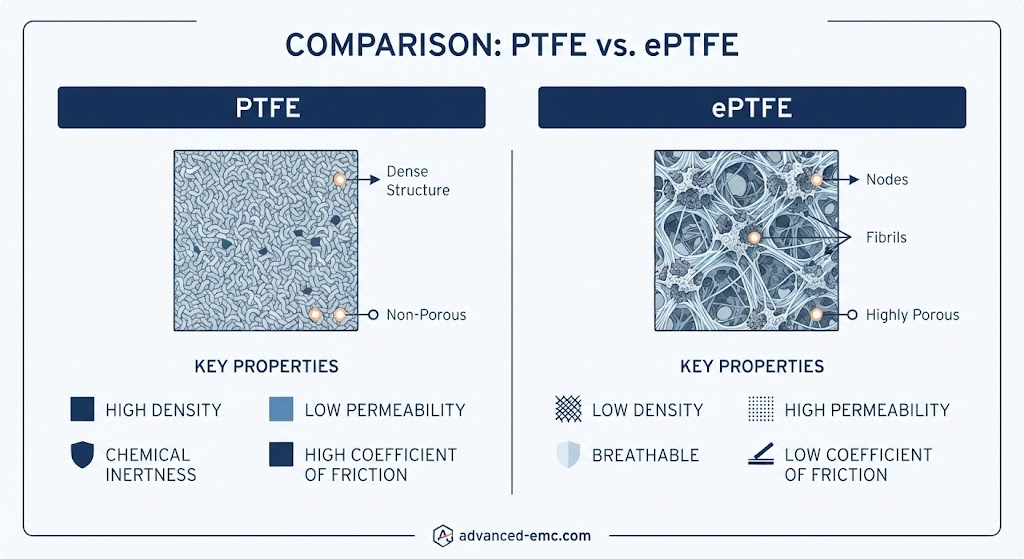
ePTFE is a specialized form of PTFE that has been mechanically stretched under controlled heat and pressure. This engineered expansion introduces porosity and internal reinforcement into the microstructure of PTFE, transforming it from a dense, rigid sheet into a material that is highly compressible, conformable, and able to provide excellent long-term sealing performance.

How ePTFE Differs from Conventional PTFE

Both ePTFE and PTFE share the same chemical composition, but the expansion process dramatically changes the physical structure and performance of ePTFE. Here is a comparison.

Comparison of PTFE vs. ePTFE

AttributeConventional PTFEExpanded PTFE (ePTFE)
MicrostructureDense, non-porous solidPorous, fibrillated network created by expansion
Compressibility & ConformabilityLowHigh as it adapts to damaged or uneven flange surfaces
Creep/Cold FlowMore prone to cold flow under loadReduced creep due to the fibrillated structure
Sealability at Low Bolt LoadsModerateExcellent, as it reliably seals even when the bolt load is insufficient
DensityHighLower due to controlled porosity
BreathabilityImpermeableIt can be breathable depending on the expansion ratio and thickness

Because of the microstructure that results from the controlled stretching and heating, ePTFE is better suited for sealing imperfect flanges, systems with temperature cycling, or connections that are sensitive to bolt-load variations.

How ePTFE Was Developed

PTFE was discovered in the 1930s, and it was in the 1960s and 1970s when engineers began to experiment with mechanical expansion techniques. One such technique resulted in the fibrillated microstructure that gives ePTFE improved mechanical properties. Today, ePTFE is used everywhere from chemical plants and semiconductor lines to medical devices and filtration systems.

Material Properties of ePTFE Sheet

While ePTFE sheet does share some of the same properties as PTFE, there are some significant differences.

Mechanical Behavior

The fibrillated matrix of ePTFE provides it with higher compressibility and resilience. This means that it can conform to warped, scratched, or pitted flange surfaces while still retaining a reliable seal. Unlike standard PTFE, ePTFE experiences far less cold flow. This property improves its long-term stability under load.

Thermal Performance

ePTFE shares PTFE’s excellent resistance to extreme temperatures, and it handles thermal cycling exceptionally well. ePTFE’s structure reduces the stress concentration that can occur during expansion and contraction, which helps it to better maintain seal integrity.

Chemical Resistance

Like PTFE, ePTFE is nearly universally chemically inert. It resists aggressive chemicals such as strong acids, bases, solvents, oxidizers, and process chemicals. This makes it ideal for harsh chemical-processing environments.

Friction and Sealing Characteristics

ePTFE material retains PTFE’s extremely low coefficient of friction and non-stick surface. ePTFE also compresses easily and fills micro-voids at the interface, significantly improving leak-tightness even when gasket loads are low.

Microstructure

The microporous, interlocking fibrils combined to achieve an excellent balance of strength and flexibility. The amount of expansion determines other properties such as density, compressibility, and sealing capability. As a result, sheets can be engineered for specific applications.

Advantages of ePTFE Sheet Over Standard PTFE

ePTFE has several advantages over standard PTFE. For example, it exhibits better performance when working with flanges that have been damaged or are irregular. It also requires no fillers or reinforcements to achieve high performance. ePTFE has a higher level of recovery and compressibility when compared with PTFE, and also possesses improved creep resistance. It also has excellent sealing capabilities at low bolt torque. ePTFE is also known for its easy installation and rework

Design Considerations for Engineers Considering ePTFE

Engineers should consider the media, temperature, pressure, and chemical exposure associated with the potential application, keeping in mind that ePTFE performs well in the presence of aggressive chemicals and extreme temperatures. Additionally, ePTFE can better compensate for flange distortion, as well as scratches and pits. ePTFE sheets are available in both high and low density forms: high density sheets exhibit better mechanical stability, while lower density sheets have better compressibility. Selection of an ePTFE sheet depends primarily on the bolt lead, operating pressures, and flange quality. Finally, for standard gasket applications, non-venting ePTFE sheets are used as opposed to ePTFE membrane options.

Common Applications of ePTFE Sheet

ePTFE is used in a wide variety of applications, including the following:

  • Chemical Processing: Here, PTFE sheet is often used in pump housings, valve covers, manways, and flange connections that are exposed to corrosive media.
  • Semiconductor and High-Purity Environments: ePTFE has proven itself ideal for ultrapure chemical distribution where contamination must be minimized.
  • Food, Dairy, and Pharmaceutical: FDA-compatible ePTFE is used and is very resistant to media that includes CIP/SIP chemicals and steam, as well as repeated exposure to thermal cycling.
  • Oil and Gas: ePTFE gaskets withstand corrosive environments, fluctuating temperatures, and low bolt loads common in pipeline and processing equipment.
  • Medical and Life Sciences: ePTFE membranes serve as vents, filters, and barrier layers in medical devices.
  • General Industrial: This includes applications ranging from heat exchangers to compressors and agitators. In fact, HVAC systems frequently use ePTFE gaskets because of their sealing reliability.

Conclusion

ePTFE sheet is a significant improvement over conventional PTFE in sealing and gasketing applications. Its microporous structure delivers superior compressibility, conformability, and creep resistance while maintaining the outstanding chemical and thermal benefits of PTFE. Whether it’s used in chemical processing, food and pharmaceutical systems, semiconductor applications, or general industrial machinery, ePTFE offers reliable long-term performance. 

Advanced EMC is a supplier that offers a wide range of ePTFE sheets, tapes, and custom gasket solutions engineered for the most demanding service environments. Our expertise in polymer sealing allows Advanced EMC to assist you with material selection, thickness optimization, and application-specific sealing guidance. Contact us today to learn more.

by Brandon Pascual Brandon Pascual No Comments

Advanced EMC Technologies: Revolutionizing Sealing Solutions Across Industries

Advanced EMC Technologies is synonymous with innovation and excellence in PTFE sealing solutions. Our products are designed to meet the most demanding requirements across various industries. In this blog, we delve into real-world application examples to showcase the exceptional capabilities of our PTFE rotary shaft seals in diverse fields such as oil and gas, renewable energy, aerospace, and space exploration.

Real-World Application: PTFE Rotary Shaft Seals in Oil and Gas Drilling

Challenge: In the oil and gas industry, drilling operations face extreme conditions, including high pressures, temperatures, and exposure to harsh chemicals and abrasive materials. Traditional seals often fail under these conditions, leading to costly downtime and repairs.

Solution: Advanced EMC Technologies’ PTFE rotary shaft seals provide a reliable solution for these challenging environments. Let’s explore how our seals excel in this application:

High-Pressure Resistance: During drilling operations, equipment such as mud pumps and rotary steerable systems experience high pressures. Our PTFE seals can withstand pressures up to 15 bar, ensuring continuous operation without seal failure.

TYPES OF SEALS FOR OIL AND GAS INDUSTRY

Broad Temperature Range: The temperature range in drilling operations can vary significantly, from sub-zero temperatures in deep-sea environments to high temperatures encountered during drilling. Our seals operate efficiently from -40 to +220°C, providing unmatched reliability.

THE BENEFITS OF PTFE SPRING ENERGIZED SEALS FOR OIL AND GAS

Chemical Resistance: Drilling fluids and chemicals used in oil and gas operations can be highly corrosive. Our PTFE seals offer exceptional resistance to a wide range of chemicals, preventing degradation and ensuring long-lasting performance.

HOW TO DESIGN AND SELECT SEALS FOR OIL AND GAS

Minimal Friction and Wear: Equipment downtime due to seal failure can be costly. Our PTFE rotary shaft seals are designed with a durable sealing lip that exhibits minimal friction and wear, reducing maintenance frequency and extending the life of the equipment.

THE OIL AND GAS INDUSTRY DURING COVID-19

Impact: By using our PTFE rotary shaft seals, oil and gas companies can achieve higher operational efficiency. The seals’ ability to withstand extreme conditions reduces the risk of equipment failure, ensuring continuous drilling operations and translating into significant cost savings.


Enhancing Energy Efficiency: PTFE Seals in Renewable Energy

Challenge: The renewable energy sector, including wind and solar power, demands reliable sealing solutions that can withstand environmental extremes and ensure efficient operation. Components must handle wide temperature ranges, exposure to elements, and continuous motion.

Solution: Advanced EMC Technologies’ PTFE seals are ideal for renewable energy applications. Here’s how:

Weather Resistance: Our seals provide excellent resistance to UV exposure, moisture, and extreme temperatures, making them perfect for outdoor applications such as wind turbine blades and solar panel mounts.

BENEFITS OF SPRING-ENERGIZED SEALS FOR WIND TURBINES

Durability: The high wear resistance of our PTFE seals ensures longevity, reducing the need for frequent maintenance and replacements in renewable energy installations.

WHEN TO USE A PTFE ROTARY SHAFT SEAL

Efficiency: By minimizing friction and wear, our seals contribute to the overall efficiency of energy generation systems, ensuring optimal performance and reduced energy loss.

SPRING-ENERGIZED SEALS FOR THE WIND INDUSTRY

Impact: Wind turbines and solar panels equipped with our PTFE seals perform more efficiently and require less maintenance, leading to lower operational costs and more sustainable energy production.


Taking Flight: PTFE Seals in Aerospace

Challenge: Aerospace applications demand sealing solutions that can endure high altitudes, temperature fluctuations, and extreme pressure conditions. Aircraft components require seals that guarantee safety and reliability.

Solution: Advanced EMC Technologies’ PTFE seals are designed to meet these stringent requirements. Here’s why our seals are a top choice for aerospace:

Temperature Tolerance: Our seals perform effectively across a broad temperature range, from the cold of high altitudes to the heat generated by aircraft engines.

A COMPREHENSIVE GUIDE TO AEROSPACE SEALS

Pressure Resistance: The high-pressure resistance of our PTFE seals ensures reliability in hydraulic systems, fuel systems, and other critical components.

SPRING-ENERGIZED SEALS FOR SPACEFLIGHT

Lightweight: Weight is a critical factor in aerospace applications. Our PTFE seals are lightweight yet robust, contributing to overall aircraft efficiency without compromising on performance.

PTFE AEROSPACE SEALS

Impact: Our seals ensure that aircraft components operate smoothly and safely, reducing the risk of mechanical failures and enhancing the overall reliability and efficiency of aerospace systems.


Reaching for the Stars: PTFE Seals in Space Exploration

Challenge: Space missions involve extreme conditions, including vacuum, radiation, and cryogenic temperatures. Seals used in rockets and spacecraft must offer exceptional reliability and durability to ensure mission success.

Solution: Advanced EMC Technologies’ PTFE seals are perfect for space applications. Here’s how they make a difference:

Cryogenic Performance: Our seals maintain integrity at cryogenic temperatures, crucial for handling rocket fuels like liquid oxygen (LOX) and liquid hydrogen.

SEALS IN SPACE: THE UNSUNG HEROES OF ROCKETRY

Vacuum Compatibility: PTFE’s properties make our seals ideal for use in the vacuum of space, where traditional materials might fail.

A COMPREHENSIVE GUIDE TO AEROSPACE SEALS

Chemical Inertness: The chemical resistance of our PTFE seals ensures they can withstand exposure to various rocket propellants and other harsh substances used in space missions.

ADVANCEMENTS IN AEROSPACE DYNAMIC SEALS: ENHANCING HIGH-TEMPERATURE CAPABILITIES FOR AEROSPACE APPLICATIONS

Impact: Our seals play a vital role in the success of space missions by ensuring the reliability and safety of critical components, from rocket engines to spacecraft systems.


Why Choose Advanced EMC Technologies?

  1. Customization: We understand that each application has unique requirements. Our team works closely with clients to design and manufacture customized PTFE seals that meet specific operational needs.
  2. Quality Assurance: Our seals are manufactured to the highest standards, ensuring consistent quality and performance. We utilize advanced materials and manufacturing processes to deliver superior products.
  3. Expert Support: From initial consultation to after-sales support, our team of experts is dedicated to providing exceptional service. We assist clients in selecting the right seals and offer ongoing support to ensure optimal performance.

Advanced EMC Technologies‘ PTFE rotary shaft seals are transforming industries by providing reliable, high-performance sealing solutions. Our seals are engineered to excel in the most challenging environments, ensuring operational efficiency, cost savings, and environmental safety.

Whether it’s drilling deep in the earth, harnessing the power of the wind and sun, soaring through the skies, or exploring the final frontier, Advanced EMC Technologies has the sealing solutions to keep your operations running smoothly.

For more information about our products and services, visit our website or contact our sales team at Sales@advanced-emc.com. Let Advanced EMC Technologies be your trusted partner in sealing solutions for all your industrial needs.