
by Sara McCaslin Sara McCaslin No Comments

The Case for Polymer BURs in High-Pressure Seals

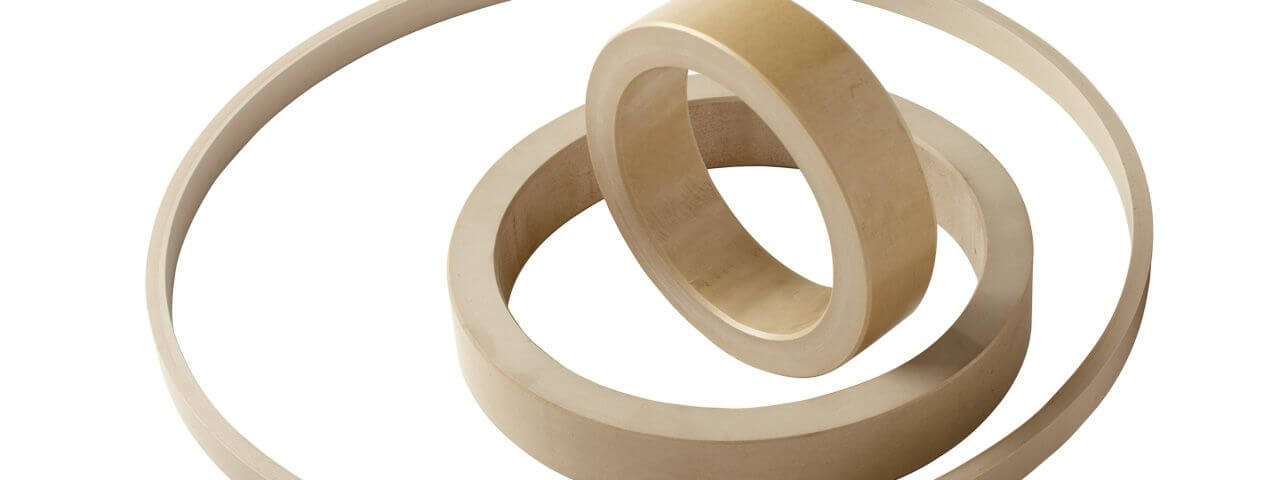
Engineers are intensely frustrated when an O-ring is specified for a design and it still fails. This is likely because the O-ring needed a backup ring (BUR), not because the O-ring was not specified correctly. In fact, polymer BURs remain an underrated but critical component in many systems, in industries ranging from food to oil & gas. 

This article looks at the main problem BURs solve, the benefits of opting for polymer BURs, and commonly used polymers. 

O-Rings and Extrusion

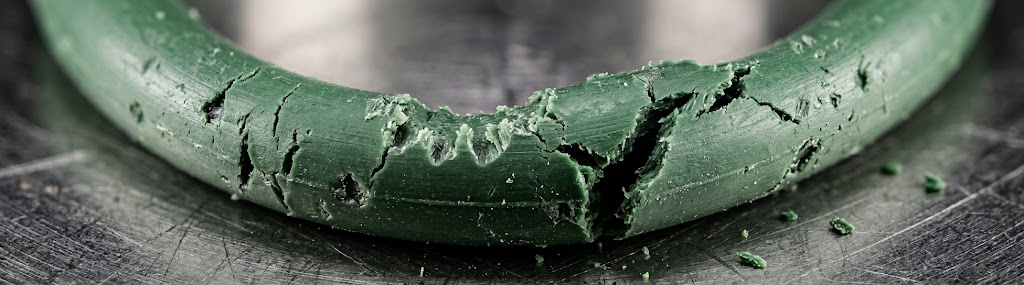
The clearance gap is the space between mating parts where the O-ring sits. Under high pressure, the O-ring is going to behave more like a fluid than a solid. It will get forced, or flow, into the clearance gap. When the O-ring extrudes into the clearance gap, it can lead to two different failure modes: nibbling and spiral failure.  Nibbling looks like something has taken multiple small bites from the O-ring. Spiral failure refers to tearing and cracking around the circumference of the O-ring.

This type of failure is irreversible and inevitably leads to weeping or a catastrophic leak. For hydraulic systems operating at high pressure, it will either manifest as a slow leak (weeping) or a catastrophic failure.
How BURs Solve O-Ring Extrusion (and More)

A backup ring (BUR) is installed against the O-ring, downstream of the pressure, to ensure it stays within the clearance gap. In short, a BUR physically closes the clearance gap, giving the seal nowhere to migrate. This not only prevents unwanted leaks but can extend the life of a seal from cycles to years.

BURs are often used in high-temperature or high-pressure applications. BURs can also help to evenly distribute pressure in applications involving varying clearance gaps or pressure fluctuations. Additionally, BURs help to reduce the effects of wear and friction on O-rings and serve as a thermal barrier to protect them from excessive heat.

Benefits of Using Polymer BURs

There are several benefits to using polymer BURs

Extrusion prevention – They effectively fill the clearance gap between mating parts, stopping the primary elastomer seal from being forced (extruded) into that gap under pressure, which would otherwise cause premature seal failure.

Extended pressure and temperature range – By protecting the O-ring from extrusion, polymer BURs allow the overall seal assembly to withstand higher pressures and wider temperature swings than an O-ring alone could handle.

Reduced wear on the primary seal – BURs absorb mechanical stress and abrasion so that the O-ring experiences fewer issues with friction and deformation, thus extending its service life.

Design flexibility with looser tolerances – Because the BUR compensates for extrusion risk, designers can use larger clearance gaps. The use of larger clearance gaps, in turn, simplifies the machining process and reduces manufacturing cost.

Compatibility across dynamic and static applications – Different polymers (PTFE, PEEK, nylon, polyurethane, acetal) let engineers tailor the backup ring’s flexibility, hardness, and chemical resistance to match whether the seal is static, reciprocating, or rotating.

Corrosion and chemical resistance – Unlike metal backup rings, polymers can be chosen that will not corrode or react with process fluids. This facet is particularly important in chemical, oilfield, or food-grade applications.

Lightweight and cost-effective – Polymers are generally cheaper and lighter than metal without sacrificing performance in most standard pressure ranges needed for BURs.

Ease of installation – Many polymer backup rings (especially PTFE) are flexible enough to be installed without requiring the use of special tools. This is in contrast to rigid metal rings that may require more complex assembly procedures.

System reliability – By preventing extrusion-related blowouts, polymer BURs reduce the risk of unplanned downtime, leaks, or catastrophic seal failure in critical systems like hydraulics, pneumatics, and downhole tools.

In short, polymer BURs let engineers push seal assemblies harder in terms of more pressure, wider gaps, tougher environments. And they do so while protecting the seal from the system.

Backup Ring Materials

When choosing a BUR material, ensure it is harder than the seal material to effectively prevent migration. They must also have lower coefficients of expansion than the seal and are engineered to be both rigid and tough. 

Polymer BURs are often used in place of elastomeric versions because they offer significantly better resistance to extrusion, deformation, and chemical exposure, as well as reduced long-term creep under high pressure.

Commonly used polymers include ….

Material Temp Range Chemical Resistance Friction Extrusion Resistance Cost Best Use Case
PTFE (virgin/filled) -70°F to 575°F Excellent
nearly universal
Very Low Good
better filled
Moderate High-temp, chemically aggressive, low-friction dynamic seals
PEEK -50°F to 590°F Excellent Moderate Excellent
highest strength
High High-pressure, large extrusion gaps, oilfield/downhole
Nylon (PA) -40°F to 180°F Fair to Good Moderate Good Low General-purpose hydraulics, cost-sensitive designs
Polyurethane (PU/AU) -40°F to 210°F Good
poor w/ water/steam
Mod–High Good
flexible
Low–Mod Dynamic seals needing toughness and abrasion resistance
Acetal (POM/Delrin) -40°F to 180°F Good Low–Mod Very Good
rigid
Low–Mod Static or low-speed dynamic, tight-tolerance applications

In general, PEEK wins over PTFE based on strength and extrusion resistance at high pressure, but PTFE wins on friction and chemical universality. Nylon is more rigid and dimensionally stable than polyurethane, but polyurethane flexes better in dynamic strokes. However, polyurethane degrades faster than Nylon in wet/steam environments. Acetal is often the “in-between” choice because it is more rigid than nylon or Polyurethane, but not as chemically or thermally capable as PTFE or PEEK.

Conclusion

Polymer BURs serve as cheap insurance against otherwise expensive failures. In fact, they are almost indispensable in chemical processing, hydraulics, oil & gas, and aerospace applications. And remember: it is best to decide on the inclusion of a BUR before failure, not after. But whether you need BURs before or after design, contact Advanced EMC for help. Our sealing engineers are ready to put their experience to work for you.

by Daniel Mays Daniel Mays No Comments

Choosing the Right Polymer Backup Ring

Choosing the right polymer backup ring can be challenging, but having a basic understanding of how they work, combined with some guidelines, can make the design decisions much easier. This blog post provides a brief overview of what backup rings are, what distinguishes polymer backup rings, and how to choose the right one for a specific application.

Backup Rings

Backup rings are supportive elements typically used with O-rings in sealing systems to help prevent extrusion in the clearance gap of a seal. Often used in high-temperature or high-pressure applications, these rings have lower coefficients of expansion and are engineered to be very rigid and tough. Backup rings can also help to evenly distribute pressure in applications involving varying clearance gaps or pressure fluctuations. Additionally, backup rings help to reduce the effects of wear and friction on O-rings and serve as a thermal barrier to protect them from excessive heat. 

Why Polymer Backup Rings?

Polymer backup rings are often used in place of elastomeric versions because they offer significantly better resistance to extrusion, deformation, chemical resistance, and long-term creep under high pressure. Materials like PTFE, PEEK, or Nylon tolerate wider temperature swings, aggressive fluids, and high-cycle dynamic motion without breaking down. The result is a more stable sealing system with significantly reduced risk of issues such as blowouts, spiral failure, or premature wear. 

Choosing the Right Polymer Backup Ring

There are several different factors that go into selecting the right polymer backup ring. 

Clearance Gap

The clearance gap is one of the most important factors when specifying a polymer backup ring. It directly determines how much support the O-ring needs to prevent extrusion. As the gap increases, the load on the elastomer rises, and the likelihood of extrusion rises sharply. This is especially true at higher pressures or temperatures.

Keep in mind that larger gaps typically require a stiffer polymer (such as PEEK instead of PTFE), a thicker or contoured backup ring profile, or even double backup rings for bidirectional pressure. Small, well-controlled gaps, however, may allow the use of thinner PTFE rings. In short, the wider the clearance gap, the stronger and more dimensionally stable the backup material must be..

Pressure and Temperature

Environmental factors that influence the selection of the right backup ring include system pressure, as higher pressures require harder, more extrusion-resistant materials. System temperatures, which impact dimensional stability, can limit the choice of materials based on their operating temperature limits. High temperatures can make materials more pliable, while low temperatures can lead to brittle behavior. Temperature also affects dimensional stability, as thermal expansion can increase the clearance gap and increase the likelihood of extrusion. 

Static or Dynamic

Another key factor in selecting a backup ring is whether the sealing system will operate in a dynamic or static environment. Static systems will involve less mechanical stress on the backup ring, allowing a wider range of polymer materials to be suitable. In contrast, dynamic applications that introduce continuous motion, friction, and side loading require tougher, more wear-resistant polymers with excellent dimensional stability, such as PEEK or certain PTFE blends. 

Backup Ring Shape

The two most commonly used backup ring shapes are the scarf-cut and solid types. Scarf-cut backup rings feature a single angled split that allows them to flex during installation. They can also conform more easily to the groove and reduce the risk of damage during assembly, since the ring can be expanded or compressed without overstressing the material. Because they can open slightly, scarf-cut rings are often chosen when hardware tolerances are tight or when installation must be done without special tools. 

Solid backup rings do not have a split and must be made from a more flexible polymer that allows them to be stretched or compressed into place without cracking. While they do not offer the same level of extrusion resistance as scarf-cut designs in extreme conditions, their continuous, unbroken profile provides uniform support and is useful in moderate-pressure systems where ease of installation and stable sealing performance are priorities.

Back-Up Ring Material

PTFE is an excellent option for backup rings due to its extremely low coefficient of friction and extensive chemical compatibility. Applications requiring dynamic sealing or very low temperatures are excellent opportunities to use PTFE. PTFE does have its limitations, however. There is the possibility of cold flow under sustained loads, which can make it unsuitable for extreme pressure conditions. Virgin PTFE is limited to about 3,600 psi. Filled PTFE (e.g., glass-filled, carbon-filled, graphite-filled, bronze-filled) is effective for pressures up to 5,800 psi.

PEEK possesses high mechanical strength and excellent resistance to extrusion, with thermal stability up to 480°F and exceptional resistance to extrusion. PEEK can be used at pressures up to 20,000 psi and a maximum temperature of 500°F. These properties make PEEK an excellent option for both high-pressure and high-temperature applications. Additional strength and hardness can be achieved by using various fillers. Finally, PEEK is compatible with a wide range of chemicals and exhibits very low friction. 

Nylon works very well in moderate conditions and is more economical compared to PEEK and PTFE. However, it does have some critical limitations that include swelling and water absorption, both of which can heavily impact tolerances. Nylon 6,6 works well at pressures below 10,000 psi and a maximum temperature of 186°F. Nylon 6,6 filled with Molybdenum Disulfide (MoS2) to reduce friction is commonly used for backup rings. However, one of the drawbacks of Nylon 6,6 is its water absorption, which can range from 0.5% to 1.4% per 24 hours.

Conclusion

Choosing the right polymer backup ring is ultimately about understanding the pressures, temperatures, clearances, and motion your system must withstand. When those variables are matched with the correct geometry and material, you will have a more reliable sealing system with fewer failures and a longer service life. If you need help evaluating your application or choosing the optimal backup ring design, Advanced EMC’s engineering team is ready to assist. Contact us today to discuss your requirements and get expert guidance on the best polymer sealing solution for your equipment.