
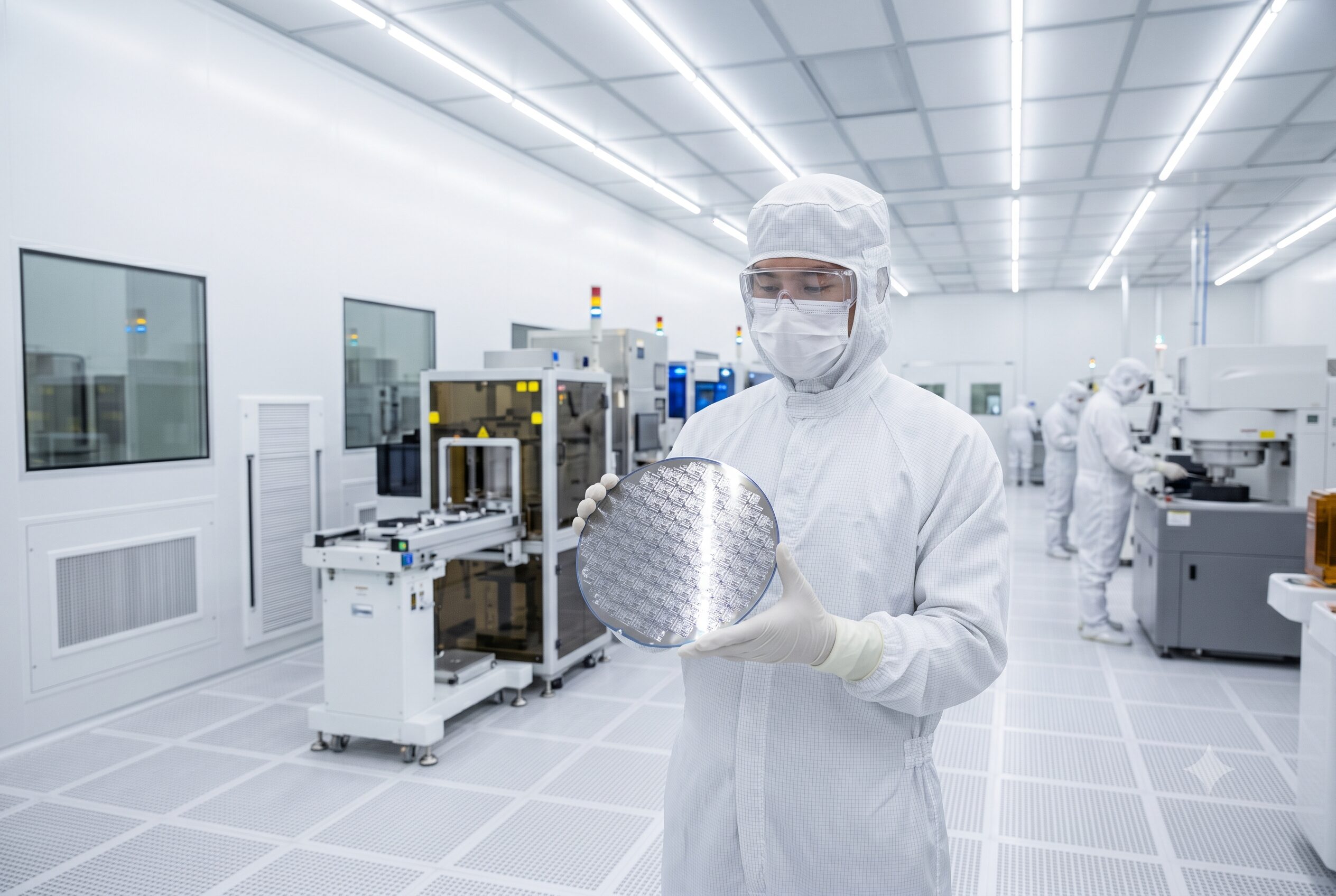
Semiconductor fabrication facilities are among the most demanding environments for seal materials on the planet because a single contamination event can scrap a wafer batch worth hundreds of thousands of dollars. And every polymer, lubricant, and elastomeric material contains residual volatiles. SEMI standards deal with how to take these residual volatiles into account when designing components, such as seals, for wafer fabrication environments. The purpose of this blog post is to discuss what SEMI standards actually require and how engineers select bearings to meet them.
The SEMI Standards Landscape
SEMI standards serve as the common language of the global semiconductor supply chain. For example, SEMI standards define fitness for use by establishing minimum thresholds (e.g., outgassing limits, contamination levels, chemical compatibility requirements) that a component must meet to be considered safe for use in semiconductor manufacturing environments. These standards also protect the wafer from contamination that can destroy device yield and make suppliers accountable.
By referencing a SEMI standard in a procurement specification, a fabrication engineer can require documented, third-party-verifiable compliance rather than relying on a supplier’s marketing claims. These standards also enable global interoperability: tools, chemicals, and components built to SEMI standards can move across fabrications and geographies without extensive re-qualification. This serves as a major economic benefit in a highly globalized industry.
SEMI F-Series (Facilities and Materials)
The SEMI F-series serves as the most relevant category for seals. Standards like SEMI F57 govern polymeric components and wetted surface materials used in UHP (ultra-high purity) gas distribution systems, covering surface finish requirements, material qualification, and cleanliness protocols. SEMI F2 addresses test methods for metallic contamination on wetted surfaces. These are the specs a seal or bearing supplier is most likely to be asked to demonstrate compliance with.
SEMI C-Series (Chemicals)
The SEMI C-Series of standards defines purity grades and acceptable contamination levels for process chemicals such as acids, solvents, and oxidizers. While these standards primarily govern the chemicals themselves, they are also critically important for material selection. If your seal is sitting in a bath governed by a C-series chemical specification, that specification indirectly defines the chemical resistance your seal must demonstrate. Engineers selecting materials for wetted components need to understand what chemical grade they are designing for.
SEMI S2 (Safety Guidelines for Semiconductor Manufacturing Equipment)
S2 is a broad equipment safety standard with direct implications for materials selection. It addresses chemical containment, materials of construction for chemical-wetted components, ventilation requirements, and labeling. It’s often the standard a tool OEM must satisfy as a condition of fab entry, making it a gateway document that touches bearing and seal design.
Purity: Metallic Contamination and Ionic Cleanliness
When it comes to cleanliness in fabrication environments, the core concern when it comes to contamination is the presence of trace metals (Fe, Na, K, Ca) as killer defects in semiconductor devices. Both dynamic seals are going to shed particles, and this includes wear debris, surface oxides, and manufacturing residues. Among the key material considerations are the use of PTFE bearings and seals, while other options include ceramic bearings (Si₃N₄, ZrO₂) as the go-to for ultra-pure applications and surface treatments (e.g., electropolishing, passivation, and their limits).
Outgassing: The Invisible Contamination Problem
Through outgassing, volatile organic compounds (VOCs) deposit on wafer surfaces and disrupt lithography, deposition, and etch processes. Two standards commonly apply: SEMI F10 and NASA ASTM E595, serving as the benchmarks engineers reference. And there are two key metrics that matter: ML (Total Mass Loss) and CVCM (Collected Volatile Condensable Materials). The general targets used by engineers are TML < 1.0% and CVCM < 0.1%. And remember that a material can pass TML and fail CVCM. Bearings and seals must comply with both. However, CVCM is the one that matters most because it captures what actually re-deposits on a cooler surface.
In seal assemblies, the vast majority of problems come from lubricants and greases (silicone-based greases are particularly problematic in vacuum) and adhesives, polymer cage materials, and elastomeric seals. This includes nylon and acetal bearing cages and standard elastomeric seals with curative that can volatize under heat and vacuum. To avoid these issues, industry best practice is to use …
- PFPE-based dry film lubricants
- PTFE lip seals (which are known for their high purity and self-lubrication)
- Perfluoroelastomers (FFKM)
Bake-Out Procedures
As already discussed, every polymer, lubricant, and elastomeric material contains residual volatiles that may include trapped solvents from manufacturing, absorbed moisture, unreacted monomers, and plasticizer fractions. At room temperature, these substances release slowly over weeks or months. Elevated temperature, however, drives that same process in hours, forcing the material to shed its residual volatiles before it is ever installed. This process is known as bake-out and must be accomplished for a material to be safe to use in a high-purity environment.
Chemical Resistance: Surviving the Process Chemistry
The process chemistry involved with semiconductor manufacturers includes chemicals such as HF, H₂SO₄, HCl, H₂O₂, IPA, NMP, ozone, and aggressive plasma environments. And although a material may be listed as chemically resistant on a data sheet, that does not account for critical variables such as concentration, temperature, and exposure time. Swell, extraction, and stress cracking are the failure modes that tables consistently miss.
The material compatibility hierarchy for seals is:
- FFKM (Kalrez®, Perlast®): broadest chemical resistance, low extractables
- PTFE: excellent passive resistance but poor dynamic sealing performance
- EPDM / FKM (Viton®): acceptable in some applications, disqualified in others (HF is a hard no for FKM)
Conclusion
SEMI compliance is not just a checklist, but rather a systems-level engineering discipline. Material selection, outgassing qualification, and chemical resistance validation must work together to result in a fully SEMI-compliant seal. Engineers who treat these as a system rather than separate line items build better products. If you are looking for a SEMI-compliant sealing solution, contact the engineers at Advanced EMC today.