
by Daniel Mays Daniel Mays No Comments

How Self-Lubricating Plain Polymer Bearings Keep Equipment Running Without Oil

Conventional bearings seize when oil runs out, but there are engineering polymer bearings that do not seize, nor do they experience stick-slip behavior. Where oil-free operation is required (e.g., food processing, pharma, wet/submerged environments), self-lubricating, high-performance polymers are the solution. This blog post discusses self-lubricating polymer plain bearings, including how they work, what the best naturally self-lubricating polymer options are, and how to select the right material.

The Problem with Conventional Lubrication

When the oil film fails at the contact surface, serious issues begin to develop for plain bearings, including adhesive wear, heat buildup, and seizure. The cost of failure of plain bearings is expensive and includes not only the cost of repairs but also unplanned downtime, contamination, and potential compliance risks. And while lubrication is necessary, there are some industries where adding lubrication to a bearing is simply impractical. These include food and beverage (NSF H1 and FDA), cleanrooms, and underwater applications. 

How Self-Lubricating Polymer Bearings Work

The core mechanism of self-lubricating bearings lies in the natural self-lubricating nature of the polymer (such as PTFE, UHMW-PE, and POM). There are two phases to the self-lubricating process: the run-in phase and the steady-state phase.

The Run-In (Break-In) Phase: When a new polymer bearing is installed, the metal shaft, no matter how highly polished it may be, has microscopic peaks and valleys called asperities. When the shaft begins to rotate against the bearing under a load, these asperities act like microscopic sandpaper. The asperities shear off a very thin layer of the polymer, and during this phase, the wear rate and friction are slightly higher. The image below shows an example of the asperities and their interaction with the lubricant film using PTFE as an example.
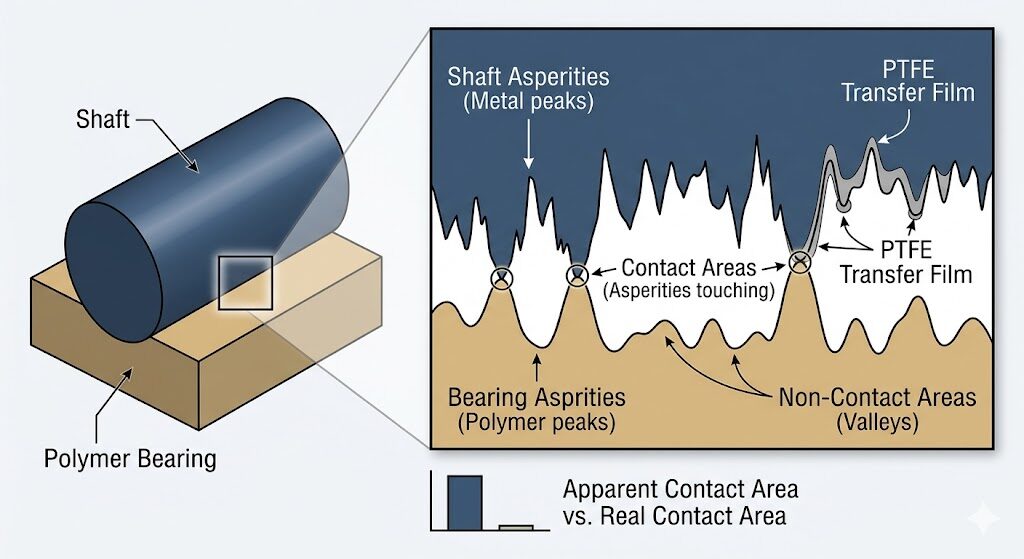
Steady-State Phase: The sheared polymer debris do not disappear. Rather, they get compacted into the valleys of the metal shaft’s surface. This process creates the transfer film. Once this film is fully established, the bearing is no longer rubbing against metal. Instead, it is rubbing against a thin layer of its own polymer material. Because polymer-on-polymer friction is exceptionally low, the wear rate drops dramatically, and the bearing can operate indefinitely without a need for external grease or oil, continuously replenishing the film as needed.

Key Polymer Materials (~150 words)

There are several polymers that have inherent self-lubricating properties due to their molecular structure, with no fillers or additives needed. Four of them are commonly used for plain bearings.

PTFE (Polytetrafluoroethylene)

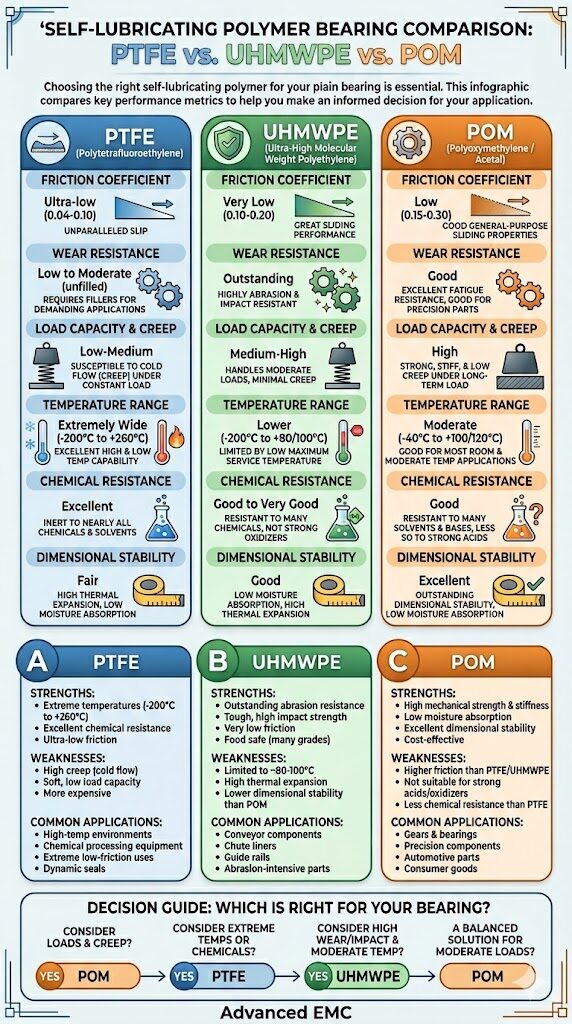
PTFE has a fluorine-carbon backbone with extremely weak intermolecular forces, giving it one of the lowest coefficients of friction of any solid material (μ ≈ 0.04–0.10). The downside of PTFE for bearings tends to be its poor wear resistance, low load capacity, and tendency to creep in its pure form. However, it is available as a bearing-grade polymer that possesses additives to enhance the strength, stiffness, and wear of unfilled PTFE without sacrificing its low friction and natural lubricity. These fillers include carbon fiber, bronze, and graphite.

UHMWPE (Ultra-High Molecular Weight Polyethylene)

UHMWPE is heavily used in extreme bearing, wear pad, and sliding applications in its virgin, unfilled state. While cross-linked or oil-filled versions exist for specialty uses, its natural abrasion resistance is so remarkably high that it rarely needs compounding to function as a heavy-duty wear surface. Its low friction, excellent toughness, and good wear resistance make it an excellent choice for ebarings, and it is widely used in food processing and orthopedic implants.

Bearing-Grade POM (Acetal/Delrin)

Bearing-grade POM is naturally slippery because of its smooth, crystalline surface and low surface energy. While it is not as low-friction as PTFE, it does offer better dimensional stability and is load-capable without any additives. Virgin POM is hard, slick, and makes an excellent light-duty bearing, but at higher speeds or loads, it can generate excess heat or squeal (caused by slip-stick). The most common bearing-grade acetal has about 10-20% PTFE fibers as an additive. These fibers effectively smear across the contact surface during operation. This further lowers the coefficient of friction and increases the limiting PV  value associated with virgin acetal.
Real-World Payoff

Using a self-lubricating plain polymer bearing eliminates the need for re-lubrication intervals, which leads to significant labor and downtime savings. In addition, self-lubricating bearings pose no issues with lubricant contamination, having a direct impact on product quality as well as compliance benefits. In addition, these beatings result in an extended service life in wet, abrasive, or chemically aggressive environments where oil-lubricated bearings fail rapidly. In fact, as an example, consider a conveyor bushing in a food plant. The voice of a lubrication-free bearing means operation exceeds the service life of traditional greased bronze bearings by 3x.

Conclusion

Self-lubricated plain bearings are a proven engineering solution to bearing lubrication issues, not a compromise. The combination of the right material with correct design and proper run-in can provide you with reliable oil-free operation. Advanced EMC encourages you to evaluate your highest-maintenance lubrication points as retrofit candidates for replacement with self-lubricating solutions. For more information on self-lubricating bearings, contact us today!
by Daniel Mays Daniel Mays No Comments

Polymer Bearings for Subsea Robotics: Surviving Pressure, Saltwater, and Zero-Maintenance Windows

The ocean floor remains one of the most unforgiving environments on Earth. Remotely operated vehicles (ROVs) and autonomous underwater vehicles (AUVs) descend thousands of meters to inspect pipelines, support offshore drilling, and conduct scientific surveys. And these ROVS do all of this in conditions that would destroy conventional mechanical components within hours, including bearings. For engineers designing subsea robotic systems, the question is never whether the environment will push the hardware to its limits. The question is whether the hardware is ready for it.

Bearings are among the most critical and vulnerable components in a subsea robot’s drivetrain, joint assemblies, and thruster systems. Make the wrong design choice here, and the entire mission fails. Make the right design choice, and you have a system that can run reliably at depth for extended deployments without ever surfacing for a service interval. Polymer bearings for subsea robotics are emerging as the answer for engineers who are finding that conventional metal bearings simply cannot provide the performance needed in the harsh environment beneath the ocean.

Pressure, Saltwater, and Maintenance-Free Operation

Subsea robotics engineers, whether they are designing robots for inspecting oil and gas pipelines or monitoring fish farms, face three specific challenges that conventional bearing materials are not designed to handle simultaneously: hydrostatic pressure, saltwater corrosion, and lubrication.

Hydrostatic pressure increases by roughly one atmosphere for every 10 meters (~32.8 ft) of depth. At 3,000 meters (~9840 ft), which is a routine working depth for deepwater inspection ROVs, the pressure exceeds 300 atmospheres. Metal bearings rely heavily on lubrication films and tight tolerances that can easily be compromised under such loads. Pressure-induced deformation, lubricant displacement, and housing distortion can all cause premature failure.

Saltwater corrosion is another relentless issue that must be addressed for successful bearing performance. Corrosion degrades surface finish, tightens clearances, and eventually seizes rotating assemblies entirely. Marine environments expose bearing surfaces to chloride ions, dissolved oxygen, and biological fouling. Steel bearings corrode; bronze bearings can undergo dezincification; and even stainless alloys remain vulnerable to crevice corrosion in low-oxygen zones.

Zero-maintenance windows may be the most operationally demanding constraint of all. A bearing on an offshore ROV working a deepwater site cannot be pulled, inspected, relubricated, or replaced on a daily basis. Many deployments run for weeks or months between topside recovery. Polymer bearings, such as those made from PEEK or PTFE composites, eliminate the need for periodic lubrication or adjustments, reducing operational costs and downtime, and ensuring continuous mission success because they are self-lubricating.

Polymer Bearings: Material Solutions for Subsea Demands

Bearing-grade polymer materials address all three of these challenges — pressure, saltwater, and maintenance-free operation — often simultaneously. Several proven engineering polymers stand out as solutions that can inspire confidence in subsea robotic applications.

PEEK (Polyether ether ketone) is the workhorse of high-performance polymer bearings in subsea use. It maintains exceptional dimensional stability even under hydrostatic loading, exhibits near-zero water absorption, and resists saltwater, hydraulic fluids, and most chemicals commonly encountered in offshore environments. Furthermore, PEEK bearings operate without external lubrication, drawing instead on the material’s inherently low friction coefficient. For ROV thruster assemblies and joint pivots, PEEK offers a compressive strength that approaches or exceeds many metal alloys while eliminating corrosion.

Filled PTFE successfully extends the lubrication-free advantage further. Unfilled PTFE is too soft for structural bearing applications, but glass-filled, carbon-filled, or bronze-filled PTFE delivers self-lubricating performance with meaningful load capacity and low friction. In slow-rotation or oscillating applications, such as the articulating arms of an inspection ROV, field PTfE bearings provide a smooth, stick-slip-free motion with no maintenance requirement and complete resistance to saltwater attack.

UHMWPE (Ultra-High Molecular Weight Polyethylene) brings outstanding impact resistance and surface toughness to applications where debris ingestion is a risk. Its extremely low coefficient of friction, combined with high chemical resistance and excellent fatigue life in wet environments, makes it well-suited for guide bearings and bushing applications in subsea manipulators and cable management systems.

Finally, Torlon (PAI, Polyamide-imide) is ideal for harsh, high-temperature, and high-load bearing applications where even PEEK approaches its limits. With excellent creep resistance and impressive compressive strength, Torlon-based bearings perform well in compact, high-load joint designs where space constraints are tight, and operating cycles are demanding.

Building Reliability Into Every Depth

The common thread across all of these materials is simple: each one removes a failure mode that metal bearings experience in the subsea environment. No corrosion, no lubrication intervals, dimensional stability under pressure, and compatibility with the full range of subsea fluids and cleaning agents are critical properties that high-performance polymers such as PEEK, filled PTFE, UHMWPE, and Torlon possess. 

For operators running extended deepwater missions, polymer bearings are not merely an alternative to metal bearings; they are the more reliable choice. Lower system weight, reduced drag on thruster assemblies, and the elimination of corrosion-driven maintenance costs all contribute to a lower total cost of ownership over the working life of AUVs and ROVs.

Ready to specify the right bearing material for your subsea robotic application? The bearing experts at Advanced EMC have strong expertise in bearing-grade polymers for even the most demanding marine and offshore environments. Contact Advanced EMC today to discuss your project requirements and get material recommendations backed by real engineering experience.