How labyrinth seals work is a subject that blends fluid dynamics, thermodynamics, and smart mechanical design. These non-contact sealing devices are engineered to control the flow of fluids or gases by utilizing a carefully designed path, thereby eliminating friction, direct contact, and the need for lubrication. Especially when made from advanced polymers like PEEK or PTFE, labyrinth seals offer a high-performance solution in applications ranging from cryogenic compressors to high-speed turbines.
In this article, we will examine how labyrinth seals operate, the scientific basis behind their unique effectiveness, the benefits they provide, and the optimal applications for these remarkably efficient sealing solutions.
What Is a Labyrinth Seal?
A labyrinth seal is a non-contact, tortuous-path sealing solution used to control leakage in rotating and reciprocating equipment. Unlike traditional contact seals that rely on mechanical interference to create a barrier, labyrinth seals use a series of grooves, teeth, or ridges that form a tight path for gases or fluids to follow. As the medium moves through this narrow, winding passage, its pressure and velocity drop sharply, reducing the likelihood of leakage.
There are multiple configurations, including radial, axial, and combined-flow labyrinth seals. These can be tailored to suit the specific application, whether the seal is integrated into a rotating shaft, compressor housing, or piston rod assembly.
Polymer labyrinth seals, such as those made from PEEK or PTFE blends, are gaining traction due to their low friction, high chemical resistance, and excellent performance in cryogenic and high-speed environments. They are ideal in applications where thermal expansion, corrosion, or dry running are concerns, such as in aerospace compressors, liquefied gas pumps, and medical devices.
The Science Behind Non-Contact Sealing
At the heart of how labyrinth seals work is a deceptively simple but highly effective principle: use geometry—not contact pressure—to control leakage. The seal’s internal structure forces fluids or gases to navigate a winding, narrow path filled with chambers, grooves, and ridges. As the medium traverses this tortuous route, it undergoes multiple sharp changes in direction and velocity, which induce turbulent flow and result in significant pressure drops across each cavity.
These pressure drops are key to reducing the driving force behind leakage. Instead of stopping flow outright—as contact seals attempt to do—a labyrinth seal gradually dissipates energy from the escaping medium until there’s not enough left to continue moving forward.
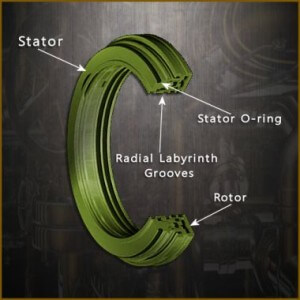
In rotating applications, the seal can also utilize centrifugal force to push fluids away from the shaft or axis of rotation, creating an additional barrier to leakage. In some designs, particularly those used in compressors and turbines, the grooves or teeth are machined to create swirl-inducing features that further resist forward flow.
When constructed from high-performance polymers, the effectiveness of a labyrinth seal is influenced by the material’s thermal expansion, dimensional stability, and surface finish. For instance, seals made from PEEK or PTFE must maintain tight tolerances to preserve the critical gap that ensures both minimal leakage and non-contact operation. Material selection also affects how well the seal performs under extreme temperature differentials, especially in cryogenic or high-vacuum environments where even minor thermal distortion can impact seal behavior.
Ultimately, labyrinth seals represent a shift from brute-force sealing to fluid dynamic control, making them a superior option where traditional contact seals fall short due to concerns about wear, friction, or contamination.
Advantages of Labyrinth Seals
One of the key advantages of labyrinth seals lies in their non-contact design. Because the seal does not rely on friction between moving parts to function, it eliminates wear from rubbing surfaces, which dramatically extends its service life, especially in high-speed or high-temperature environments. This also eliminates the need for lubrication, reducing system complexity and long-term maintenance costs.
Another significant benefit is the ability to operate under extreme conditions. Labyrinth seals made from polymers such as PEEK or PTFE can withstand wide thermal gradients, resist chemical attack, and maintain sealing performance even when exposed to cryogenic temperatures or dry-running conditions. These materials also offer excellent dimensional stability and low thermal expansion, which is critical in precision applications.
Additional advantages include:
- Low leakage with minimal energy loss: While not completely leak-proof, labyrinth seals offer an excellent balance of leakage control and energy efficiency, ideal for gas handling and rotating machinery.
- Contamination resistance: With no metal-on-metal contact or lubricants required, the risk of particulate generation or contamination is minimized. This makes them ideal for cleanroom, medical, and semiconductor environments.
- Versatility in design: Labyrinth seals can be tailored to a wide range of geometries, clearances, and performance targets. This allows engineers to optimize them for specific pressure differentials, rotational speeds, and media types.
Taken together, these benefits make labyrinth seals a compelling option for engineers who need reliable, maintenance-free sealing in demanding environments.
Limitations and Design Considerations
Despite their many advantages, labyrinth seals are not a one-size-fits-all solution. The very features that make them excellent for non-contact, low-maintenance sealing can also limit their suitability in specific applications.
A key limitation to consider is that labyrinth seals are not completely leak-tight, which is how they are designed to work. They are designed to significantly reduce flow—especially gases—but not eliminate it. This makes them unsuitable for sealing low-viscosity liquids under high pressure, where even minimal leakage can be problematic or dangerous.
Additionally, their performance is highly dependent on precise manufacturing tolerances. Maintaining the optimal clearance between rotor and stator elements is critical: too wide, and leakage increases; too tight, and there is a risk of contact during thermal expansion or shaft deflection. This makes proper design and installation crucial to long-term effectiveness.
Other key considerations include:
- Material selection: Polymer labyrinth seals must account for thermal expansion, chemical compatibility, and creep. PEEK and PTFE are popular due to their dimensional stability; however, the design must accommodate potential cold flow or softening at high temperatures.
- Environmental compatibility: While these seals excel in dry, clean environments, they may not be suitable for use where solids, particulates, or slurries are present. The small clearances can become clogged or abraded over time.
- Installation precision: Slight misalignments during assembly can compromise performance, especially in high-speed rotating systems. Advanced EMC emphasizes the importance of partnering with experienced sealing engineers to ensure proper design integration.
Conclusion
Understanding how labyrinth seals work reveals the remarkable power of precision engineering and fluid dynamics when combined with the right materials. These non-contact sealing solutions offer a unique combination of performance, longevity, and reliability, particularly in high-speed, high-temperature, or cryogenic applications where traditional seals often fail to meet expectations. While they aren’t ideal for every situation, their advantages make them a trusted solution across aerospace, industrial, and motorsports industries.
Suppose you’re looking for a sealing solution that can withstand your most demanding applications. In that case, Advanced EMC Technologies offers industry-leading expertise in polymer labyrinth seals, including custom designs in PEEK, PTFE, and other high-performance materials. Contact us today to find the proper labyrinth seal for your system. Let our engineering team help you seal in performance without compromise.