
Pitch and yaw bearings for wind energy applications need seals that keep grease in and contamination out for a 20-year lifespan. The catch is that every bit of contact force that makes a seal effective also makes it drag, and in pitch systems that drag loads the pitch motor and gear train directly. The real design question is not how much lip force is needed, but how to maintain that force for two decades without it creeping up or wearing down. That’s as much a spring selection question as a material one, and it’s the focus here.
Why a Spring Energizer is Needed
A conventional elastomer lip seal relies on interference fit and elastic squeeze for contact force, and holds up reasonably well as long as the rubber’s memory does. PTFE-based lips behave differently: virgin PTFE has excellent chemical/thermal stability and the lowest friction coefficient of any solid, but poor elastic recovery, and creeps (cold-flows) under sustained pressure. Fillers such as glass, bronze, carbon, or moly disulfide reduce creep and improve wear resistance but do not provide spring-back as rubber does. Once a filled PTFE lip has taken a compression set or worn down, it stays that way.
Relying on the PTFE itself to maintain lip force through 20 years of thermal cycling and wear is the wrong approach. That is the job a mechanical spring energizer is built for.
How a Spring-Energized Seal Solves the Retention Problem
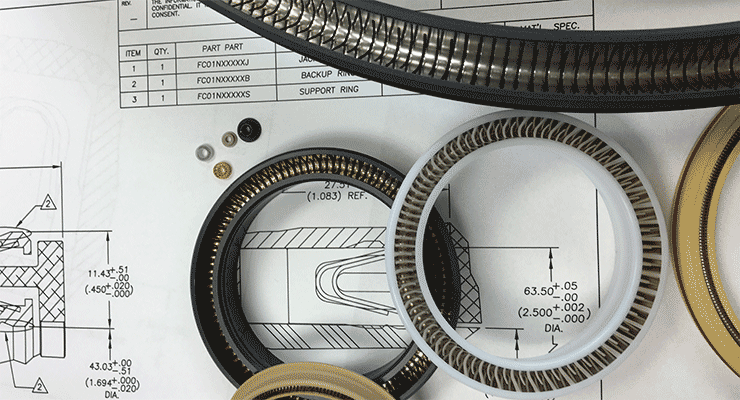
A spring-energized PTFE seal separates the sealing surface from the sealing force. The PTFE (or filled PTFE) jacket provides the low-friction contact surface; a precision metal spring seated inside it provides and maintains the contact force, independent of the polymer’s mechanical behavior. Because the spring carries the sustained load, it can deliver a nearly constant force across a wide deflection range and resist compression set almost entirely, which answers the 20-year question. The seal keeps compensating for jacket wear, misalignment, out-of-roundness, and eccentricity as they accumulate, rather than losing contact force as a plain PTFE lip does.
Three Spring Geometries, Three Different Jobs
Advanced EMC builds spring-energized seals with three spring geometries, each suited to different motion and friction requirements:
- Cantilever (“V” or “M”) spring: offers a moderate load and deflection range, with a positive wiping action at the lip’s front edge. Well suited where the seal also needs to scrape out abrasive contamination off the shaft or race.
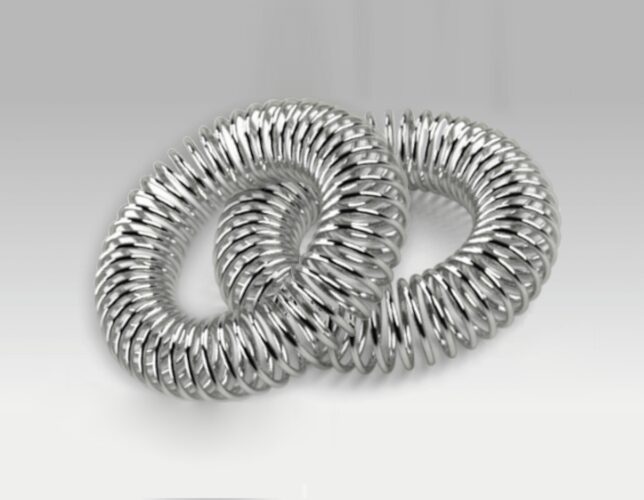
- Canted coil (“W”/slant coil) spring, including Advanced EMC’s proprietary FlexForce design: provides a wide deflection range with a flat, relatively constant load curve, and correspondingly tight, predictable control of friction and torque. Wind industry literature points to this geometry specifically for pitch-drive gear seals. Each coil deflects independently, so canted coil springs also resist compression set well over long dwell periods.
- Helical spring: offers a low deflection range and high unit load, and is used where the seal is essentially static or very slow-moving, and friction is not the limiting factor.

Matching Spring Geometry to Pitch vs. Yaw Duty
Pitch bearings oscillate slowly through a limited arc, reverse direction often, and sit through long dwell periods. Every bit of lip drag shows up as torque the pitch motor and gearbox must overcome, so friction predictability matters most. A canted coil spring is generally the better fit because its flat load curve keeps friction stable through dwell and reversal cycles, rather than relying on the PTFE’s own memory.
Yaw bearings rotate more continuously over a larger diameter, and onshore yaw seals often see more dust and grit than pitch seals buried in the hub. A cantilever spring, especially with a scraper-lip profile, often makes more sense here because the wiping action helps exclude contamination, and the slightly higher friction is easier to tolerate on a larger, more continuously rotating bearing.
The Spring Alloy Is Not an Afterthought
The spring geometry solves mechanical retention; the spring alloy solves corrosion and temperature exposure, and getting it wrong reintroduces the failure mode the spring was meant to eliminate. Stainless steel is the default for general-purpose duty. Hastelloy’s nickel-based chemistry is the step up for aggressively corrosive media. Elgiloy’s fatigue and corrosion resistance suit combined heat and salt-laden exposure, which is a real consideration offshore. Advanced EMC offers all three, plus other high-performance alloys, for FlexForce springs.
The Honest Tradeoffs
A spring energizer is not a free upgrade. It adds design variables, namely geometry and alloy, that must both be specified and qualified correctly. The gland or housing must be sized for the spring’s working deflection range, so a spring-energized seal generally is not a drop-in replacement for a housing designed around a standard lip seal. And it does not solve which PTFE compound should sit at the jacket face contacting grease and the shaft or race for two decades. That is a separate material question, covered in our companion article on jacket material selection.
Talk to a Sealing Engineer
If you are specifying seals for pitch or yaw bearings and need 20-year performance without a rising friction penalty on the pitch motor, Advanced EMC can help with spring geometry and alloy selection for your duty cycle. Contact us today to talk through FlexForce canted coil spring options with a sealing solutions engineer.