
by Sara McCaslin, PhD Sara McCaslin, PhD No Comments

How Spring Selection Defines Spring-Energized Seal Performance

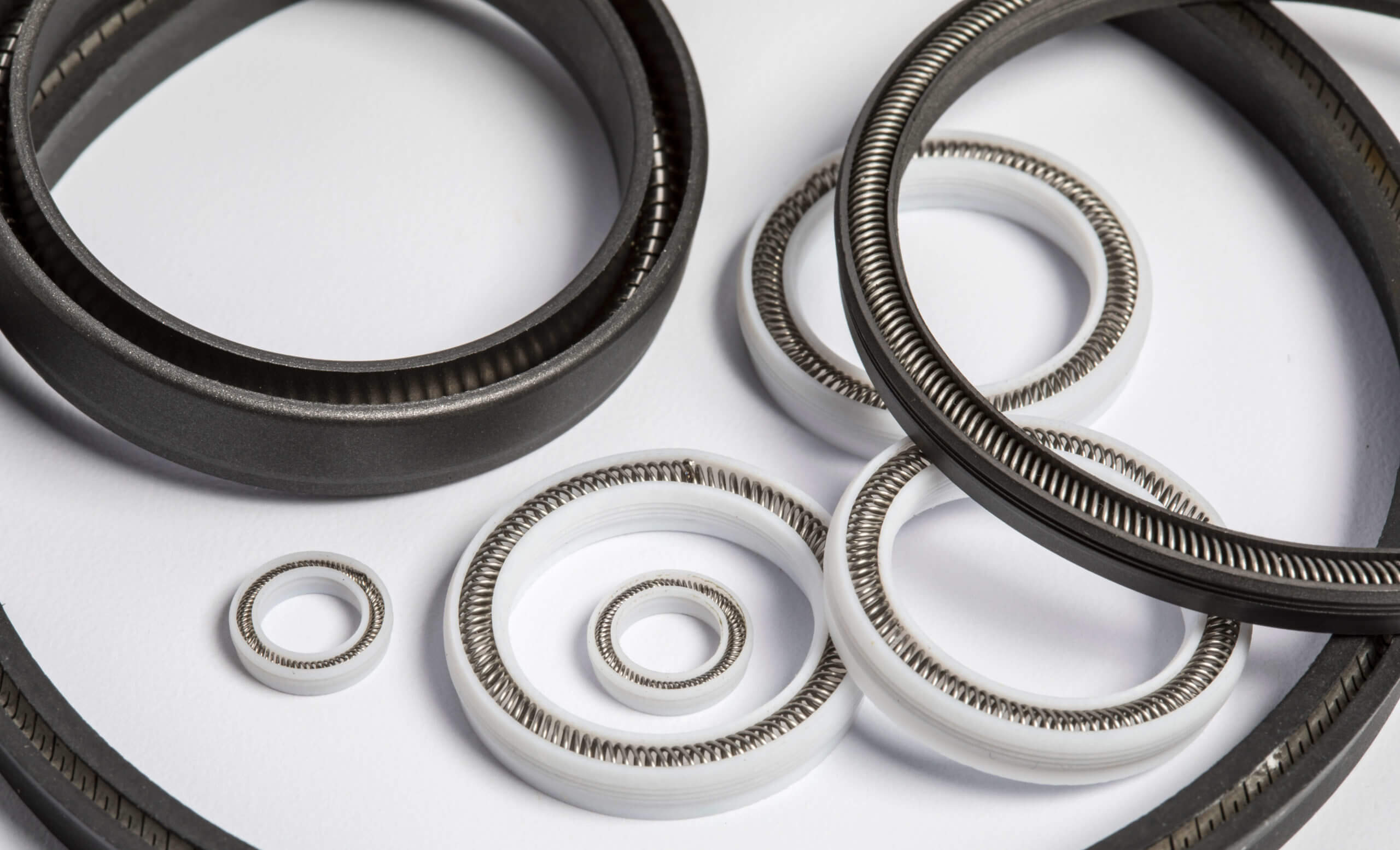
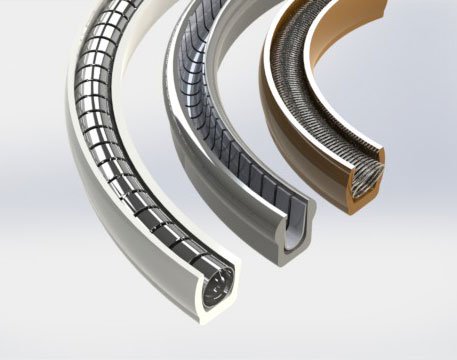
Most failures blamed on PTFE actually originate in the spring. This blog post discusses the load-management system and key features of spring-energized seals for canted coil springs, V springs, cantilever springs, helical springs, and coil springs.

Canted Coil Springs (Slant Coil Springs)
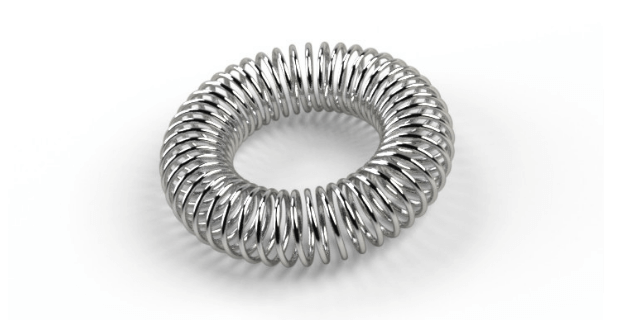
Canted Coil Springs and Slant Coil Springs from Advanced EMC Technologies

These springs are wound so that individual coils are set at an angle to the longitudinal axis. They are highly versatile and often used for dynamic sealing applications. Their key feature of canted coil springs is the flat load curve they provide. These spring energizers generate a nearly constant force across a wide deflection range. The constant force allows precise control over friction and torque, making these spring energizers ideal for applications where these factors are critical. Canted coil springs are also unlikely to experience compression set.

Canted coil spring energizers work best in moderate to high-speed rotary applications. Beyond sealing, their unique design allows them to serve as mechanical connectors (latching/locking), EMI/RF shields, and multi-point electrical conductors.

V Springs (V Ribbon Springs)

The V spring is a general-purpose, cantilever-type energizer. They offer an excellent balance of performance and cost-effectiveness. In addition, V springs provide a moderate load over a wide deflection range. They function well in both static and dynamic applications, including those involving rotary or reciprocating motion.

V springs are frequently recommended for severe service conditions, including vacuum pressures and cryogenic temperatures. V spring energizers are often a preferred choice for harsh operating environments.

Cantilever Springs (Finger Springs)

Often referred to as finger springs, these spring energizers feature a V-shaped cross-section and are distinguished by a linear load curve, meaning the force increases linearly with deflection.

The load is concentrated at the very front edge of the seal lip, which provides positive wiping action and makes them particularly effective for exclusion and scraping applications. They also generate extremely low friction.

Cantilever spring energizers are well-suited for sealing viscous media. They are typically found in low to medium-speed applications, such as hydraulic cylinders, pumps, compressors, and shocks.

Helical Springs (Helical Flat / Compression Springs)

Helical springs consist of a wound ribbon of metal and are characterized by a high load-versus-displacement curve. Because they produce a very high unit load with a small deflection range, helical springs provide tight, reliable sealing. They are well-adapted for sealing light gases and liquids.

Helical springs are generally limited to static, slow-dynamic, or intermittently dynamic applications because friction and wear are less of a concern than seal reliability. These spring energizers are often used in pipe flanges and crush jackets where the seal must embed into surface irregularities. Experts highly recommend helical configurations for cryogenic applications.

Coil Springs (Spiral Pitch Springs)

When many people visualize a spring-energized seal, they picture this wire coil type. These spring-energizers actually perform best in high-pressure, medium-speed applications and are known for their low friction. 

Spring Materials

The performance of spring-energizers is also dependent on the material selection. The material selection is primarily determined by the chemical and thermal environments involved. At Advanced EMC, we recommend one of the following spring materials: 

  • Stainless Steel (300 Series, 17-7 PH, 301/304): Common for general-purpose and cryogenic applications
  • Hastelloy: Recommended for highly corrosive media
  • Elgiloy: Used for high heat, corrosive environments, and salt water
  • Inconel: Used in severe environments and cryogenic applications
Conclusion

When spring-energized seals fail, the problem is often not the jacket, but the spring. Knowing about load consistency, deflection behavior, and how that force is delivered over time is key to deflection, friction, wear, and whether a seal actually survives its operating environment.

At Advanced EMC, spring-energized seals are engineered as complete systems, not just components. Our team will assist you from spring selection to geometry and material pairing, aligning the seal design with real-world conditions. If you are troubleshooting a failure or designing for demanding service, contact Advanced EMC today.
by Sara McCaslin, PhD Sara McCaslin, PhD No Comments

Polymer Seals in Food and Dairy Applications: Challenges for Engineers

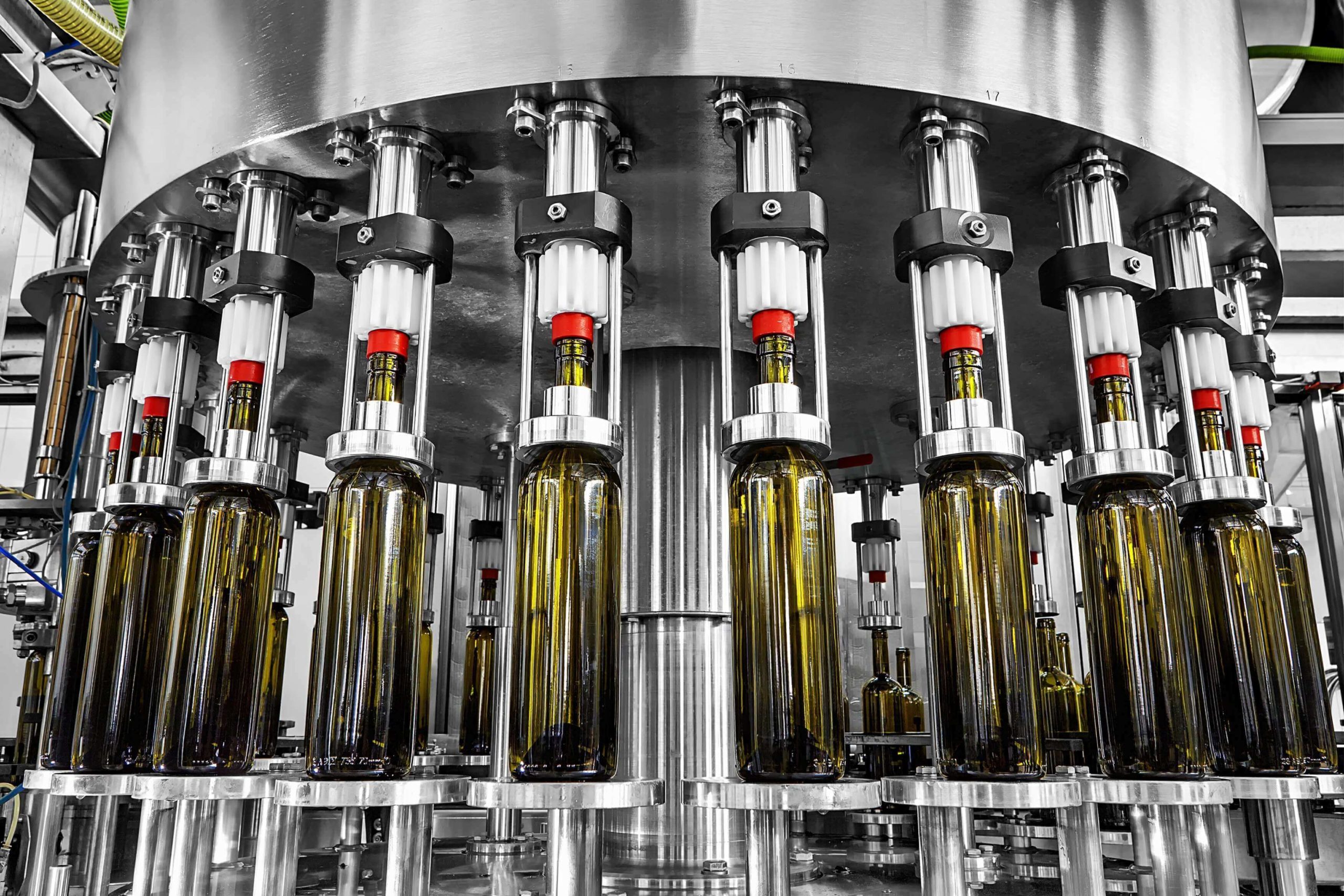
There are numerous challenges associated with polymer seals for the food and dairy industries, and the complications are numerous. From hygiene by design and zero tolerance for contamination to the unbelievably high cost of recalls, to temperature swings and moisture issues, engineers put in a significant amount of work to ensure that polymer seals are designed and specified correctly. 

This blog post will explore the challenges and discuss solutions to each one.

Challenge 1: Surviving sanitation cycles (CIP/SIP)

CIP (Clean In Place) and SIP (Sanitize In Place) are harsh on seals and can involve repeated exposure to hot caustics, oxidizers, steam, and sometimes UV radiation. Additionally, the thermal spikes that often accompany CIP/SIP can lead to dimensional issues due to expansion and contraction. Issues with moisture absorption during the sanitation cycles are also a major problem.

Engineers need to consider the chemical intertness of the polymer chosen, as well as dimensional stability through temperature changes and low moisture absorption. Materials such as PTFE and UHMW-PE are an ideal choice for addressing these issues. They can retain key properties across cryogenic to steam conditions and withstand the most common CIP/SIP chemicals. Finally, PTFE is stable under exposure to UV used for sanitation.

Challenge 2: Chemical compatibility with cleaners and barrier fluid

Some of the common chemicals that are used to clean food and dairy equipment include . . .

  • Alkaline cleaners (such as sodium hydroxide-based)
  • Acidic cleaners (such as phosphoric or nitric acid) 
  • Oxidizing agents like sodium hypochlorite (bleach) or peracetic acid 
  • Quaternary ammonium compounds (quats)

These chemicals can lead to various issues, depending on the material used for the seal, including softening, hardening, and cracking. However, PTFE and UHMW-PE are minimally reactive to such chemicals.

Challenge 3: Contamination control and lubricant management

In the food and dairy industry, any external lubricant can become a contaminant; even “food-grade” oils complicate HACCP plans. This severely limits the type of polymers that can be used for seals; however, PTFE and UHMW-PE are both self-lubricating and can handle dry running.

Challenge 4: Moisture, swelling, and dimensional drift

Hot washdowns and steam can drive steam into hygroscopic materials, which leads to swelling and dimensional drift that can, in turn, cause compression and changes in clearances. PTFE and UHMW-PE exhibit negligible moisture absorption, which enhances fit and facilitates improved leak control after washdown. 

Challenge 5: Abrasion and scratch avoidance on product-contact surfaces

Product-contact surfaces must stay as free as possible of abrasions and scratches because such surface imperfections can trap microbes and residues. For this reason, surfaces must be durable, smooth, and easy to clean. UHMW-PE offers exceptional abrasion resistance while remaining gentle to mating surfaces, and PTFE has a very low surface energy that effectively sheds debris.

Challenge 6: Wear life and unplanned downtime

When seals fail, there is a much higher risk of contamination and increased downtime. Both are expensive to deal with. PTFE and UHMW-PE both exhibit excellent wear resistance, which can extend service life and reduce the frequency of unplanned downtime. 

Challenge 7: Taste, odor, and extractables

Some polymers leach flavors or odors into sensitive products, which is unacceptable in the food and dairy industry. However, both PTFE and UHMW-PE do not impart any taste or odor, and are non-toxic, making them an ideal solution to this challenge.

Challenge 8: Compliance and hygienic standards

Finally, engineers must navigate the FDA, 3-A Dairy, and customer audits while balancing performance and cost. Fortunately, PTFE and UHMW are available in FDA-compliant grades and are used in 3-A Dairy-compliant designs.

PTFE vs. UHMW-PE Seals in Food and Dairy Applications

Here is a table to help you choose between PTFE and UHMW-PE for polymer seals in the food and dairy industry.

If Your Primary Concern Is…Choose:Reason
Aggressive chemicals, oxidizers, or caustic CIP/SIP agentsPTFEUnmatched chemical inertness and high-temperature stability
Steam sterilization or UV sanitationPTFEHandles heat and radiation without degradation
Abrasion, impact, or misalignmentUHMW-PEExcellent toughness and wear resistance
Cost-effective wear surfaces in moderate cleaning regimesUHMW-PEEconomical and durable for non-critical seals
Low friction, precision dynamic sealingPTFEVery low coefficient of friction and dry-running capability
Hygienic, FDA / 3-A compliant designEitherBoth are available in food-grade, non-contaminating formulations

Solutions for Polymer Seals in Food and Dairy Applications

There are several challenges engineers face when designing for food and dairy designs. However, the right choice of material can address many of these issues, and both PTFE and UHMW-PE are popular choices.  

The experts at Advanced EMC are here to help you find the right sealing solution, from the type of seal you need to the best material for your food and dairy applications. Contact us today to learn more!