
Once a spring energizer is handling contact-force retention in a pitch or yaw bearing seal (see our companion article on spring selection), there remains a second decision left: which PTFE compound forms the sealing face. The jacket contacts grease and the shaft or race for 20 years, and the spring offers nothing in terms of wear resistance, chemical compatibility, or heat handling there. That is the focus of this article.
What the Spring Energizer Does Not Fix
A spring energizer solves the elastic-recovery and compression-set problem: it keeps the jacket pressed against the shaft or race at steady force regardless of what the PTFE is doing mechanically. It does not change how the jacket wears, handles frictional heat, or holds up against grease and contamination. Virgin PTFE has the lowest friction coefficient of any solid and excellent chemical/thermal stability, but limited wear resistance over millions of cycles. That is what fillers are for, and selecting the right one for pitch versus yaw is where most of the engineering judgment lives.
Filled PTFE vs. Composite/Laminate
Two terms get conflated and are worth separating. Particulate-filled PTFE refers to glass fiber, bronze, graphite/carbon powder, PEEK, or moly disulfide (MoS₂) blended into the PTFE matrix, changing its wear and creep behavior. Composite/laminate lip designs differ: a PTFE or filled-PTFE face is bonded onto a fabric-reinforced or elastomer-backed carrier, where the elastomer provides spring force and elastic recovery while the PTFE face provides low friction.
In a design that already uses a mechanical spring, the elastomer-backed laminate approach is largely redundant. The spring already provides the resilience that the elastomer carrier would otherwise provide. This is why spring-energized jackets are almost always filled, not laminate, PTFE: the jacket only needs to be optimized for friction, wear, and chemical compatibility.
Disambiguating “Carbon”
“Carbon” in a filled-PTFE context can mean graphite/carbon powder as a solid lubricant, or carbon fiber as structural reinforcement, which happen to be opposite jobs. Advanced EMC’s carbon grade (Fluorolon 1034, 23% carbon/2% graphite) is the former: a lubricity filler, not a fiber reinforcement, and worth confirming before assuming “carbon-filled” means stiffness gains.
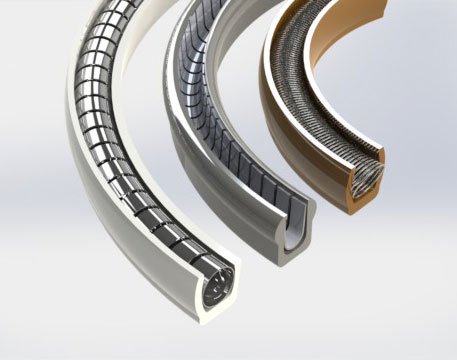
Matching Fill Type to Pitch vs. Yaw Conditions
Bronze adds weight and corrosion exposure; glass fiber increases friction; moly trades load capacity for lubricity. Engineers should also rule out fillers too abrasive for the mating shaft or race up front.
Why PV Data Does Not Transfer Between Pitch and Yaw
PV limit data for filled PTFE is typically generated on continuously rotating rigs and does not translate directly to pitch service. Pitch bearings oscillate through a limited arc with long dwell periods, putting the interface into a boundary-lubrication regime a continuous-rotation curve is unable to capture. The film on a rotating shaft re-establishes itself with each revolution; it does not reform in the same way during slow oscillation. This is also behind fretting damage in pitch-bearing raceways, where lubricant is pushed out of contact, and metal-to-metal wear takes over. Yaw duty is closer to how PV data is generated, but ask suppliers for oscillating-duty data before specifying a pitch compound off continuous-rotation numbers.
Manufacturing Realities
Filled PTFE costs more than a standard elastomer lip, mostly due to process rather than material. It is compression-molded and machined to final geometry rather than injection-molded. Keep in mind that PTFE never becomes a flowable melt even above its melting point, so injection molding is not an option; manufacturing drives most of the added cost.
It also demands tighter process control: uneven filler dispersion creates local wear/friction variation, and sintering drift shifts finished properties. Vetting a supplier’s process capability matters as much as the filler choice.
Talk to a Sealing Engineer
If you’re specifying a PTFE jacket material for a spring-energized pitch or yaw bearing seal, Advanced EMC’s Fluorolon compounds cover the fill types listed above and are matched to your grease chemistry, contamination profile, and duty cycle. Contact us today to talk through jacket material selection and see our companion article on spring geometry and alloy selection for the other half of the design.