

by Sara McCaslin Sara McCaslin No Comments

Selecting a PTFE Jacket Material for Spring-Energized Wind Turbine Seals

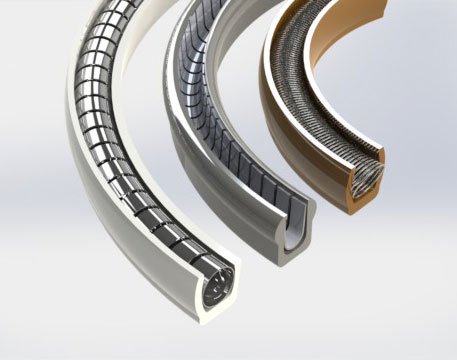
Once a spring energizer is handling contact-force retention in a pitch or yaw bearing seal (see our companion article on spring selection), there remains a second decision left: which PTFE compound forms the sealing face. The jacket contacts grease and the shaft or race for 20 years, and the spring offers nothing in terms of wear resistance, chemical compatibility, or heat handling there. That is the focus of this article.

What the Spring Energizer Does Not Fix

A spring energizer solves the elastic-recovery and compression-set problem: it keeps the jacket pressed against the shaft or race at steady force regardless of what the PTFE is doing mechanically. It does not change how the jacket wears, handles frictional heat, or holds up against grease and contamination. Virgin PTFE has the lowest friction coefficient of any solid and excellent chemical/thermal stability, but limited wear resistance over millions of cycles. That is what fillers are for, and selecting the right one for pitch versus yaw is where most of the engineering judgment lives.

Filled PTFE vs. Composite/Laminate

Two terms get conflated and are worth separating. Particulate-filled PTFE refers to glass fiber, bronze, graphite/carbon powder, PEEK, or moly disulfide (MoS₂) blended into the PTFE matrix, changing its wear and creep behavior. Composite/laminate lip designs differ: a PTFE or filled-PTFE face is bonded onto a fabric-reinforced or elastomer-backed carrier, where the elastomer provides spring force and elastic recovery while the PTFE face provides low friction.

In a design that already uses a mechanical spring, the elastomer-backed laminate approach is largely redundant. The spring already provides the resilience that the elastomer carrier would otherwise provide. This is why spring-energized jackets are almost always filled, not laminate, PTFE: the jacket only needs to be optimized for friction, wear, and chemical compatibility.

Disambiguating “Carbon”

“Carbon” in a filled-PTFE context can mean graphite/carbon powder as a solid lubricant, or carbon fiber as structural reinforcement, which happen to be opposite jobs. Advanced EMC’s carbon grade (Fluorolon 1034, 23% carbon/2% graphite) is the former: a lubricity filler, not a fiber reinforcement, and worth confirming before assuming “carbon-filled” means stiffness gains.
Matching Fill Type to Pitch vs. Yaw Conditions

Fill TypeKey BenefitTradeoffBest-Fit Duty
Glass fiber (Fluorolon 1015/1025)Abrasion resistance, dimensional stabilityHigher friction; can itself abrade the mating surfaceDusty/sandy onshore sites; yaw seals exposed to grit;  pair with a hardened or coated shaft/race
Bronze (Fluorolon 1028)Highest load capacity and thermal conductivity of common fills; 40% bronze loading roughly doubles PTFE’s thermal conductivityLower corrosion resistance; heavierYaw systems with higher duty-cycle heat buildup
Moly disulfide (Fluorolon 1017)Self-lubricating, less abrasive than glass, good grease compatibilityLower load capacity than bronze or glass-filled gradesPitch bearings;  slow oscillation, long dwell periods
Carbon/graphite (Fluorolon 1034)Wear resistance and reduced creep, dry or wet serviceBlend is a lubricity filler, not stiffness reinforcement; friction runs slightly higher than moly aloneHigh-speed or continuous-duty shaft seals
Polyimide (Fluorolon 1058)Best creep resistance of common fills; very low wear even dry-runningCostly; narrower supplier basePitch bearings needing dry,long-dwell service
PEEK-basedRetains stiffness and wear resistance where PTFE softens and creepsNot a PTFE filler; a separate PEEK-based material family; costlier, harder to form thinHigh-value offshore installs where switching material families is justified

Bronze adds weight and corrosion exposure; glass fiber increases friction; moly trades load capacity for lubricity. Engineers should also rule out fillers too abrasive for the mating shaft or race up front.

Why PV Data Does Not Transfer Between Pitch and Yaw

PV limit data for filled PTFE is typically generated on continuously rotating rigs and does not translate directly to pitch service. Pitch bearings oscillate through a limited arc with long dwell periods, putting the interface into a boundary-lubrication regime a continuous-rotation curve is unable to capture. The film on a rotating shaft re-establishes itself with each revolution; it does not reform in the same way during slow oscillation. This is also behind fretting damage in pitch-bearing raceways, where lubricant is pushed out of contact, and metal-to-metal wear takes over. Yaw duty is closer to how PV data is generated, but ask suppliers for oscillating-duty data before specifying a pitch compound off continuous-rotation numbers.

Manufacturing Realities

Filled PTFE costs more than a standard elastomer lip, mostly due to process rather than material. It is compression-molded and machined to final geometry rather than injection-molded. Keep in mind that PTFE never becomes a flowable melt even above its melting point, so injection molding is not an option; manufacturing drives most of the added cost.

It also demands tighter process control: uneven filler dispersion creates local wear/friction variation, and sintering drift shifts finished properties. Vetting a supplier’s process capability matters as much as the filler choice.

Talk to a Sealing Engineer

If you’re specifying a PTFE jacket material for a spring-energized pitch or yaw bearing seal, Advanced EMC’s Fluorolon compounds cover the fill types listed above and are matched to your grease chemistry, contamination profile, and duty cycle. Contact us today to talk through jacket material selection and see our companion article on spring geometry and alloy selection for the other half of the design.

by Daniel Mays Daniel Mays No Comments

Hytrel: A Deep Dive into Its Properties and Applications

Hytrel, a thermoplastic polyester elastomer (TPE) from DuPont, provides an excellent balance between flexibility and strength. Seal engineers know that if a seal is too rigid, it responds to changes in motion or pressure. Too soft, and it fails under heat or chemical attack. And that’s where Hytrel, a thermoplastic polyester elastomer (TPE) from DuPont, finds its niche as it bridges the gap between rubber-like elasticity and plastic-like toughness.

If you are looking for a material that resists fatigue, survives dynamic loads, and endures challenging fluids, then it is time to take a deep dive into Hytrel. This article looks at the science behind it, the different grades available, and where it works best. 

Understanding Hytrel: Structure, Chemistry, and Properties

Hytrel is a block copolymer comprised of alternating hard (polybutylene terephthalate) and soft (polyether) segments. This unique molecular structure type offers excellent versatility, as the hard segments provide mechanical strength, creep resistance, and dimensional stability. In contrast, the soft segments contribute elasticity, impact resistance, and low-temperature flexibility.

Engineers value Hytrel for properties such as:

  • Excellent flex fatigue resistance and rebound resilience, with the ability to flex in multiple directions
  • Wide operating temperature range (cryogenic to +315°F), depending on the grade
  • Very strong chemical resistance to media, including solvents, oils, fuels, and hydraulic fluids
  • An excellent combination of high wear resistance and low compression set
  • Good creep resistance

Additionally, it retains its mechanical properties even at high temperatures and remains flexible even at low temperatures.

Hytrel components can be manufactured in a number of different ways, including thermoplastic processing, extrusion, melt casting, rotational molding, blow molding, and injection molding.

There are two grades of Hytrel available: standard grades, which are the most economical and strike an excellent balance between cost and performance, and high-performance grades, which are ideal for environments where issues like abrasion and tear can be problematic. Each of these grades have ranges of hardness and elastic modulus, all achieved by varying the ratio of soft to hard segments in the molecular structure.

Grades of Hytrel

There are various grades of Hytrel, some of which are summarized here.

Hytrel 4056

This grade offers an excellent combination of toughness and strength over a considerably wide temperature range. It works extremely well for low-temperature and cryogenic applications that require a material that is able to retain flexibility. 

Hytrel 4068 and Hytrel 4069

Both grades offer good flex-fatigue and creep resistance combined with outstanding low-temperature properties. And they can be formed using molding or extrusion. They have a higher melting point and lower elastic modulus than 4056. In addition, there is a food-grade material available: Hytrel 4068FG.

Hytrel 4556

4556 is similar to grades 4068 and 4069, with a low-to-medium elastic modulus. This grade works extremely well for seals and gaskets.

Hytrel 5526 and Hytrel 5556

In terms of general properties, these particular grades provide a good balance. Its flow properties, however, primarily limit it to injection molding and extrusion as the manufacturing method. They also offer a balance of properties with a medium modulus.

Hytrel 4053FG NC010

When food contact grade seals are needed, 4053FG NC010 may be an option. This grade has a low modulus extrusion, and its properties include flex-fatigue resistance, creep resistance, and good low-temperature properties. 

Engineering with Hytrel: Applications and Design Considerations

There are several applications where Hytrel offers excellent performance, starting with sealing for dynamic applications.

Dynamic Sealing

It performs extremely well in reciprocating and rotary seals where flexibility and abrasion resistance are critical. In fact, its ability to recover quickly after deformation reduces leakage in spring-energized and lip seal designs.

Harsh Chemical and Thermal Environments

It’s excellent resistance to fuels, hydraulic oils, and cleaning solvents makes it a solid choice for automotive, aerospace, and industrial systems. Although it is not as inert as PTFE, it still outperforms many rubbers and urethanes in aggressive chemical environments.

Manufacturing and Compatibility

Because Hytrel is a thermoplastic, it can be welded, machined, or molded with high precision. In addition, it bonds well to certain metals and other polymers, making it ideal for multi-material seal assemblies.

Specific Applications

Here is a sample of just some of the applications where it excels:

  • Chassis Suspension Systems
  • Thermoplastic Tubing and Elastomeric Hose
  • Innovative Furniture Design
  • Medical Device Materials
  • Sustainability in Airbag Systems
  • Plastics For Sporting Goods
  • Cable Insulation and Jacketing
  • Polymers for Oil and Gas
  • Food Contact Materials
  • Seals and Gaskets

Limitations

Even with the excellent performance it offers, Hytrel does have limitations. For example, prolonged exposure to hot water or steam can degrade performance, and certain polar solvents may affect long-term durability. In addition, Hytrel does not work well in environments with continuous exposure to aggressive chemicals such as strong acids or halogens, and this is especially true at high temperatures.

Conclusion

Hyrtrel provides a solid middle ground between flexible rubber and rigid polymer solutions. Its resilience, fatigue life, and processability make it a go-to choice for demanding environments. Its balance of strength and elasticity will translate into longer service life, better energy efficiency, and reliable performance under real-world stress.

At Advanced EMC Technologies, we understand that every design challenge requires the right material match. Our engineering team works closely with clients to design Hytrel-based component solutions optimized for temperature, pressure, and chemical exposure. Contact Advanced EMC today to discuss how Hytrel can elevate the performance of your next sealing system.