
by Sara McCaslin Sara McCaslin No Comments

Kynar (PVDF) vs. PTFE: Choosing the Right Fluoropolymer for Fluid Handling Seals


A specification that simply calls out “flouropolymer” is quite incomplete. PVDF and PTFE are both fluoropolymers and grouped under that umbrella term, but they are quite different. When it comes to mechanical and chemical behavior, specifying the wrong material can lead to premature seal failure and expensive downtime. The objective of this blog post is to provide a clear, practical basis for determining which material is the most appropriate.

How PVDF and PTFE Are the Same

Both PVDF (Kynar) and PTFE (Teflon) resist a broad range of acids and solvents, and both handle highly elevated temperatures better than elastomers. They also share low coefficients of friction, low surface adhesion, and non-stick properties. And both have their own specialties in fluid-handling applications.

Where PVDF Pulls Ahead of PTFE 

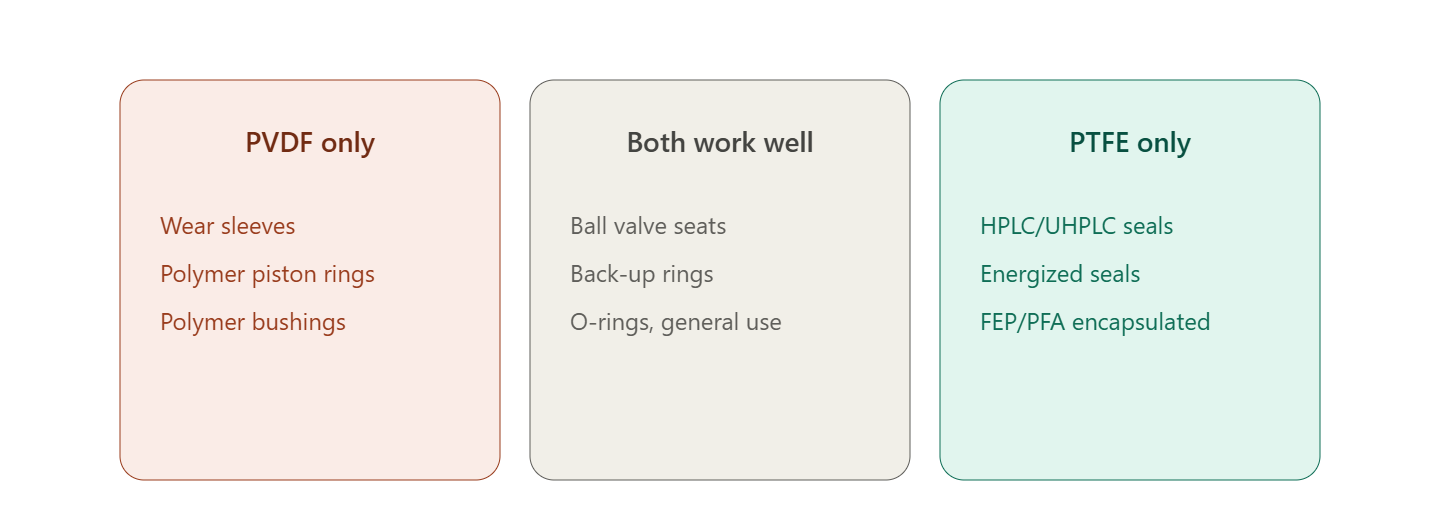
PVDF (Polyvinylidene Fluoride) has distinct advantages over PTFE (Polytetrafluoroethylene). It exhibits better mechanical strength than PTFE (by about 2-3x) and has excellent abrasion resistance, which means it can hold up better under slurry or particulate-laden fluid flow. Wear resistance is another property of PVDF that excels over PTFE, especially in dynamic seal contact, such as wear sleeves and piston rings.  It also exhibits lower cold flow and creep under compression, which is very important for seal performance over time under sustained load. 

Finally, PTFE might be more expensive than the equivalent PVDF stock. While PTFE stock is inexpensive, PVDF is melt-processable. Being melt-processable can make PVDF vastly more cost-effective for high-volume molded parts.

Where PVDF Loses Against PTFE

PTFE has an extremely low coefficient of friction compared to PVDF (0.04-0.10 vs. 0.15-0.30). And in the presence of high-pH caustics and strong bases, PTFE performs without issue, whereas PVDF begins to degrade. There are also polar solvents, amines, fuming acids, and some ketones that attack PVDF’s chemical structure and polymer chain. PVDF’s chemical resistance chart has real gaps where PTFE’s is closer to “resistant to everything below its temp limit.” Always check material compatibility at your actual operating temperature, not ambient temperature. It is a fact that many “resistant” ratings degrade at elevated temperatures.

PVDF vs PTFE – Who Wins?

The table below summarizes the similarities and differences between PVDF and PTFE.
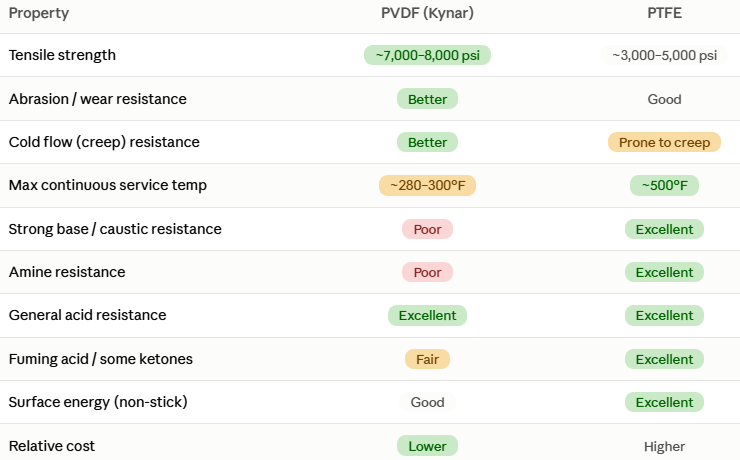
*Values are approximate; exact values are based on material grade and blend

* PVDF: Lower for high-volume molding; PTFE: Lower for machined stock

Decision framework

Here is a checklist for fluid handling engineers choosing between PVDF and PTFE:

  1. What’s touching the seal? Check for a strong base or problem solvent first; if it is present, PTFE wins outright
  2. Is there abrasive/particulate content or high dynamic wear? If so, lean toward PVDF if  the compatibility allows
  3. Is the seal under sustained compressive load where creep matters? If so, lean toward PVDF
  4. Static seal, clean chemistry, wide chemical exposure risk (multi-product lines, CIP/COP)? PTFE is the safer default.

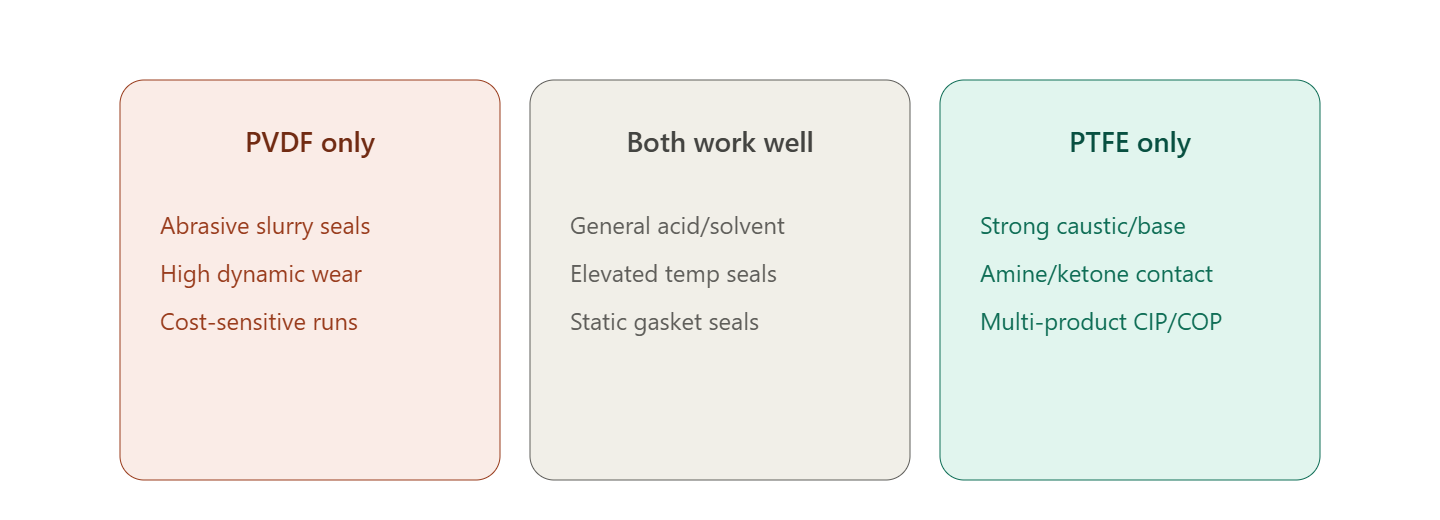
The figures below show examples of where each material performs best.
Conclusion

Borderline cases with mixed process streams, elevated-temperature caustics, or unusual solvent blends are exactly where a materials engineer should get involved before committing to tooling. It is always cheaper to change a decision on paper than after seals are cut. Advanced EMC is here to help you choose the right material and seal for your fluid-handling challenges. And keep in mind that Advanced EMC offers several material options if neither material is a fit.


by Daniel Mays Daniel Mays No Comments

Applications for Kynar in Aerospace

In applications involving aircraft or space flight, selecting the right materials ensures performance and reliability under extreme conditions.  Because of its special properties, engineers have found many applications for Kynar in aerospace. 

Kynar, a highly durable fluoropolymer, is known for its exceptional chemical resistance, thermal stability, and ease of manufacturing. This blog post explores why Kynar has become a go-to for aerospace components, emphasizing its unique properties that make it easy to produce and reliable in demanding environments.

What is Kynar?

PVDF (Polyvinylidene Fluoride) has several trade names, including Kynar (Arkema), KF (Kureha), and Solef or Hylar (Solvay), although it is typically referred to as PVDF. It is a semi-crystalline fluoropolymer developed as a coating material by DuPont in 1948. During the years, Kynar’s usage has extended well beyond a high-performance coating. This is no small part due to its high manufacturability, including machining and injection molding.

PVDF is a highly durable, semi-crystalline fluoropolymer known for its exceptional resistance to chemicals, UV radiation, and weathering. It boasts high mechanical strength, thermal stability, and excellent dielectric properties, making it ideal for applications in harsh environments. PVDF is commonly used in piping systems, chemical processing, electrical insulation, and coatings, especially where high purity and resistance to aggressive chemicals are crucial. Additionally, it is easily processed through injection molding and extrusion, offering versatility for manufacturing.

Properties of Kynar

Kynar has multiple properties that make it an excellent choice for many aerospace applications, most of which are summarized below.

Mechanical and Physical Properties

PVDF (Kynar) posseses outstanding mechanical properties, including good tensile strength, excellent abrasion resistance, lightweight, and low density (1.78 gm/cm³), making it ideal for aerospace applications.  It also has a high service temperature rating of 300°F and a low water absorption rate (0.4%), both of which enhance its performance in harsh environments.

Chemical and Environmental Resistance

One of PVDF’s most valuable features is its tremendous chemical resistance to a wide range of aggressive chemicals, including substances such as chlorine and hydrogen gases. It can also handle exposure to radiation, including outstanding resistance to UV radiation and weathering effects. 

Thermal and Electrical Properties

PVDF (Kynar) possesses excellent heat resistance and thermal stability, making it ideal for situations where insulation is needed, and is why it is used so often in wiring and cabling. In addition, PVDF is flame-resistant, exhibits low smoke generation, and possesses a UL 94 V-0 rating, indicating it is both non-flammable and self-extinguishing. PVDF also exhibits high electrochemical stability.

Processing and Manufacturing

Kynar has a reputation for excellent manufacturability. It is highly machinable and has one of the lowest melting points, making it melt-processable and injection moldable. PVDF exhibits easy processing on industry-standard equipment, easy post-processing, and is recyclable.

Aerospace

Use of Kynar in Aerospace

There are several areas where Kynar is an ideal material:

  • Pump assemblies
  • Tanks and vessels
  • Nozzles
  • Sensors and actuators
  • Fittings, pipes, tubing, and valves
  • Membranes, including microfiltration membranes
  • Filters and filter housings
  • Liners and films
  • Cable jacketing and harnessing
  • Cross-linked closed-cell foam for use in Lithium-Ion batteries

Conclusion

In conclusion, Kynar (PVDF) is an exceptional material for aerospace applications due to its outstanding mechanical properties, chemical resistance, thermal stability, and ease of manufacturing. Its versatility and durability make it ideal for critical components such as pump assemblies, cable jacketing, and filtration systems.

If you’re looking for high-quality Kynar components or other advanced sealing solutions, contact Advanced EMC today to learn how we can meet your aerospace needs. From materials to machining and injection molding, let our team work with you to reach your design goals.