by Sara McCaslin Sara McCaslin No Comments

Kynar (PVDF) vs. PTFE: Choosing the Right Fluoropolymer for Fluid Handling Seals


A specification that simply calls out “flouropolymer” is quite incomplete. PVDF and PTFE are both fluoropolymers and grouped under that umbrella term, but they are quite different. When it comes to mechanical and chemical behavior, specifying the wrong material can lead to premature seal failure and expensive downtime. The objective of this blog post is to provide a clear, practical basis for determining which material is the most appropriate.

How PVDF and PTFE Are the Same

Both PVDF (Kynar) and PTFE (Teflon) resist a broad range of acids and solvents, and both handle highly elevated temperatures better than elastomers. They also share low coefficients of friction, low surface adhesion, and non-stick properties. And both have their own specialties in fluid-handling applications.

Where PVDF Pulls Ahead of PTFE 

PVDF (Polyvinylidene Fluoride) has distinct advantages over PTFE (Polytetrafluoroethylene). It exhibits better mechanical strength than PTFE (by about 2-3x) and has excellent abrasion resistance, which means it can hold up better under slurry or particulate-laden fluid flow. Wear resistance is another property of PVDF that excels over PTFE, especially in dynamic seal contact, such as wear sleeves and piston rings.  It also exhibits lower cold flow and creep under compression, which is very important for seal performance over time under sustained load. 

Finally, PTFE might be more expensive than the equivalent PVDF stock. While PTFE stock is inexpensive, PVDF is melt-processable. Being melt-processable can make PVDF vastly more cost-effective for high-volume molded parts.

Where PVDF Loses Against PTFE

PTFE has an extremely low coefficient of friction compared to PVDF (0.04-0.10 vs. 0.15-0.30). And in the presence of high-pH caustics and strong bases, PTFE performs without issue, whereas PVDF begins to degrade. There are also polar solvents, amines, fuming acids, and some ketones that attack PVDF’s chemical structure and polymer chain. PVDF’s chemical resistance chart has real gaps where PTFE’s is closer to “resistant to everything below its temp limit.” Always check material compatibility at your actual operating temperature, not ambient temperature. It is a fact that many “resistant” ratings degrade at elevated temperatures.

PVDF vs PTFE – Who Wins?

The table below summarizes the similarities and differences between PVDF and PTFE.
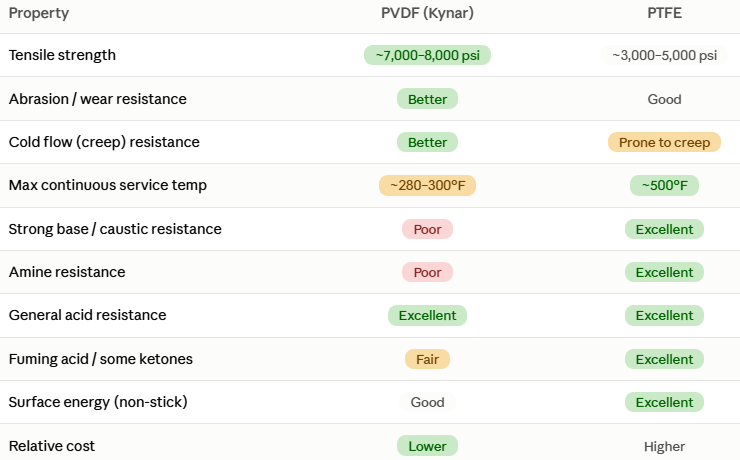
*Values are approximate; exact values are based on material grade and blend

* PVDF: Lower for high-volume molding; PTFE: Lower for machined stock

Decision framework

Here is a checklist for fluid handling engineers choosing between PVDF and PTFE:

  1. What’s touching the seal? Check for a strong base or problem solvent first; if it is present, PTFE wins outright
  2. Is there abrasive/particulate content or high dynamic wear? If so, lean toward PVDF if  the compatibility allows
  3. Is the seal under sustained compressive load where creep matters? If so, lean toward PVDF
  4. Static seal, clean chemistry, wide chemical exposure risk (multi-product lines, CIP/COP)? PTFE is the safer default.

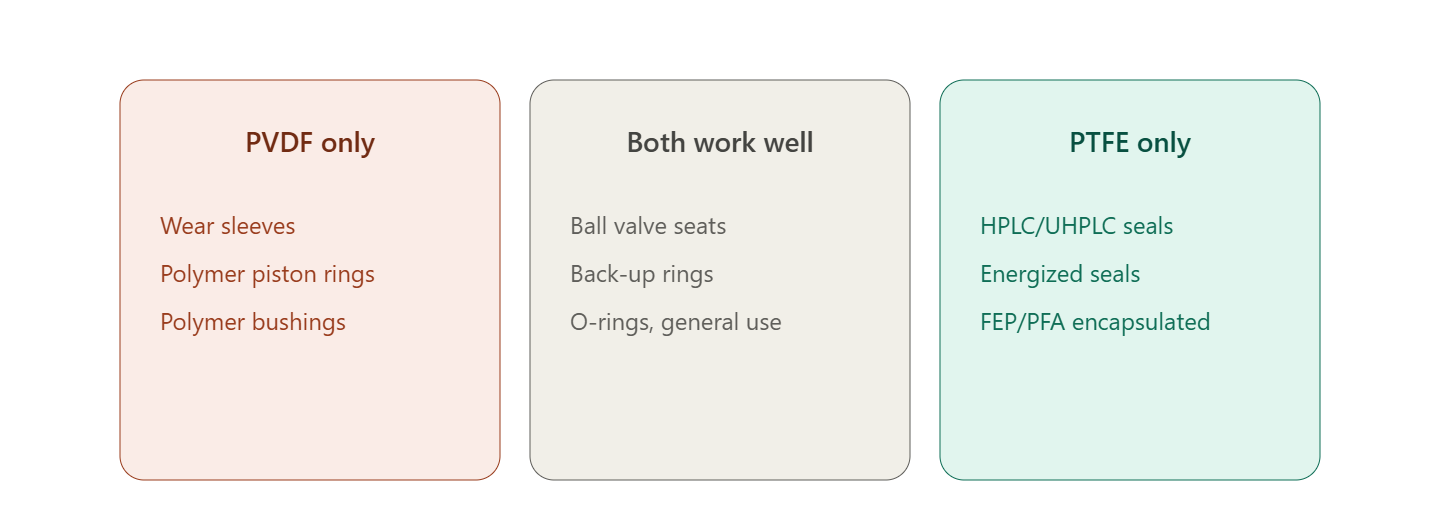
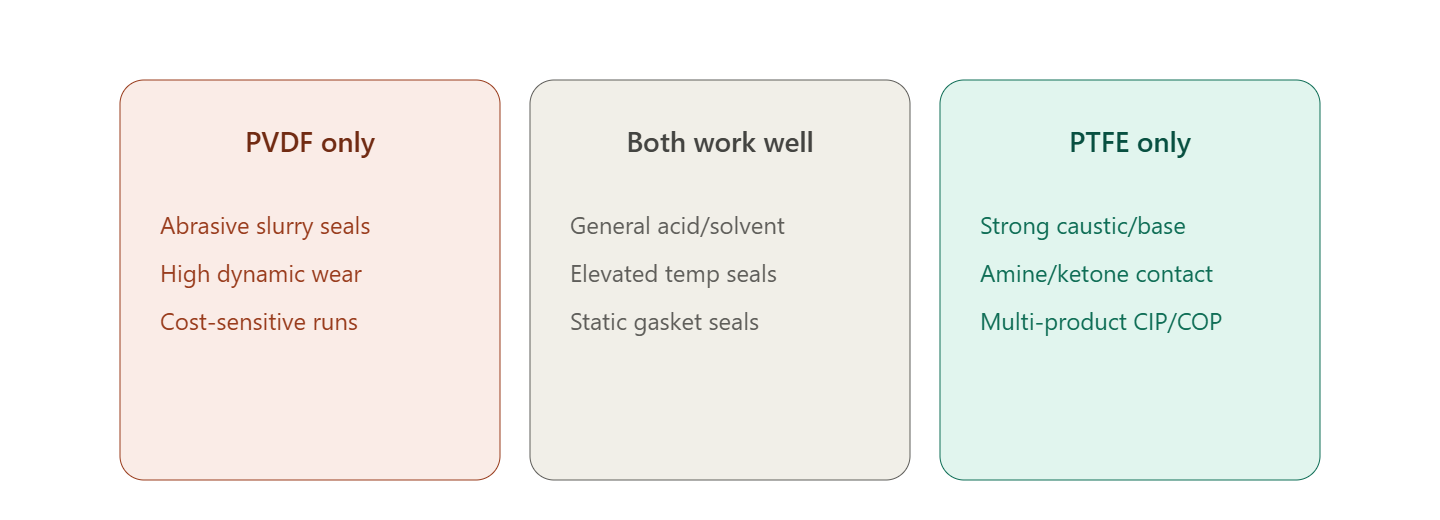
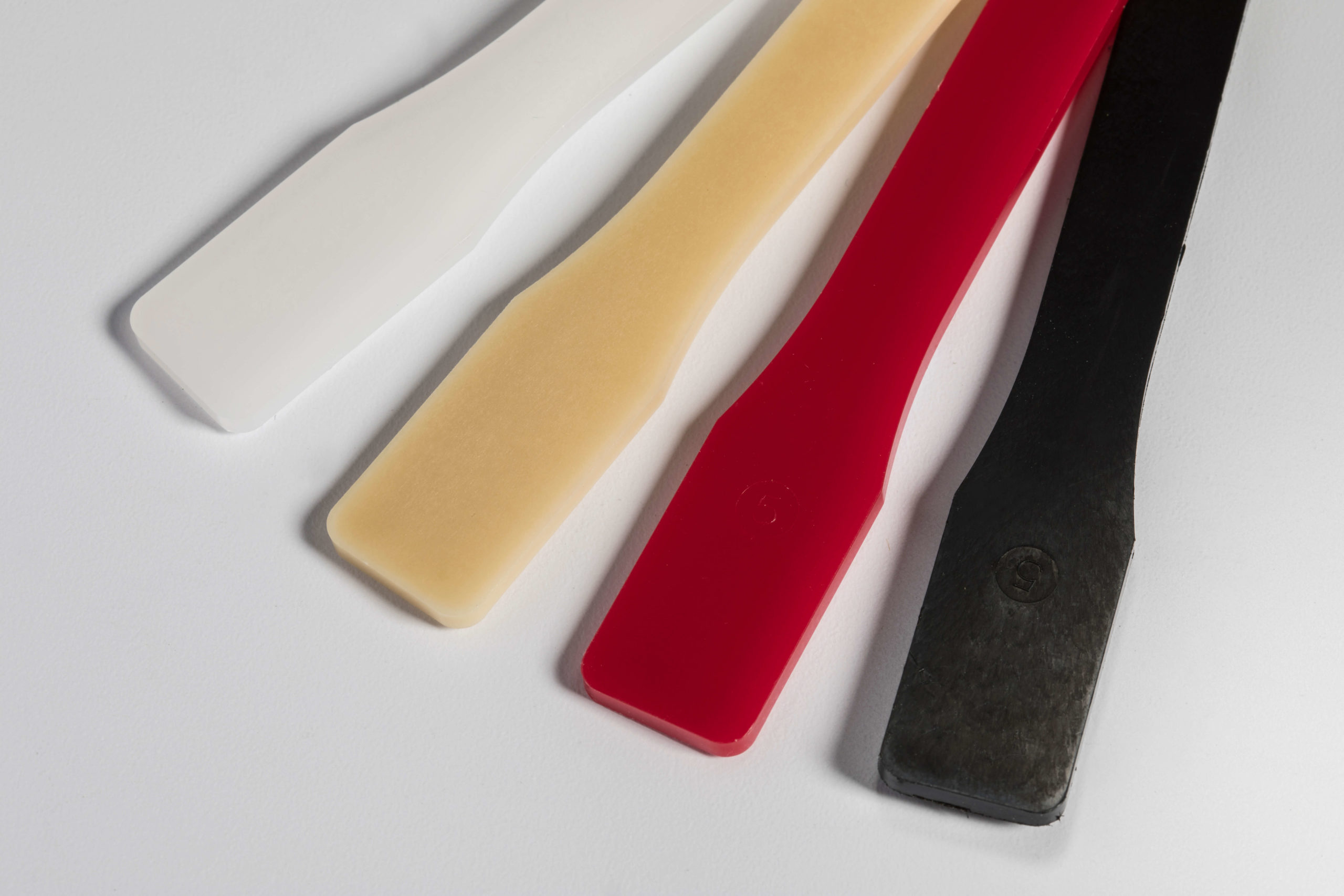
The figures below show examples of where each material performs best.
Conclusion

Borderline cases with mixed process streams, elevated-temperature caustics, or unusual solvent blends are exactly where a materials engineer should get involved before committing to tooling. It is always cheaper to change a decision on paper than after seals are cut. Advanced EMC is here to help you choose the right material and seal for your fluid-handling challenges. And keep in mind that Advanced EMC offers several material options if neither material is a fit.
by Daniel Mays Daniel Mays No Comments

Kynar: Its Properties and Uses

Kynar is a high-performance PVDF fluoropolymer known for its strength, chemical resistance, and excellent durability in harsh environments. Engineers rely on it for applications where purity, stability, and reliable long-term performance are essential. This blog post takes a close look at its unusual properties and various uses.

What Is Kynar (PVDF)?

Kynar (PVDF) is a semi-crystalline fluoropolymer that comprises repeating vinylidene fluoride units. It has very strong carbon–fluorine (C–F) bonds, making it among the strongest bonds in organic chemistry. These strong (C–F) bonds give it excellent resistance to both environmental degradation and chemical attack. It also exhibits 50–60% crystallinity, which is responsible for its high tensile strength, good fatigue resistance, and excellent barrier properties. It also offers a unique balance of dimensional stability, rigidity, and toughness due to its crystallinity. 

How PVDF Compares to Other Fluoropolymers 

The fluoropolymer PVDF belongs to the same chemical family as PTFE, FEP, and PFA, but it has properties that set it apart. 

For example, PTFE offers superior high-temperature performance and chemical resistance, but it cannot be melt-processed as easily. PVDF, on the other hand, is fully melt-processable, which allows manufacturers to use conventional extrusion, injection molding, blow molding, and rotational molding equipment. This significantly lowers fabrication cost and opens the door to more complex shapes, thin-wall components, and high-volume production runs than PTFE can support.

While FEP and PFA are melt-processable like PVDF, they are more flexible and have lower mechanical strength. One of PVDF’s most significant engineering advantages is its higher modulus and strength compared to PTFE, FEP, or PFA. This makes it suitable for structural components where other fluoropolymers might be too soft. PVDF also offers significantly higher mechanical strength, good rigidity, and superior abrasion resistance while sharing the chemical and corrosion resistance of the fluoropolymer family. 

Its primary drawback is its constrained temperature range. PVDF does possess a broad service temperature window, typically −40°C to ~150°C, depending on grade. While this is lower than PTFE’s upper limit (~260°C), PVDF still possesses excellent rigidity within its working range. This rigidity helps maintain dimensional stability in pressurized systems, rotating equipment, and components exposed to mechanical loads, where PTFE may creep or cold-flow.

Key Material Properties of Kynar

Kynar has several key material properties that make it ideal for use in seals, gaskets, and o-rings, as well as bearings, linings, barriers, cable jacketing, and more. 

Mechanical Properties

Among fluoropolymers, Kynar is known for its high tensile strength, toughness, and stiffness as well. It also has good resistance to wear and abrasion, as well as excellent fatigue performance and resistance to both flexural and tensile creep, contributing to its suitability to seal and bearing applications.

Thermal Properties

As mentioned earlier, the service temperature range of Kynar is −40°C to ~150°C, depending on the grade. It is also naturally flame-resistant, and a UL94 V-0 grade is available. Additionally, Kynar has low thermal conductivity, which is one reason it is often chosen for barrier or insulating applications. It also exhibits excellent thermal stability during temperature changes.

Chemical Resistance

Kynar exhibits outstanding resistance to acids, bases, halogens, and solvents (alcohols, ketones, and esters) as well as a number of hydrocarbons and fuels. In addition, possesses exceptional resistance to permeation, which can be a critical factor in chemical handling and semiconductor applications.

Electrical Properties

Kynar has a high dielectric strength and stable insulating performance across a wide range of frequencies, making it an ideal choice for electrical insulation and jacketing.

Nuclear Properties

Kynar is highly stable in radiation-rich environments, a feature that makes it particularly suitable for space and nuclear applications. In such applications, it is used for seal jacketing, sensor housings, and cooling water systems, among others.

UV and Weatherability

Kynar exhibits excellent outdoor performance because of its natural resistance to UV, ozone, and gamma radiation, as well as its environmental stability. In addition, it is resistant to the formation of fungus. Its long service life in such environments has made it a proven material for use in architectural cladding and wire insulation. 

Purity and Low Extractables

Naturally low levels of ionic contamination have long made Kynar an excellent choice for semiconductor wet-process systems and high-purity chemical handling. In addition, due to its low outgassing, Kynar exhibits minimal weight loss under high-vacuum conditions.

Processability Advantages

Kynar is exceptionally easy to process, with very little specialized equipment required, and applicable manufacturing methods include injection molding, extrusion, welding, compression molding, and rotational molding, making it far more processable than PTFE. This is due in part to Kynar’s wide processing window.

Conclusion

Kynar has is a trusted engineering polymer. It it delivers stable, long-lasting performance in demanding environments. It maintains dimensional stability under load, provides reliable sealing when used in PVDF-based components, and offers a rare combination of strength, chemical resistance, and ease of processing. With properties such as a wide operating temperature range, strong fatigue resistance, and naturally high purity, Kynar supports applications across chemical processing, semiconductors, aerospace, and energy. Its blend of durability, stability, and manufacturability makes it a reliable choice across industries.

Contact Advanced EMC for customized Kynar components, seals, and bearings, as well as general guidance on PVDF material selection.