by Sara McCaslin, PhD Sara McCaslin, PhD No Comments

Startup and Running Friction in Polymer Bearings

Startup and running friction can vary based on several different factors, and in this article we focus on what they are, why their values differ, and typical coefficients, as well as a detailed look at why these differences occur. It ends with a discussion of what impact startup and running friction have on bearing design.

Startup and Running Friction

Polymer bearings tend to exhibit higher breakaway (startup) friction than steady-state running friction due to factors such as static adhesion, microasperity interlocking, and transfer-film formation dynamics. 

The startup friction coefficient µₛ is measured at the onset of motion and represents static friction. The term “startup” does not refer solely to time zero, however. It represents the peak friction force or torque required to break the bearing free after a period of rest. Startup friction is actually the regime of dry contact when the polymer surface is still unconditioned. Unconditioned  means that the transfer film on the counterface is incomplete or patchy

The running friction coefficient µₖ represents a kinetic or dynamic measure of friction. It takes place when steady sliding motion is established and is represented by. Running friction relates to the frictional resistance that exists when two surfaces are in motion, steadily sliding against each other. 

Running friction applies after the initial breakaway event has occurred and the system has moved past issues such as static adhesion and micro-locking. As a result, the coefficient of running friction is typically lower and more stable than startup friction, especially for materials such as PTFE and UHMW-PE.

Why Startup and Running Friction Can Differ in a Polymer

There are some key factors that differentiate startup friction from running friction in polymers. For example, at rest, there is adhesion and junction growth. Polymer chains can increase the real contact load at under load rest (creep/relaxation), thereby increasing µₛ.In addition, at startup, there will be surface roughness and plowing. The roughness increases issues with mechanical interlocking and plowing. These two effects also raise the starting friction value.

In running friction conditions, materials like PTFE form a transfer film that reduces the effect of asperities and surface roughness, which reduces running friction. There is, however, a risk of stick-slip. This phenomenon is more likely to occur when the stiffness of the system is low, the speed is low, and the µₛ / µₖ ratio is high.

Typical Coefficients of Friction

The values below represent commonly used engineering polymers and are typical dry sliding vs steel values. These values can vary with pressure, speed, temperature, finish, fillers, and test method.

  • PTFE (virgin)
    • Startup friction (µₛ): ~0.05–0.10, often nearly identical to running friction
    • Running friction (µₖ): ~0.05–0.10
    • Minimal difference between startup and running friction
  • PEEK (unfilled)
    • Startup friction (µₛ): ~0.20
    • Running friction (µₖ): ~0.25
    • Exhibits a noticeable increase from startup to running friction
  • UHMW-PE
    • Startup friction (µₛ): ~0.15–0.20
    • Running friction (µₖ): ~0.10–0.20
    • Running friction can be equal to or lower than startup friction
  • Nylon 66 (PA66)
    • Startup friction (µₛ): ~0.20 (against steel)
    • Running friction (µₖ): ~0.15–0.25 (typical)
    • Moderate variability depending on surface finish and condition

What Is Behind the Difference Between Startup and Running Friction

Several factors account for the difference between startup and running friction. Pressure and dwell time, for example, mean that higher loads and long dwell times increase the real contact area and have the potential to raise µₛ. For speed, higher speeds can actually reduce friction after the polymer transfer film stabilizes, but can also raise heat generation. 

Temperatures are known to impact polymer modulus and creep, which can shift both µₛ and µₖ and alter the risk of stick-slip. In addition, the counterface material and hardness will affect the adhesion and transfer film, which is why it is important that the frictional coefficient used in design calculations represents the friction against the counterface material (e.g., PTFE vs steel, PEEK vs aluminum).

Note that PTFE-filled PEEK, MoS₂-filled nylon, and glass/bronze-filled PTFE shift friction and wear differently, often lowering friction but sometimes increasing counterface wear.

Surface finish also has a significant impact. If the surface finish is too rough, plowing will occur, increasing both friction and wear. On the other hand, if the surface finish is too smooth it can increase adhesion issues.

Impact on Bearing Design

Startup and running friction impact material selection, clearance, and surface finish in bearing design. Startup friction is dominated by static friction and adhesion at rest. This fact significantly impacts breakaway torque and can be a limiting factor in low-speed, intermittent, or precision motion systems. In such systems, stick-slip, noise, and control instability are unacceptable. 

Running friction, on the other hand, is governed by dynamic friction. Once motion is established, it controls steady-state heat generation, wear rate, and long-term dimensional stability. It directly influences PV limits and service life. 

Because many polymers exhibit higher startup friction than running friction, engineers need to balance low breakaway forces with acceptable operating temperatures and wear. This is usually accomplished through the use of self-lubricating materials, fillers, or surface texturing to manage both regimes. A successful polymer bearing design accounts for the full friction lifecycle, ensuring reliable motion at startup without sacrificing durability during continuous operation.

Conclusion

Startup and running friction have a significant impact on bearing design, as well as factors such as material fillers, pressure, temperature, and counterface material. If you are looking for a polymer bearing solution, contact the experts at Advanced EMC. Our team of bearing specialists can help you find the best bearing material for your design and can help you select the optimal material from our range of bearing-grade polymers.

by Sara McCaslin, PhD Sara McCaslin, PhD No Comments

Encapsulated O-Rings: Reliable Sealing for Aggressive Chemicals and Extreme Conditions

Encapsulated O-rings bridge the gap between chemical resistance and elastic sealing force. In this blog post, we discuss what an encapsulated O-ring is, why it is used, its design, and where it is used.

What are Encapsulated O-Rings?

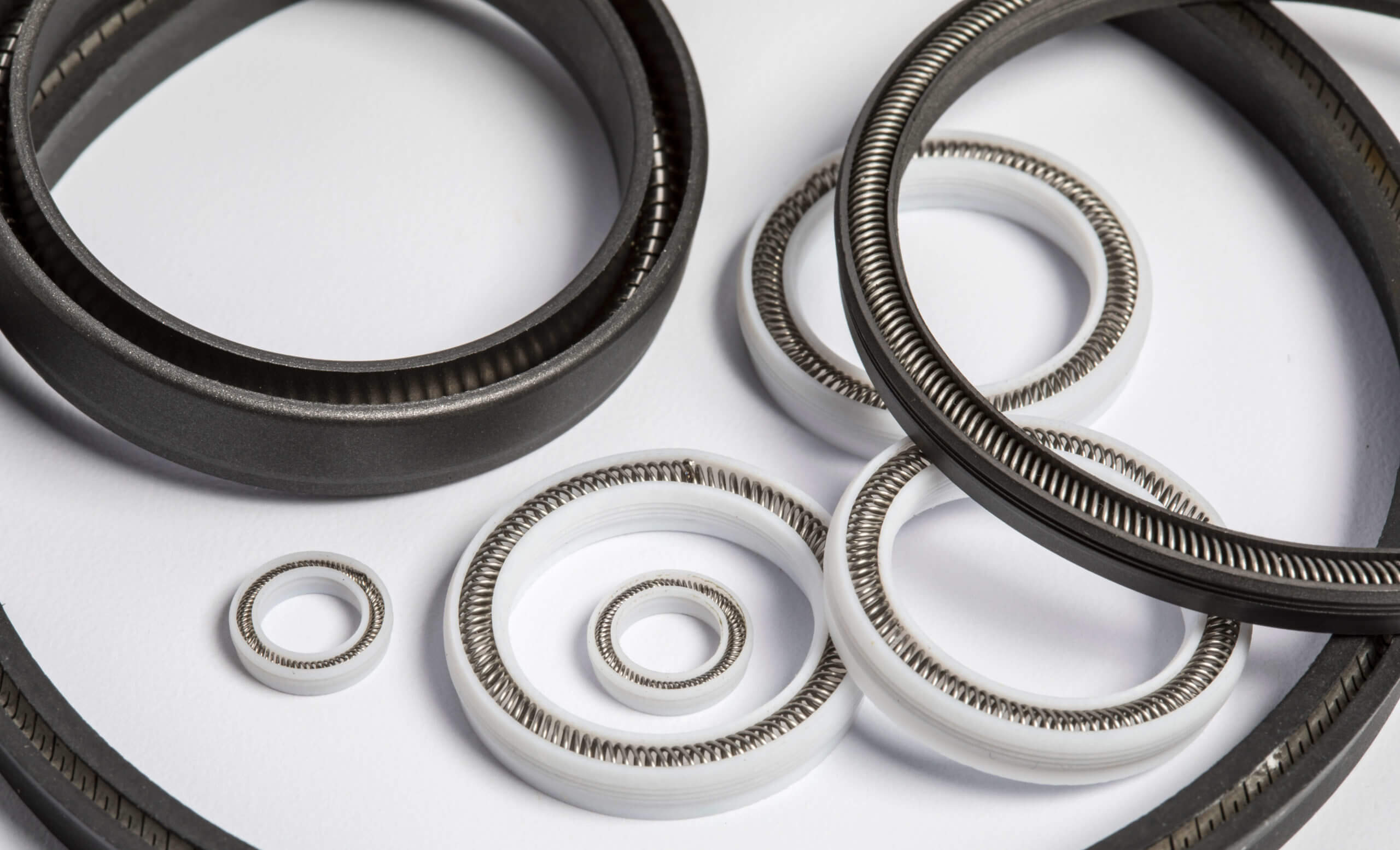
Encapsulated O-rings have a fluoropolymer jacket that protects an internal energizing element (usually an elastomer or a spring energizer). They successfully combine the chemical resistance and thermal performance of engineering fluoropolymers with the elastic recovery of an inner core, allowing them to serve as a successful sealing solution in operating environments that are too harsh for traditional elastomeric O-rings.

Why Use Encapsulated O-Rings

Encapsulated O-rings offer several key features, beginning with their excellent chemical compatibility with a very wide range of aggressive fluids and gases. They also provide excellent temperature capabilities that are well beyond those of conventional elastomers. The use of a fluoropolymer jacket also means that there will be less permeation, swelling, and degradation. Finally, encapsulated O-rings offer long-term sealing reliability in both static and low-speed dynamic applications. 

Encapsulation Approach

Encapsulating Material

The most common jacket materials used for encapsulation are FEP or PFA .

PropertyFEP (Fluorinated Ethylene Propylene)PFA (Perfluoroalkoxy)
Chemical ResistanceExcellent chemical resistance; suitable for most aggressive acids, bases, and solventsNear-universal chemical resistance, comparable to PTFE, including highly aggressive media
Temperature RangeTypically −200 °C to +205 °C (−328 °F to +400 °F)Typically −200 °C to +260 °C (−328 °F to +500 °F)
Elasticity / FlexibilityMore flexible than PTFE; performs well in thin-wall encapsulationsSlightly stiffer than FEP but more flexible than PTFE
Melt ProcessabilityFully melt-processable; easily extruded and encapsulatedFully melt-processable; allows precise, uniform encapsulation
Jacket ManufacturingWell suited for seamless encapsulation around elastomer or spring coresSuitable for seamless encapsulation, though processing is more demanding
Permeation ResistanceVery low permeabilityExtremely low permeability, lower than FEP
Surface FinishVery low coefficient of friction; smooth and consistentVery low coefficient of friction; excellent surface finish
Seal ConformabilityGood conformability due to jacket flexibilityModerate conformability; relies more on core energization than FEP
Typical Use in Encapsulated O-RingsMost common jacket material due to flexibility and ease of processingUsed for higher-temperature or more chemically aggressive applications
Cost ConsiderationsGenerally more cost-effectiveHigher material and processing costs than FEP

Encapsulation Thickness

The thickness of the jacket has a significant impact on the performance of the encapsulated O-ring. A thinner jacket means increased flexibility and conformability, as well as better sealing at low compression loads. A thicker jacket provides better chemical protection and resistance to permeation, but also means reduced flexibility and the need for a higher sealing force. 

It is important to balance the thickness with application requirements, including pressure, temperature, media aggressiveness, and gland design.

The jacket needs to be sufficiently thick to resist creep, deformation, and intrusion, as well as permeation and chemical resistance. In addition, the thickness must align with the tolerances, gland dimensions, and required compression. The jacket thickness must also account for thermal expansion over the operating temperature range. 

Seamless or Split Encapsulated O-rings

Another factor in the design of encapsulated O-rings is the manufacturing method used, either seamless or split encapsulation. The difference between the two directly affects sealing reliability. Seamless encapsulation forms a continuous jacket around the internal energizing core. This eliminates joints or weld lines that could become leak paths or chemical ingress points. 

Split encapsulation, on the other hand, uses a longitudinal seam that is closed after assembly. This makes installation easier but can introduce a potential weak spot under pressure, vacuum, or thermal cycling. For more demanding applications involving aggressive chemicals, vacuum service, or pressure fluctuations, the seamless encapsulation method is generally preferred because it provides more uniform sealing performance and improved long-term durability.

Internal Core

Elastomer cores are commonly used in encapsulated O-rings for applications operating within moderate temperature and pressure ranges. Silicone or fluorocarbon elastomers have excellent elasticity and good initial compression recovery. This allows the seal to conform to minor surface imperfections. While cost-effective and suitable for many static sealing applications, elastomer cores are more susceptible to compression set and loss of resilience at temperature extremes.

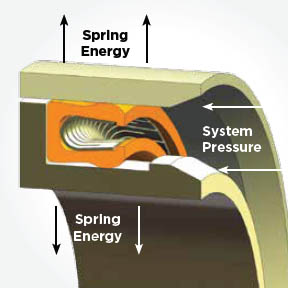
Materials such as 302 stainless steel, FKM, or EPDM spring-energized cores are used when elastomers cannot reliably perform. This usually occurs in operating conditions that include extreme temperatures, vacuum conditions, or long service life requirements. By replacing elastomers with metal springs, these designs deliver consistent sealing force across a wide temperature range and maintain contact pressure even in vacuum or low-pressure environments. This makes spring-energized encapsulated O-rings well suited for critical static sealing applications where long-term reliability is essential.

Where Encapsulated O-Rings are Used

Encapsulated O-rings are often used in chemical processing systems where aggressive acids, solvents, and corrosive fluids are present. The fluoropolymer jackets provide excellent chemical resistance, which makes them a reliable choice for harsh media handling and long service intervals. In pharmaceutical and sanitary systems, encapsulated designs are desirable when cleanability, low contamination risk, and consistent sealing performance are necessary.

In aerospace and vacuum applications, encapsulated O-rings are able to maintain sealing integrity across extreme temperatures and low-pressure conditions . In addition, they are  a critical sealing solution in semiconductor manufacturing and other high-purity processes, that require excellent performance with regard to  outgassing, extractables, and chemical compatibility.

These O-rings are used with valve stems, flanges, joints, swivels, pumps, turbo expanders, and waterless fracking.

Conclusion

Encapsulated O-rings are an excellent option for applications that involve aggressive chemicals, wide temperature ranges, or high-purity environments that cause conventional elastomers to swell, degrade, or contaminate the system. If you are in the market for encapsulated O-rings, contact Advanced EMC today. Our team of sealing specialists are happy to work with you in finding the right solutions for your design needs.