
by Sara McCaslin, PhD Sara McCaslin, PhD No Comments

Torlon Bearings: The Unsung Heroes of High-Load, High-Temperature Mechanisms

Torlon bearings handle extreme loads and high heat in applications where metals and other polymers simply cannot maintain their performance. Made from ultra-strong polyamide-imide (PAI), Torlon bearings can maintain dimensional stability and low friction even under extreme stressors. 

This blog post explores why Torlon bearings excel in such demanding environments, the grades they are available in, what sets them apart from other high-performance materials, and the manufacturing options available.

What Makes Torlon Different: A Polymer Built for Extremes

Torlon PAI (Polyamide-Imide) is a thermoset aromatic imide-amid polymer that was initially developed for its ultra-high molecular strength but also possesses excellent thermal performance and wear resistance. 

Torlon offers continuous service temperature of up to ~500°F (260°C) with minimal creep or softening, and remains stable even when exposed to fuels, lubricants, and most industrial fluids. Torlon has low friction and does an excellent job of resisting wear against both metal and polymer counterparts. These and other properties make Torlon an excellent choice for demanding bearing environments.

Bearing Design Challenges in High-Load, High-Temperature Mechanisms

Common challenges in these environments include high PV conditions, lubrication starvation, wide temperature swings, and thermal cycling issues. All of these issues are met head-on by Torlon bearings.

There are many harsh environments that require high-load, high-temperature bearings, such as jet engine accessory drives, gear pumps, and compressors. And Torlon excels in situations where metals are prone to seize or gall, and polymers may creep or deform. From industrial ovens to downhole drilling tools, electric motors to high-speed aerospace actuators, Torlon has proven itself to be an excellent bearing solution. 

Why Torlon Bearings Excel Under Pressure

Load Capacity and Strength

Torlon possesses a compressive strength that exceeds 35,000 ksi and is able to maintain stiffness even at elevated temperatures, both of which make it excellent for static and dynamic bearing loads. It is also able to retain its mechanical integrity at temperatures beyond 250°C, as well as resisting thermal fatigue and maintaining appropriate clearances in mixed-material assemblies. 

Torlon is naturally self-lubricating, and its coefficient of friction can be further enhanced through  internal fillers like graphite and/or PTFE. It also exhibits excellent wear rates even in dry or marginally lubricated conditions. Its low coefficient of thermal expansion improves alignment and minimizes vibration in high-speed systems. Its low coefficient of thermal expansion improves alignment and minimizes vibration in high-speed systems.

Finally, Torlon components can be injection molded, compression molded, and machined, with exceptional machinability for attaining extremely tight tolerances. 

Grades and Configurations for Torlon Bearings

There are several bearing grades of Torlon available, with various fillers that each enhance key properties. These are summarized in the table below.

GradeFiller TypeKey PropertiesTypical ApplicationsPerformance Notes
Torlon 4203UnfilledHighest purity and electrical properties; moderate wearElectrical connectors, insulatorsBaseline for comparison; not optimized for bearing use
Torlon 430112% Graphite, 3% PTFEExcellent wear resistance and low friction; maintains strength and dimensional stabilityBushings, thrust washers, compressor bearingsIndustry standard bearing grade; performs well under dry or marginally lubricated conditions
Torlon 4435Carbon Fiber + PTFESuperior load-bearing and wear performance; higher modulus and thermal conductivityHigh-load bearings, gears, seal ringsImproved heat dissipation and rigidity; reduced thermal expansion
Torlon 4645Carbon Fiber + Graphite + PTFEMaximum wear and load capacity; top-tier strength and PV limitAerospace bearings, downhole tools, turbocharger bushingsBest balance of strength, wear resistance, and temperature endurance among all grades


Comparing Torlon Bearings to Metal and Other Polymers

Compared to their metal counterparts, Tolon bearings are going to be lighter, corrosion-free, have no galling, lower noise, and reduced lubrication demand. And when compared to higher grades of PEEK and PPS, it retains stiffness and strength even at elevated temperatures and exhibits better dimensional control both under heat and load.

There are, however, tradeoffs. Torlon does cost more, and the molding process is going to be more complicated, but this can be justified because of its reliability and longer service life.

Manufacturing and Machining Considerations

Because Torlon has such a high glass transition temperature (≈280°C), it requires careful molding and post-curing. Compression molding can be used and works exceptionally well for large or thick cross-section bearings where uniform density is critical. Injection molding is another option, and it is ideal for high-volume, precision components with fine detail. While Torlon can be machined, it requires very sharp tooling and the use of coolant, all due to the hardness of the material. In addition, Torlon may require post-curing and stress relief.

The Hidden Value: Reliability and Lifecycle Cost

Including Torlon bearings in a design often means extending the MTBM (Mean Time Between Maintenance) due to reduced wear and a reduced risk of seizure. They also mean a lower cost of ownership compared to metal or standard polymer polymers that usually require much more frequent replacements. In addition, Torlon bearings are a lightweight, reduced-lubrication solution that enhances energy efficiency.

Conclusion

Torlon bearings are critical to high-performance machinery, delivering excellent reliability where strength, heat resistance, and dimensional stability are necessary. Capable of withstanding extreme loads and temperatures that would cause metals to seize and conventional polymers to deform, they provide unmatched durability in the most demanding environments. 

Advanced EMC engineers will help you design and manufacture precision Torlon bearing solutions for aerospace, industrial, and energy applications where reliability is not optional and loads are high. Contact our knowledgeable team to discuss your next high-performance bearing challenge.
by Sara McCaslin, PhD Sara McCaslin, PhD No Comments

Why Spring-Energized PTFE Seals Work in So Many Applications

Spring-energized PTFE seals work incredibly well. Engineers know that when designing equipment for truly hostile operational environments, whether facing cryogenic cold, aggressive media, or extreme pressure cycling, the reliability of the seal is absolutely critical. Traditional seals frequently fail under such harsh conditions, suffering from issues such as chemical attack, thermal degradation, or permanent deformation. The proven industrial solution for conquering these critical limitations lies in the PTFE spring-energized seal.

In this blog post, we discuss exactly why PTFE spring-energized seals work so well, including the use of PTFE and spring-energizers, along with a discussion of where these seals are used.

Where Spring-Energized Seals Conquer Extreme Conditions

Before discussing why these seals work so well, it would be wise to quickly review the many different industries and applications in which they have proven themselves. PTFE spring-energized seals have become indispensable across almost every challenging industrial sector because of their unique performance characteristics. Advanced EMC provides solutions for industries including Oil & Gas/Energy, Medical Devices, Aerospace & Defense, Automotive, and Food, Dairy, and Pharmaceutical.

In Oil & Gas and Energy, seals must handle extremely high pressures, sometimes up to 25 kpsi. They must also maintain integrity when exposed to chemically aggressive media such as sour gas and acid gases. In these applications, the PTFE jacket resists the chemicals while the energized springs help keep the seal in place.

For Aerospace & Defense, especially in cryogenic space applications, seals must survive conditions where temperatures drop below -250°C. Traditional elastomeric seals often shrink and lose sealing force at these cryogenic temperatures. PTFE spring-energized seals compensate for thermal contraction and are suitable for applications such as cryogenic fuel transfer and rocket engines. Virgin PTFE and high-purity filled PTFE variants also exhibit minimal outgassing, meeting NASA/ESA standards for use in a vacuum.

In the Medical Device and Pharmaceutical industries, reliability and purity are paramount. Virgin PTFE is both FDA- and USDA-approved. These seals are crucial in fluid management systems, surgical instruments, and diagnostic equipment. They withstand aggressive sterilization processes, including high-temperature Clean-In-Place (CIP) and Sanitize-In-Place (SIP) procedures, due to PTFE’s high thermal stability and chemical inertness. PTFE is also hydrophobic, repelling water and making it easier to clean complex geometries.

The Material Foundation: Why PTFE?

Polytetrafluoroethylene (PTFE), also know as Teflon®, is a synthetic fluoropolymer of tetrafluoroethylene. This material forms the resilient seal jacket, providing excellent chemical and thermal performance. Pure PTFE is almost completely chemically inert, meaning it resists attack from aggressive media such as acids, solvents, and reactive gases, minimizing the risk of degradation or swelling. It is also hydrophobic and non-wetting.

In addition, PTFE boasts an operating temperature range: it is thermally stable enough for continuous service up to 500°F, and certain specialized compounds can function reliably in cryogenic conditions as low as -450°F. PTFE also has the lowest coefficient of friction of any known solid and is naturally self-lubricating, which means it performs well in dry or non-lubricated applications. All of these are reasons to choose PTFE as the seal jacket in a spring-energized seal.

PTFE Spring-Energized Seals Work So Well

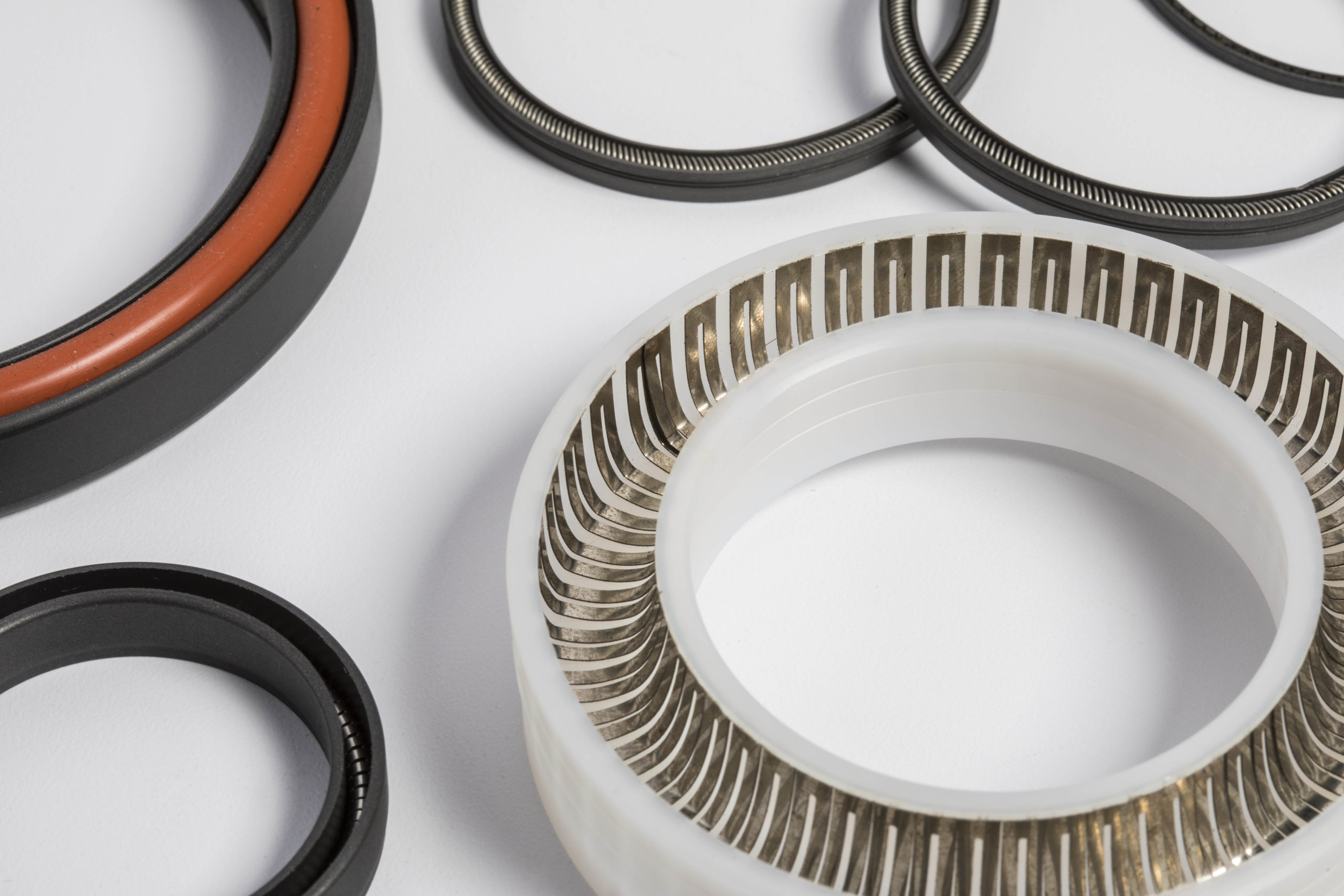
The core principle of a spring-energized seal lies in its architecture: a polymer seal jacket housing an internal metallic spring energizer. The spring’s primary job is to apply a continuous force against the sealing surface. This initial force ensures a consistent seal is maintained, especially at low system pressures.

The energizer’s constant force provides permanent resilience to the seal jacket, compensating for operational issues that would cause conventional seals to fail, including:

  • Jacket wear
  • Hardware misalignment and eccentricity
  • Dimensional changes due to thermal contraction or expansion
  • Misalignment

When system pressure increases, the pressure begins to supplement the spring force. This drives the seal lip against the mating surface, resulting in a tighter, highly efficient barrier. The spring design also ensures that the seal maintains force over time, eliminating the problem of permanent deformation or compression set seen in elastomers.

Engineers can select from various spring types to suit specific needs. The V spring (V ribbon spring energized seal) is an excellent candidate for cryogenic and vacuum applications, where coil springs (spiral pitch springs) work well, where low friction and high pressure are involved, typically in medium-speed applications. The helical flat spring is adapted to a wide range of pressures, from high pressure all the way down to vacuum conditions. An elastomeric O-ring energizer can be used when the use of metal must be avoided, and is adapted well to extreme pressures.

Conclusion

Robust, reliable sealing is absolutely necessary in mission-critical operations, regardless of the industry. Spring-energized PTFE seals provide a superior engineering solution. By combining the chemical inertness, wide temperature range, and low friction of PTFE with the persistent mechanical force of a metallic spring, these seals eliminate issues like compression set and loss of sealing force over time. They flex, adapt, and hold their seal integrity even when conditions shift fast.

For applications that demand unparalleled performance where failure is not an option, PTFE spring-energized seals work extremely well as they provide the durability, adaptability, and precision required. When specifying a PTFE spring-energized seal, never take for granted the finish of the mating surface. Advanced EMC Technologies offers expert polymer sealing solutions, leveraging more than 100 years of combined experience. Contact Advanced EMC today to learn how spring-energized seals can improve the reliability and lifespan of your system.