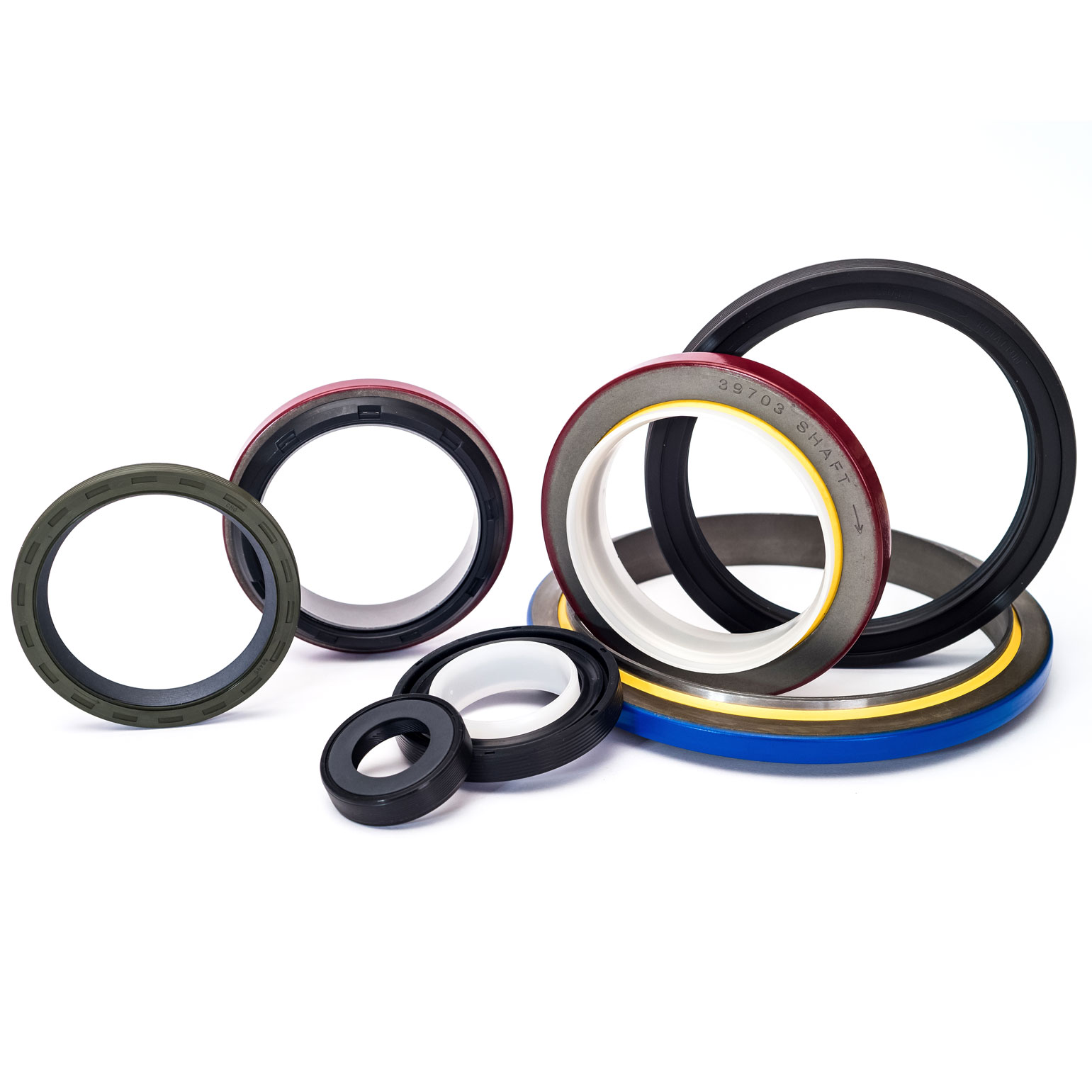
Creep and stress relaxation are types of time-dependent deformation that matter in sealing as too many engineers in the field typically see “assembled dry, passed leak test, then seeps later.” Sealing force is not a fixed number: it decays over time. And polymer seals can be affected by factors such as viscoelasticity, temperature sensitivity, and constraint effects.
This article explores core definitions and concepts related to creep and stress relaxation, then covers how different polymer sealing materials behave and tips for the design and installation of seals to minimize these issues.
Definitions and Concepts for Creep and Stress Relaxation
Creep is defined as the increase in strain under constant applied stress. The constant stress can be, for example, contact stress from interference, bolt load transferred through a gasket, or differential pressure loading. The results of creep are dimensional change, extrusion growth, reduced interference, and/or a contact pattern shift.
Cold flow refers to creep at moderate or ambient temperature and is controlled by a combination of stress and constraints. As a type of creep, cold flow is dominated by a combination of viscoelastic and viscoplastic deformation under a sustained compressive load.
Stress relaxation is decreasing stress under constant strain as the result of fixed gland volume, captured seal, or fixed squeeze. This can be a problem for static seals, where the gland maintains constant displacement, not constant stress. The results of stress relaxation include clamp-load loss, loss of sealing force, and an increased possibility of leakage.
Polymers can still look like they kept their shape, but they may not be pushing as hard against the metal anymore. In elastomers, “compression set” is mainly about the rubber not springing back. In polymers, the bigger issue is that the internal stress slowly bleeds off over time, so sealing force drops even if the part does not look significantly deformed.
When a polymer is compressed, part of the squeezed portion will spring back right away, but part of it returns slowly, and another part never returns because the material has permanently shifted shape. The longer a seal is under compression, the more the polymer begins to relax and flow, so even after the load is removed, it may not be able to rebound to restore the original sealing force.
And if you compress a polymer seal and then release it, the force on the way back will usually be lower than on the way in because some energy is lost inside the material. That’s why repeated squeeze-and-release cycles will not bring the seal back to the original force level.
Material Behavior in High-Performance Seal Polymers
PTFE (unfilled): PTFE has extremely low friction and is very chemically resistant, but it gives up the sealing load over time. Virgin PTFE tends to creep and relax under sustained compression, therefore requiring a strong gland support, tight extrusion-gap control, or spring energization.
PTFE (filled): Filled PTFE holds up better because fillers increase stiffness and reduce cold-flow behavior. Filled PTFE can usually retain its sealing force longer than virgin PTFE, but the filler used can also increase friction and may affect counterface wear.
PEEK: PEEK is typically chosen when long-term load retention matters greatly. PEEK’s higher stiffness means better resistance to creep and stress relaxation, though solid gland design and surface control still matter. PEEK is also available in filled variants that can impact its properties.
UHMW-PE: UHMW-PE is excellent for abrasion and low friction, but it can still relax under long compressive dwell, especially if stresses are high or support is limited. It performs best when the design itself minimizes sustained stress and prevents extrusion.
PAI (Torlon): PAI offers the strongest resistance to time-dependent deformation in this group. It retains shape and sealing load well, making it a strong fit for high loads and elevated temperatures where other polymers may drift.
| Material | Creep Resistance | Stress Relaxation Resistance | Rebound After Long Dwell | Extrusion Risk (if poorly supported) |
| PTFE (unfilled) | Low | Low | Low | High |
| PTFE (filled) | Moderate | Moderate | Low–Moderate | Moderate |
| PEEK | High | High | Moderate–High | Low–Moderate |
| UHMW-PE | Low–Moderate | Low–Moderate | Moderate | Moderate–High |
| PAI (Torlon) | Very High | High–Very High | High | Low |
Design Variables That Control Creep and Relaxation
Gland constraint is the first major factor. A fully confined gland gives the seal fewer places to move, which cuts down creep flow and helps prevent extrusion. If the gland is only partially confined, any clearance becomes an escape route for the seal, and support has to be both radial and axial. Radial support keeps the polymer from pushing into the extrusion gap under pressure. Axial support helps prevent shifting and uneven edge loading. The small geometry details count as well; add corner radii and lead-in chamfers, and avoid sharp edges that create stress concentrations. Also, remember tolerance stack-up: as the seal relaxes, the “effective” clearance and contact conditions can change even if the metal parts do not.
More squeeze is not going to automatically be safer. Higher initial stress can accelerate creep and stress relaxation, especially with heat. The goal is to start with enough contact stress to seal, then still have enough after the material settles. That means designing around the minimum required contact stress at end-of-life, not just at assembly.
Extrusion gap control is about finding where pressure can escape and blocking it. The gap changes with temperature, pressure-driven hardware deflection, and assembly variation. Backup rings help by mechanically closing off that path. Their details matter, though.
Surface finish can make or break long-term performance. Roughness peaks concentrate stress and encourage localized flow, and surface lay can create leak paths. With filled polymers, counterface hardness matters because wear risk can increase with the wrong pairing. Aim for a finish that reduces stress peaks without creating new friction or lubrication issues.
Hardware stiffness also impacts load retention. Flexible joints can magnify clamp-load loss as polymers relax, so stiffer flanges, spacers, and bolt patterns will significantly assist with stability. For demanding duty cycles, spring-energized seals are an excellent option as they add an additional force to compensate for potential issues, such as relaxation, wear, thermal cycling, and small misalignment.
Installation Tips for Mitigating Creep and Stress Relaxation
Many issues with creep start at installation, where a small nick, a cut, or a twisted seal can leak early, then get blamed on cold flow. Over-compressing the seal during assembly also makes it worse by driving high stress that speeds up relaxation and can leave permanent deformation. A simple fix is better handling and proper lubrication during installation to reduce the potential for surface damage and help the seal seat without problems due to uneven stress.
Load management matters just as much after assembly. Polymer gaskets and seats often benefit from controlled retorque protocols (when the application allows it) because the initial load can drop quickly during the first dwell. A common approach is initial torque, a short wait, then a retorque and verification check. Keep in mind that if over-torque pushes stress too high, it can accelerate creep and shorten the sealing life.
Finally, storage can quietly pre-load your failure. If a seal sits compressed on the shelf, it may relax before it sees service, starting life with serious issues related to sealing force. Temperature history matters as well, especially if parts are stored near heat sources or in hot warehouses. When possible, ship and store seals uncompressed, and for critical applications, controlled conditioning and careful packaging can protect long-term load retention.
Conclusion
Creep, cold flow, and stress relaxation are not mysterious defects, but rather predictable behaviors that appear whenever polymers sit under load for long periods. For this reason, treat them as design inputs and build a sealing system around them by choosing the right material, controlling deformation with proper gland constraint, relying on stiff hardware to maintain load, and validating the design with tests that match real pressure, temperature, and dwell-time conditions.
Advanced EMC is here to help with all your sealing needs, and our engineers are happy to help you navigate your way through potential creep and stress relaxation issues. Contact us today!