
by Sara McCaslin Sara McCaslin No Comments

Ball Valve Seats: How Seat Material Impacts Valve Life and Leak Rate

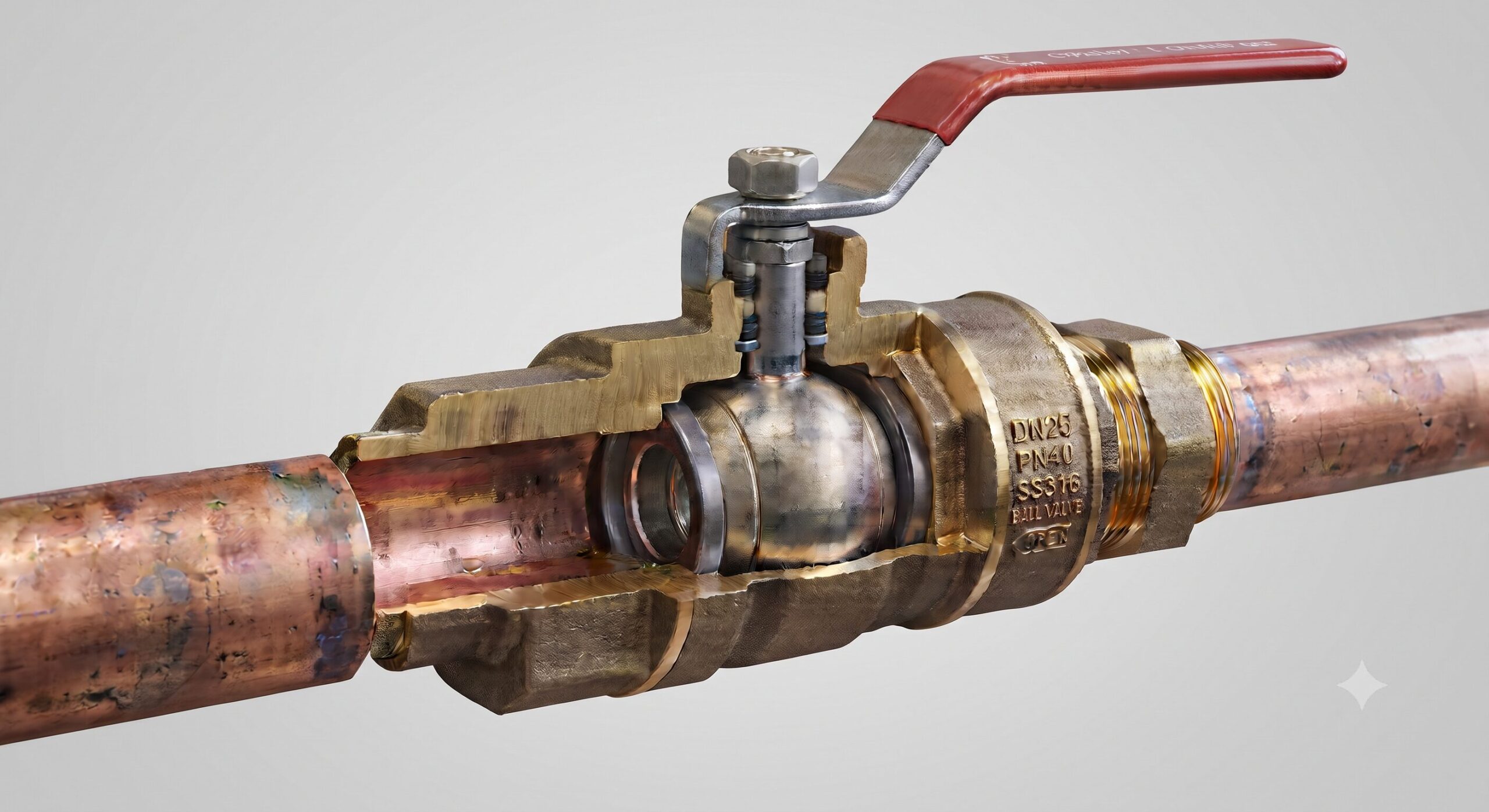
Ball valve seats are critical in industrial fluid control applications. While the valve body and ball are crucial to the design as well, the seat is responsible for sealing the fluid and achieving a uniformly distributed seating stress. That is why poorly specified valve seat materials can lead to leaks, pressure drops, and catastrophic failure. 

As an engineer, if you are looking for a reliable seal with a long service life, it is extremely important to match the chemical and mechanical properties of ball valve seats to the specific operating environment, including temperature, pressure, and media compatibility. The objective of this blog post is to review the materials, including their major properties, benefits, and drawbacks, and take a quick look at how to choose the right one. 

The Engineering Mechanics and Key Properties of Ball Valve Seats

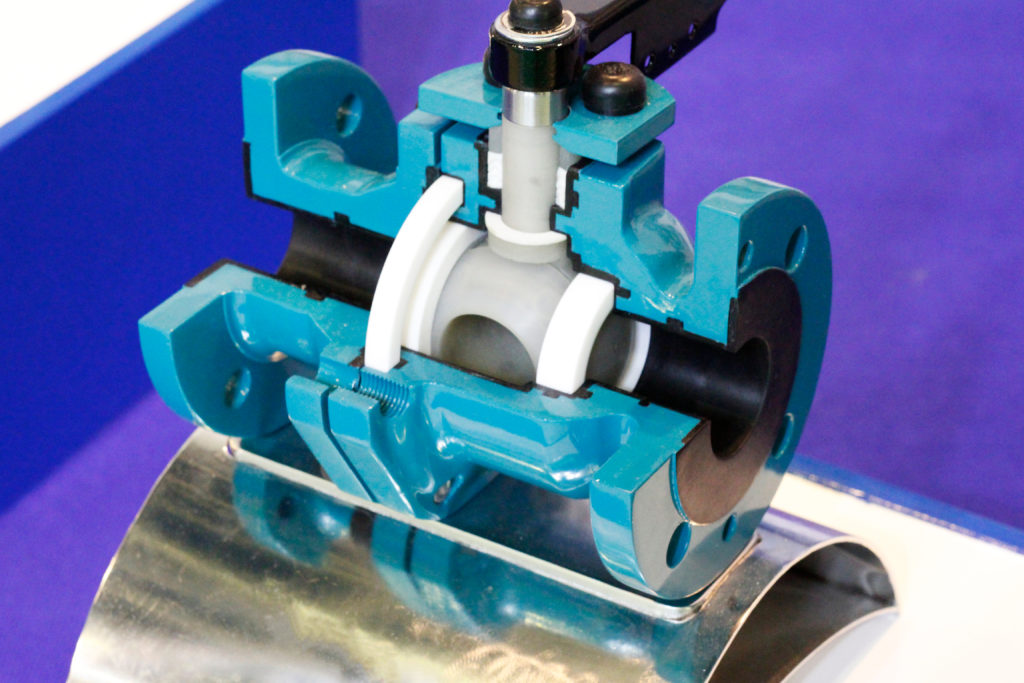
Soft-seated ball valves depend on the combined elasticity and ductility of polymers to conform to the shape of the ball, leading to a leak-proof seal. As a result, there are some essential material properties that engineers must take into account:

  • Low Coefficient of Friction: Low friction will minimize stem torque, which in turn prevents excessive wear and tear that leads to leaks and potentially catastrophic failure.
  • Dimensional Stability & Low Thermal Expansion: This combination ensures the seat retains its shape during temperature fluctuations, which is vital for preventing leaks.
  • Stress Recovery: Stress recovery is the material’s ability to bounce back (return to its original shape) after continuous cycling and compression.

Common Failure Modes Driving Leakage and Lifespan Reduction

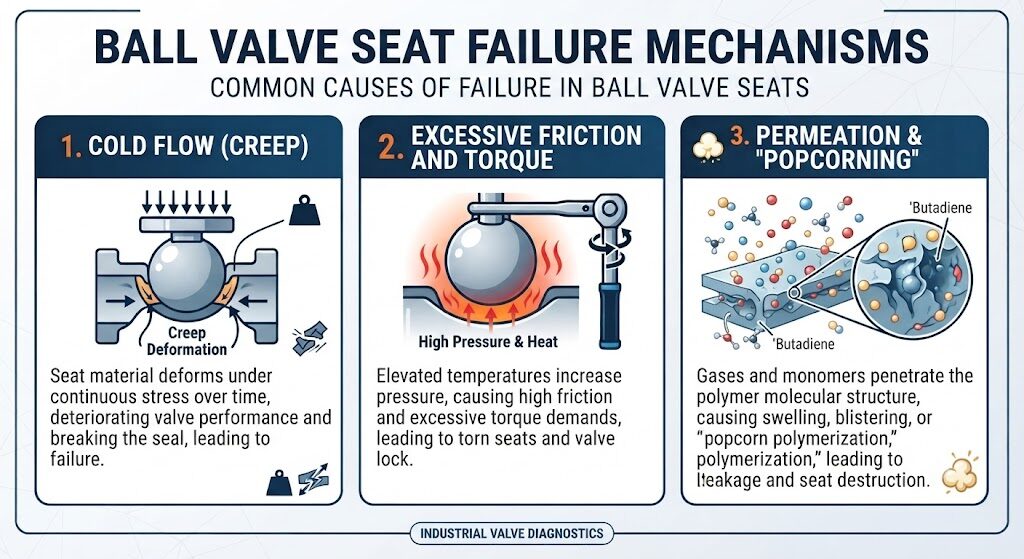
There are three common failure modes associated with ball valve seats. These modes drive leakage and lead to a reduced lifespan.

Cold Flow (Creep)

Solid materials slowly deform under continuous mechanical stress in a phenomenon called creep. Over time, this creeping action deteriorates valve performance and breaks the seal. The result is ball valve failure.

Excessive Friction and Torque

Elevated temperatures can increase pressure between the seat and the ball, leading to high friction. High friction leads to higher torque demands, which can ultimately tear the ball valve seats apart and lock the valve.

Permeation and “Popcorning”

Describe how gases and monomers (like butadiene) can penetrate the polymer at a molecular level. Explain how this causes the seat material to swell, blister, or undergo “popcorn polymerization,” leading to catastrophic leakage and seat destruction.
PTFE vs. PEEK for Ball Valve Seats

Two of the most common material choices for ball valve seats are PTFE and PEEK. 

Virgin and Filled PTFE (Polytetrafluoroethylene)

Virgin and filled PTFE offer unmatched chemical compatibility, along with the lowest coefficient of friction, self-lubrication, and dry running. They also perform very well in temperatures from cryogenic temperatures down to −330°F  up to 400°F–550°F. However, PTFE is highly susceptible to cold creep and radiation damage, so keep in mind that it is not a global solution. At the same time, adding glass or carbon graphite to PTFE not only reduces cold flow but also improves wear and extrusion resistance in high-pressure applications.

PEEK (Polyetheretherketone)

PEEK is another potential option. It has good chemical compatibility, low friction, and self-lubrication combined with excellent mechanical strength and good rigidity. PEEK works extremely well in high-pressure, high-temperature (480°F, continuous and up to 600°F) environments. It’s also unaffected by continuous steam/hot water exposure and is highly resistant to radiation. However, it becomes brittle at low temperatures (making it a poor choice for cryogenic temperatures) and is susceptible to concentrated sulfuric acid and certain highly oxidizing acids. It also requires a higher stem torque than PTFE solutions because its friction, although low, is still higher than PTFE.
PCTFE Ball Valve Seats for Low Permeation Applications

Advanced Material Solutions for Niche and Critical Applications

PCTFE (Polychlorotrifluoroethylene)

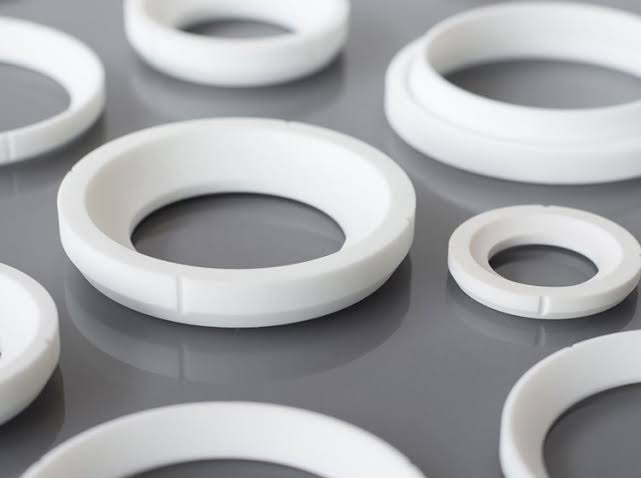
PCTFE is known for its performance in low-permeation applications. It has a highly dense molecular structure and low microporosity that make it virtually immune to issues with swelling and popcorning. PCTFE maintains mechanical properties down to −400°F, making it ideal for cryogenic applications, and it also works well in semiconductor applications requiring low outgassing. It also exhibits excellent radiation resistance.

TFM (Modified PTFE)

TFM is a second-generation PTFE that offers a much denser molecular structure, allowing it to deliver the chemical resistance of standard PTFE combined with significantly better stress recovery, reduced cold flow, and lower porosity.

Acetal (Delrin) and UHMW-PE

Acetal provides extreme rigidity, high abrasion resistance, and cold flow resistance at pressures up to 5,000 psi and performs quite well in radioactive environments (but should not be used with Oxygen flow). Its primary limitation is its temperature range: −70°F to 180°F. UHMW-PE has specialized low-level radiation resistance and works well with highly abrasive media.
valve seat failure

Choosing the Right Material for Ball Valve Seats

MaterialTemp RangeBest ForWatch Out For
PTFE (Virgin)Cryogenic to 400°FBroadest chemical compatibility, lowest frictionCold creep, radiation damage
PTFE (Filled)Cryogenic to 550°FHigh-pressure service, better wear/extrusion resistanceSlightly less inert than virgin PTFE
PEEKCryogenic-poor to 600°FHigh temp/pressure, steam service, radiation resistanceBrittle when cold, attacked by sulfuric acid
PCTFEDown to -400°FCryogenic, low-outgassing (semiconductor)Niche/higher cost
TFMSame as PTFEPTFE chemistry with less cold flow/porosityPremium cost
Acetal (Delrin)ModerateHigh-pressure (5,000 psi), abrasion resistanceNarrower chemical range
UHMW-PEGeneral serviceAbrasive media, low-level radiationNot a broad chemical solution

Conclusion

Moving away from default polymer choices for ball valve seats and moving toward more optimized material choices can result in extended valve life and zero-leakage systems. Remember to specify the polymer compounds used in your design carefully; whether upgrading from virgin PTFE to TFM for better stress recovery, or specifying PCTFE to combat permeation, it can help ensure safety and longevity even in aggressive environments. And if you’d like to talk to one of our sealing specialist engineers, contact Advanced EMC today.

by Daniel Mays Daniel Mays No Comments

The Advantages of PCTFE Material Exploring the Versatility of PCTFE Fluoropolymer

PCTFE, or Polychlorotrifluoroethylene, is a unique fluoropolymer material with exceptional performance characteristics. With its excellent chemical resistance, low permeability to gases and liquids, high tensile strength, and wide temperature range tolerance, PCTFE has become a popular choice in various industries. This article will explore the advantages of PCTFE material and its versatility in different applications.

PCTFE Fluoropolymer

What is PCTFE?

PCTFE is a thermoplastic fluoropolymer that belongs to the family of polymers known as chlorotrifluoroethylene (ECTFE). The polymerization of chlorotrifluoroethylene monomers produces it through a process called free radical polymerization. This unique material possesses a combination of properties that make it highly desirable for many industrial applications.

Chemical Resistance

One of the critical advantages of PCTFE material is its exceptional chemical resistance. It can withstand exposure to corrosive chemicals such as acids, bases, solvents, and aggressive media like chlorine gas. This makes it an ideal choice for applications requiring contact with harsh chemicals.

Low Permeability

Another notable characteristic of PCTFE material is its extremely low permeability to gases and liquids. It exhibits one of the lowest permeation rates among all known polymers and fluoropolymers. This property makes it suitable for applications where maintaining product integrity or preventing leakage is crucial.

Mechanical Strength

PCTFE possesses excellent mechanical strength due to its high tensile strength and impact resistance. It has a higher modulus than most other fluoropolymers like polytetrafluoroethylene (PTFE) or polyvinylidene fluoride (PVDF), which allows it to withstand higher loads and pressures. This makes PCTFE a reliable choice for structural integrity and durability applications.

Wide Temperature Range Tolerance

PCTFE material exhibits exceptional thermal stability over a wide temperature range. It can withstand temperatures as low as -200°C (-328°F) and as high as 150°C (302°F) without losing its mechanical or chemical properties. This wide temperature range tolerance suits it for extreme environments where other materials may fail.

Versatility of PCTFE Fluoropolymer Material

PCTFE’s unique combination of properties makes it an extremely versatile material with applications across various industries. Let’s explore some of the common areas where PCTFE finds extensive use:

Aerospace Industry

PCTFE is widely utilized in the aerospace industry due to its exceptional chemical resistance, low outgassing properties, and ability to withstand extreme temperatures. It is used in critical components such as seals, gaskets, O-rings, valves, and electrical connectors. The high performance and reliability of PCTFE make it an essential material for ensuring safety and longevity in aerospace applications.

Pharmaceutical Industry

The pharmaceutical industry requires materials that maintain product purity while withstanding exposure to aggressive chemicals during manufacturing processes. PCTFE’s excellent chemical resistance, low permeability, and biocompatibility make it an ideal choice for pharmaceutical equipment such as tubing systems, pumps, valves, and containers.

Oil & Gas Industry

In the oil and gas industry, where corrosive fluids are prevalent along with high-pressure environments, PCTFE has proven to be highly effective due to its superior chemical resistance properties. It is used in various applications, including seals for wellheads and valves, pipe lining systems, and handling corrosive fluids like acids or brines.

Electrical Industry

PCTFE’s excellent electrical insulation properties make it suitable for use in the electrical industry. It is commonly used in cable insulation coatings because it can withstand high voltages and maintain electrical integrity. Also, PCTFE is used in connectors, switches, and other electronic components where reliable electrical insulation is required.

Cryogenic Applications

With its ability to handle extremely low temperatures without losing its mechanical properties, PCTFE finds extensive use in cryogenic applications. It is used to construct cryogenic storage tanks, valves, seals, and gaskets for handling liquefied gases like nitrogen or oxygen. The low permeability of PCTFE ensures minimal gas loss during storage or transportation.

PCTFE material offers many advantages due to its exceptional chemical resistance, low permeability, mechanical strength, and wide temperature range tolerance. Its versatility makes it an excellent choice for various industries, including aerospace, pharmaceuticals, oil and gas, electrical engineering, and cryogenic applications. With its unique combination of properties and ability to withstand harsh environments while maintaining the integrity of products or systems it uses, PCTFE remains a preferred choice for critical applications where reliability is paramount.

Frequently Asked Questions (FAQs)

Q1: Is PCTFE similar to PTFE?

A1: While PCTFE and PTFE are fluoropolymers with excellent chemical resistance properties, they differ in mechanical strength and temperature range tolerance. Unlike PTFE, which has a lower modulus and limited temperature range (-200°C to +260°C), PCTFE possesses higher tensile strength and a more comprehensive temperature range (-200°C to +150°C).

Q2: Can I use PCTFE material for food-grade applications?

A2: Yes! Due to its excellent chemical resistance and low permeability properties, PCTFE is considered safe for food contact applications. It complies with various food regulatory standards, such as FDA regulations.

Q3: Are there any limitations or drawbacks of using PCTFE?

A3: While highly versatile, it’s important to note that the manufacturing process of specific complex shapes using pure solid-state techniques can be challenging due to the high melting point of the material. However, this limitation can be overcome by utilizing molding techniques.

Q4: How does the cost compare between fluoropolymers like PTFE and FEP?

A4: Due to its unique combination of performance characteristics, exceptional chemical resistance properties, and superior mechanical strength compared to other fluoropolymers, PCTFE tends to be more expensive than PTFE or FEP.

Q5: Can PCTFE withstand radiation exposure?

A5: Yes, PCTFE fluoropolymer material exhibits good resistance to radiation and can withstand exposure to ionizing radiation without significantly degrading its physical properties. This makes it suitable for applications in nuclear power plants or other radiation-prone environments.