by Daniel Mays Daniel Mays No Comments

Backup Rings in High-Pressure Sealing Systems: Preventing Seal Extrusion and Extending Service Life

Backup rings in high-pressure sealing systems address face extrusion failure in both dynamic and static seals found in high-pressure systems. Extrusion in sealing occurs when pressurized fluid forces the seal material into the clearance gap between mating surfaces, compromising seal performance. However, backup rings are a simple, low-cost (but critical) solution for extending the service life and maintaining the performance of extreme sealing conditions.

The Challenge of Seal Extrusion in High-Pressure Applications

Seal extrusion happens when pressurized fluid forces part of a sealing element into the clearance gap between mating hardware surfaces. Under high pressure, the soft material deforms plastically and begins to “flow” into this gap, where it can be pinched, torn, or permanently deformed. The result from seal extrusion is nibbling damage along the edges, rapid loss of sealing capability, and, in severe cases, catastrophic leakage.

Extrusion not only shortens seal life but also accelerates equipment wear, drives unplanned downtime, and raises operating costs in hydraulic, pneumatic, and process systems. The causes of seal extrusion are typically high pressure differentials ( > 1500 psi) and/or significant clearance gaps, exacerbated by the use of elastomers or polymers that deform plastically under a load. Seal extrusion can be difficult to avoid under certain circumstances, but that is where backup rings come in.

Backup Rings in High-Pressure Sealing Systems: Purpose and Function

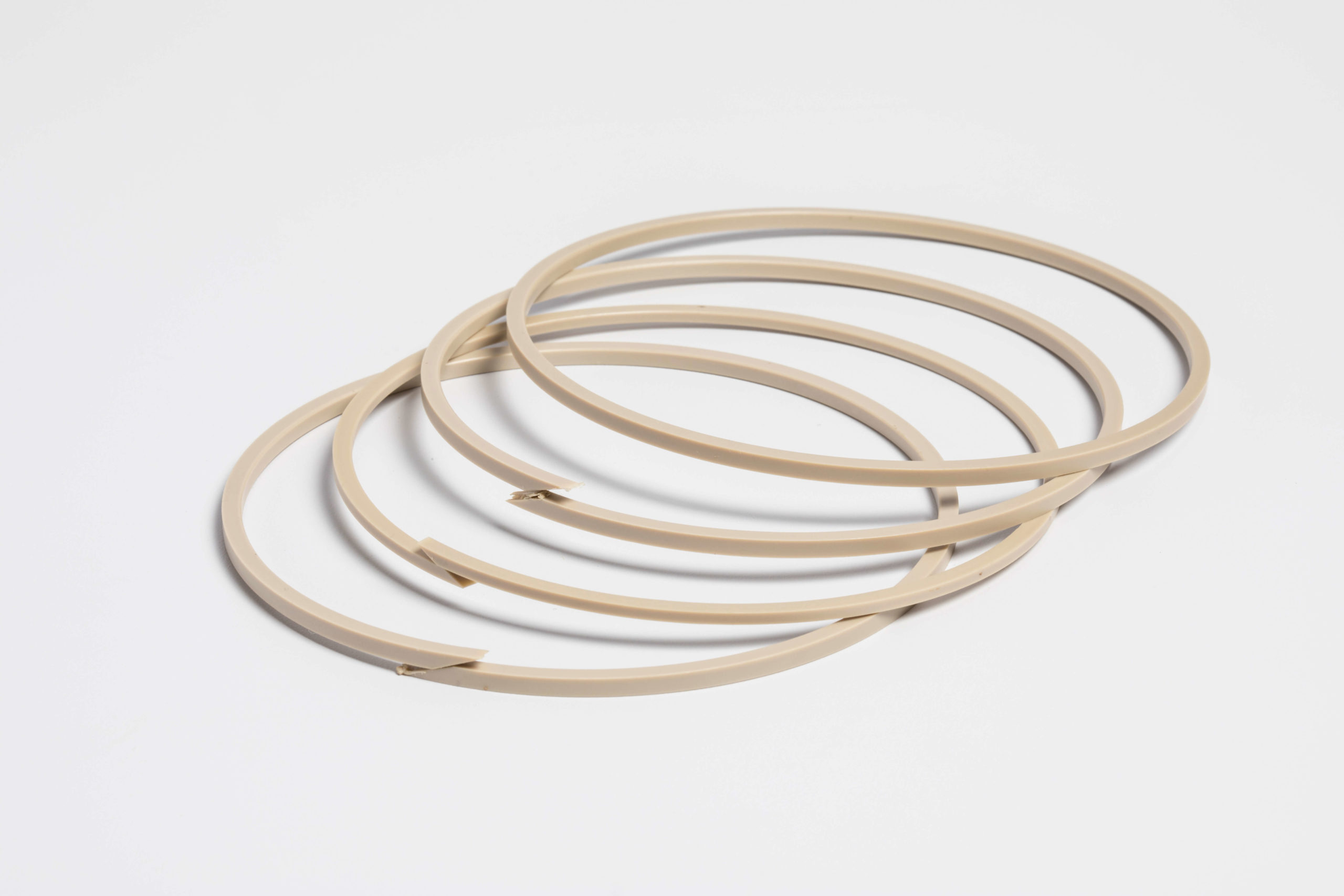
Backup rings in high-pressure sealing systems are annular support components that are installed next to a seal, such as an O-ring or a spring-energized seal. They act as an effective barrier to keep the seal from being forced into the clearance gap.

Backup rings come in different configurations, including single-ring, double-ring (for applications with bi-directional pressure), as well as split vs solid rings. Regardless of the configuration chosen, it is critical to achieve a precise fit because too loose undermines support, while too tight causes problems with assembly.

Material Considerations for Backup Rings in High-Pressure Sealing Systems

The three most commonly used materials for backup rings are PTFE, PEEK, and Nylon. However, other materials such as  UHMW-PE, filled PTFE blends for wear resistance, reinforced polymers for high PV limits, may be used.

PTFE

PTFE is an excellent option for backup rings with its extremely low coefficient of friction and extensive chemical compatibility. It works exceptionally well for applications requiring dynamic sealing or very low temperatures. Its primary limitations are the possibility of cold flow under sustained loads, so it might not always be suitable for extreme pressure conditions.

PEEK

PEEK is another good option for use as a backup ring with its high mechanical strength and excellent resistance to extrusion, as well as its thermal stability up to ~250°C. It also possesses exceptional resistance to extrusion. While it may be a more costly option compared to other polymers, it has found widespread application in industries such as aerospace, oil and gas, and high-performance hydraulics.

Nylon (PA)

Nylon works extremely well in moderate conditions with its strength, and it has a more economical price compared to PEEK and PTFE. However, it does have some critical limitations that including swelling and water absorption, both of which can heavily impact tolerances.

Design and Geometry Options

Solid backup rings provide the best extrusion resistance but can be challenging to install. Split rings can simplify the assembly process, but may allowed extrusion under extremely high loads, which essential defeats the purpose of having a backup ring. Another alternative is the use of spiral cut designs, which balance easier installation (without requiring excessive stretching) with maintaining good support for the seal. Contoured cuts such as scarf of step joints further reduce weak points found at splits.

For pressure direction, a single ring works when the load comes from one side, while double rings are necessary for bidirectional pressure. In every case, the trade-off is clear: easier installation often means slightly higher extrusion risk at the joint.

Engineering Considerations for Integration

Housing tolerances are critical for backup rings. Excessive clearance gaps increase the risk of extrusion, while precise fits provide reliable support. Single rings work well when pressure comes from one direction. However, double rings are required when it fluctuates or is bidirectional. Temperature adds another layer of complexity. Heat accelerates creep and changes dimensions through thermal expansion, which weakens long-term performance. Material compatibility is also important. Chemicals, lubricants, or swelling agents can reduce hardness and shorten service life. In failure analysis, extrusion often appears as edge nibbling or shearing. Compression set, on the other hand, leaves the ring permanently deformed. Recognizing the difference is key to preventing repeat issues.

Conclusion

Backup rings extend seal service life by preventing premature failure and protecting against extrusion. They reduce downtime and maintenance costs, which is especially valuable in high-value systems. Reliability and safety improve in critical applications where failures aren’t an option. They also make it possible to use softer elastomers for better sealing performance without increasing the risk of extrusion.

Investing in the right backup ring extends seal life, reduces failures, and ultimately saves money and downtime. Contact us at Advanced EMC to learn more about backup ring solutions.

by Daniel Mays Daniel Mays No Comments

Advanced EMC Technologies: Revolutionizing Sealing Solutions Across Industries

Advanced EMC Technologies is synonymous with innovation and excellence in PTFE sealing solutions. Our products are designed to meet the most demanding requirements across various industries. In this blog, we delve into real-world application examples to showcase the exceptional capabilities of our PTFE rotary shaft seals in diverse fields such as oil and gas, renewable energy, aerospace, and space exploration.

Real-World Application: PTFE Rotary Shaft Seals in Oil and Gas Drilling

Challenge: In the oil and gas industry, drilling operations face extreme conditions, including high pressures, temperatures, and exposure to harsh chemicals and abrasive materials. Traditional seals often fail under these conditions, leading to costly downtime and repairs.

Solution: Advanced EMC Technologies’ PTFE rotary shaft seals provide a reliable solution for these challenging environments. Let’s explore how our seals excel in this application:

High-Pressure Resistance: During drilling operations, equipment such as mud pumps and rotary steerable systems experience high pressures. Our PTFE seals can withstand pressures up to 15 bar, ensuring continuous operation without seal failure.

TYPES OF SEALS FOR OIL AND GAS INDUSTRY

Broad Temperature Range: The temperature range in drilling operations can vary significantly, from sub-zero temperatures in deep-sea environments to high temperatures encountered during drilling. Our seals operate efficiently from -40 to +220°C, providing unmatched reliability.

THE BENEFITS OF PTFE SPRING ENERGIZED SEALS FOR OIL AND GAS

Chemical Resistance: Drilling fluids and chemicals used in oil and gas operations can be highly corrosive. Our PTFE seals offer exceptional resistance to a wide range of chemicals, preventing degradation and ensuring long-lasting performance.

HOW TO DESIGN AND SELECT SEALS FOR OIL AND GAS

Minimal Friction and Wear: Equipment downtime due to seal failure can be costly. Our PTFE rotary shaft seals are designed with a durable sealing lip that exhibits minimal friction and wear, reducing maintenance frequency and extending the life of the equipment.

THE OIL AND GAS INDUSTRY DURING COVID-19

Impact: By using our PTFE rotary shaft seals, oil and gas companies can achieve higher operational efficiency. The seals’ ability to withstand extreme conditions reduces the risk of equipment failure, ensuring continuous drilling operations and translating into significant cost savings.


Enhancing Energy Efficiency: PTFE Seals in Renewable Energy

Challenge: The renewable energy sector, including wind and solar power, demands reliable sealing solutions that can withstand environmental extremes and ensure efficient operation. Components must handle wide temperature ranges, exposure to elements, and continuous motion.

Solution: Advanced EMC Technologies’ PTFE seals are ideal for renewable energy applications. Here’s how:

Weather Resistance: Our seals provide excellent resistance to UV exposure, moisture, and extreme temperatures, making them perfect for outdoor applications such as wind turbine blades and solar panel mounts.

BENEFITS OF SPRING-ENERGIZED SEALS FOR WIND TURBINES

Durability: The high wear resistance of our PTFE seals ensures longevity, reducing the need for frequent maintenance and replacements in renewable energy installations.

WHEN TO USE A PTFE ROTARY SHAFT SEAL

Efficiency: By minimizing friction and wear, our seals contribute to the overall efficiency of energy generation systems, ensuring optimal performance and reduced energy loss.

SPRING-ENERGIZED SEALS FOR THE WIND INDUSTRY

Impact: Wind turbines and solar panels equipped with our PTFE seals perform more efficiently and require less maintenance, leading to lower operational costs and more sustainable energy production.


Taking Flight: PTFE Seals in Aerospace

Challenge: Aerospace applications demand sealing solutions that can endure high altitudes, temperature fluctuations, and extreme pressure conditions. Aircraft components require seals that guarantee safety and reliability.

Solution: Advanced EMC Technologies’ PTFE seals are designed to meet these stringent requirements. Here’s why our seals are a top choice for aerospace:

Temperature Tolerance: Our seals perform effectively across a broad temperature range, from the cold of high altitudes to the heat generated by aircraft engines.

A COMPREHENSIVE GUIDE TO AEROSPACE SEALS

Pressure Resistance: The high-pressure resistance of our PTFE seals ensures reliability in hydraulic systems, fuel systems, and other critical components.

SPRING-ENERGIZED SEALS FOR SPACEFLIGHT

Lightweight: Weight is a critical factor in aerospace applications. Our PTFE seals are lightweight yet robust, contributing to overall aircraft efficiency without compromising on performance.

PTFE AEROSPACE SEALS

Impact: Our seals ensure that aircraft components operate smoothly and safely, reducing the risk of mechanical failures and enhancing the overall reliability and efficiency of aerospace systems.


Reaching for the Stars: PTFE Seals in Space Exploration

Challenge: Space missions involve extreme conditions, including vacuum, radiation, and cryogenic temperatures. Seals used in rockets and spacecraft must offer exceptional reliability and durability to ensure mission success.

Solution: Advanced EMC Technologies’ PTFE seals are perfect for space applications. Here’s how they make a difference:

Cryogenic Performance: Our seals maintain integrity at cryogenic temperatures, crucial for handling rocket fuels like liquid oxygen (LOX) and liquid hydrogen.

SEALS IN SPACE: THE UNSUNG HEROES OF ROCKETRY

Vacuum Compatibility: PTFE’s properties make our seals ideal for use in the vacuum of space, where traditional materials might fail.

A COMPREHENSIVE GUIDE TO AEROSPACE SEALS

Chemical Inertness: The chemical resistance of our PTFE seals ensures they can withstand exposure to various rocket propellants and other harsh substances used in space missions.

ADVANCEMENTS IN AEROSPACE DYNAMIC SEALS: ENHANCING HIGH-TEMPERATURE CAPABILITIES FOR AEROSPACE APPLICATIONS

Impact: Our seals play a vital role in the success of space missions by ensuring the reliability and safety of critical components, from rocket engines to spacecraft systems.


Why Choose Advanced EMC Technologies?

  1. Customization: We understand that each application has unique requirements. Our team works closely with clients to design and manufacture customized PTFE seals that meet specific operational needs.
  2. Quality Assurance: Our seals are manufactured to the highest standards, ensuring consistent quality and performance. We utilize advanced materials and manufacturing processes to deliver superior products.
  3. Expert Support: From initial consultation to after-sales support, our team of experts is dedicated to providing exceptional service. We assist clients in selecting the right seals and offer ongoing support to ensure optimal performance.

Advanced EMC Technologies‘ PTFE rotary shaft seals are transforming industries by providing reliable, high-performance sealing solutions. Our seals are engineered to excel in the most challenging environments, ensuring operational efficiency, cost savings, and environmental safety.

Whether it’s drilling deep in the earth, harnessing the power of the wind and sun, soaring through the skies, or exploring the final frontier, Advanced EMC Technologies has the sealing solutions to keep your operations running smoothly.

For more information about our products and services, visit our website or contact our sales team at Sales@advanced-emc.com. Let Advanced EMC Technologies be your trusted partner in sealing solutions for all your industrial needs.